

From Battle to Balance: Fletching, Meaning-making and Veteran Recovery
Abstract This commentary reflects on the ancient craft of fletching as a personally meaningful practice that supports recovery and reintegration following military service. Drawing on lived experience, the essay situates fletching within broader conversations in veteran studies concerning identity loss, moral injury and the limits of exclusively verbal or clinical approaches to healing. Rather than… Read more »
Recent US Veteran Cohorts Develop Chronic Health Conditions at Earlier Ages: Evidence from the Health and Retirement Study
Introduction The US veteran population is shrinking in size while its age composition is also changing1,2 As earlier generations pass away, more recent cohorts account for a growing share of veterans entering older adulthood, when chronic disease and functional limitations become more common. Whether these cohorts are reaching older ages in better or worse health… Read more »
Combat Tourniquets and the Prevention of Iatrogenic Limb Ischaemia in Modern Warfare
Abstract Health support for anticipated Australian Defence Force (ADF) operations necessitates the capability to deliver prolonged austere field care in response to the constraints of contested mobility, extended evacuation distances, resource limitations and tactical requirements. Combat tourniquet application in the context of Prolonged Casualty Care (PCC) represents an emerging challenge at all levels of healthcare… Read more »
Treating and Managing SW & I
Abstract This paper proposes a SW&I Spiritual Health Protocol–Provisional (SW&ISH–P) that will expand on the spiritual aspects of the treatment and management of Spiritual Wounds and Injuries (SW&I) previously discussed in this journal.1 It is set against the fundamental principle that the SW&I is likely to occur within a broader injury context and, as such,… Read more »
Artificial Intelligence in Outpatient Diagnostic Workflow: A Systematic Review with Implications for Military Health Systems
Introduction Outpatient services frequently suffer from prolonged in-clinic waiting times, inefficient workflows and delays in obtaining diagnostic results before specialist consultations.1 These inefficiencies negatively affect patient satisfaction, strain hospital resources, and, in military healthcare, may contribute to delays in evaluation and treatment pathways relevant to operational readiness.2 Factors contributing to prolonged waiting times include structural… Read more »
Residential and Inpatient Interventions for Military Veterans within Forensic and Secure Mental Health Services: A Scoping Review
Introduction Armed Forces veterans are at increased risk of developing mental health difficulties, particularly post-traumatic stress disorder (PTSD), depression, and substance use disorders (SUDs).1 This heightened vulnerability is closely linked to exposure to combat-related trauma as well as the complex psychological, social and occupational challenges associated with transitioning back into civilian life.2,3 Suicide rates among… Read more »
Evaluation of Self-Perceptions of Physical Demand and Physical Fitness of Volunteers during the Adaptation Internship of Reserve Officers of the 2nd Class of the Brazilian Air Force
Abstract The recruitment and mobilisation of higher education professionals for temporary military service occurs annually in the Brazilian Air Force occur annually. After the selection process, volunteers complete a Technical Adaptation Internship to prepare future junior officers for the specific conditions of military service. These courses generally last approximately two months and have high physical,… Read more »
Editorial – JMVH
Thirty-four years ago, the initial issue of the Journal of Military and Veterans’ Health (JMVH) (then Australian Military Medicine (AMM)) was published in February 1992. SQNLDR James Ross was the inaugural President and the first article published, fittingly on “Should Defence Force Personnel receive Influenza Vaccine?”, also came from James Ross. By 1993, CMDR Russ… Read more »
The Gender Debate: Effects of 10-weeks Strength Training on Operational Readiness for Females in the Military
ABSTRACT Introduction: Military service is a physically demanding occupation, and fewer women than men meet the military fitness standards, especially in manual handling and load carriage. Therefore, integrating women into physically demanding military roles requires effective physical conditioning programs to ensure operational readiness. Methods: Twenty-eight female soldiers were randomly assigned to either a 10-week gender-specific… Read more »
Medical Corps Disease Mortality during the First World War: Australia vs. Turkey
Medical corps officers were often the ‘canary in the coal mine’ for infectious disease mortality in armies during the pre-antibiotic era. This means that medical officers could be among the first indicators of a serious medical problem (See https://wordhistories.net/2018/03/31/canary-coal-mine). Deployed forces, however, could experience exotic threats, such as malaria and cholera, that could kill both… Read more »
United States Service Members’ Resilience, Wellbeing and Social Support Resources Post-deployment
Abstract Introduction: Military service members encounter numerous stressors post-deployment. Unit cohesion, community, social connections and leadership can serve as resilience support systems and may help improve service members’ wellbeing. This research examines the perceived value of these support systems for service members post-deployment. Methods: A cross-sectional convenience sample of 78 United States military officers (n=54)… Read more »
Burnout, Life Satisfaction, and Social Exclusion Levels of Retired Non-Commissioned Officers and the Relationships Between These Phenomena: The Case of Türkiye
Abstract Background: Research on the social and psychological conditions of retired non-commissioned officers (NCOs) remains limited. Therefore, examining burnout, life satisfaction and social exclusion among retired NCOs is critical. Objective: This study aimed to measure levels of burnout, life satisfaction and social exclusion among retired NCOs in Türkiye and to examine the relationships among these… Read more »
Prevalence of Long-Term Health Conditions in Current-serving, Previous-Serving and Never-Serving Australians: An Age-Adjusted Comparative Analysis using 2021 Census Data
ABSTRACT Background Long-term health conditions (LTHC) are major contributors to morbidity and mortality in Australia and may be more prevalent in Australian Defence Force (ADF) veterans. Previous analyses are limited because they do not control for age and sex confounding or disaggregate by ADF service status. Purpose We aimed to estimate and compare the age-standardised… Read more »
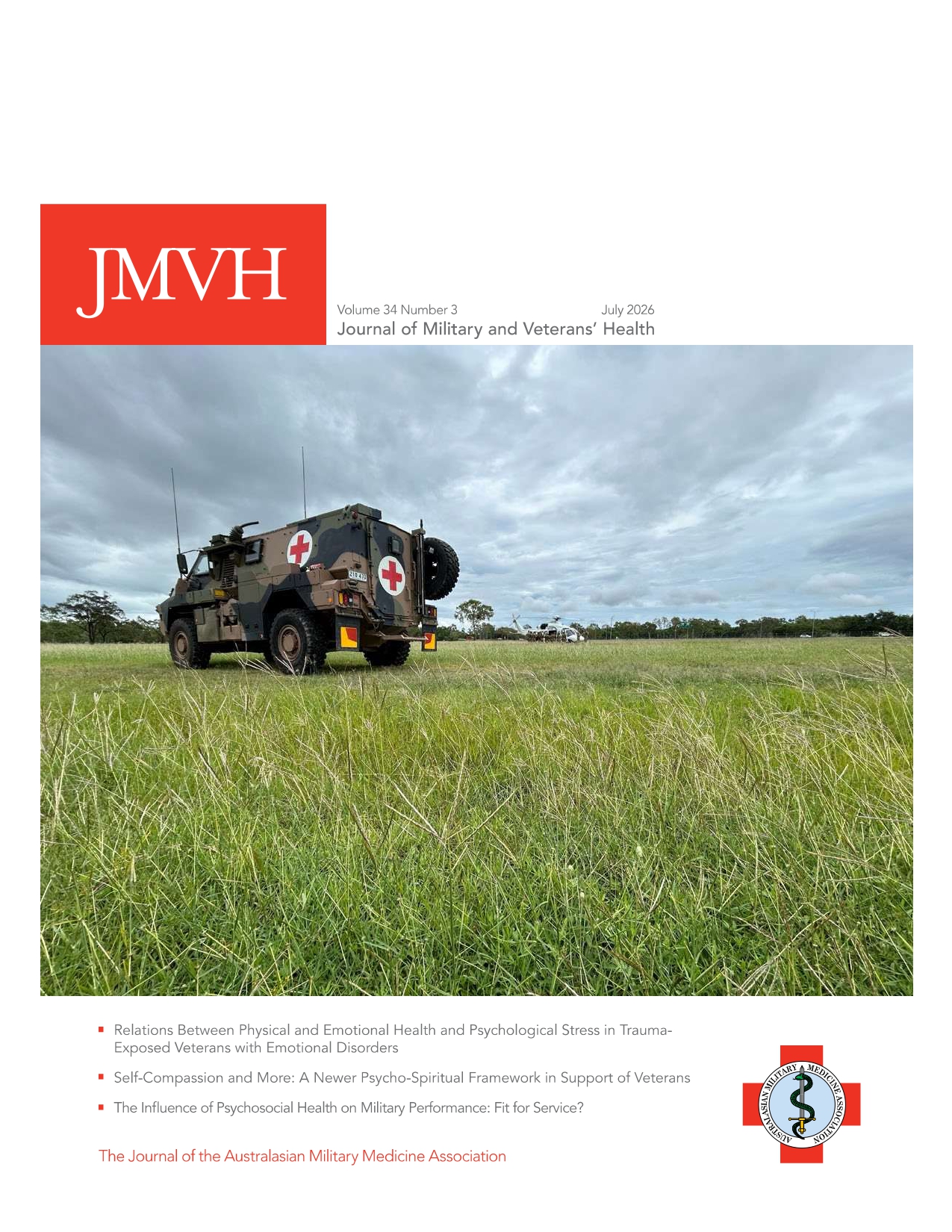
The Influence of Psychosocial Health on Military Performance: Fit for Service?
Abstract When considering military fitness, the focus must be on psychological and physiological ability and thus suitability for service, determinants which are themselves influenced by health. Health, especially in the military context, is the product of several factors (including psychosocial ones), as will be highlighted in the current study. The influence of psychosocial health and… Read more »
Hookworm infections in the Military
Abstract Soil-transmitted helminths such as hookworm are rarely a problem for military units unless they directly contact faecally contaminated soil during tropical operations. Localised epidemics incapacitating small infantry units have been recorded in the Solomon Islands and Bougainville during World War II and in Vietnam, Grenada and Sierra Leone more recently. Scattered hookworm infection cases… Read more »
Editorial – The 1991 Gulf War
Thirty-five years ago, 1872 Australians, including Australian Defence Force (ADF) health personnel, served in the Persian Gulf between August 1990 and the ceasefire in February 1991. While primarily a Royal Australian Navy task group, involving HMAS Adelaide, HMAS Darwin, HMAS Sydney, HMAS Brisbane, HMAS Success and HMAS Westralia in maritime interdiction, sanctions enforcement and replenishment… Read more »
More on the Staff of Asclepius
In a 2010 issue of ADF Health I wrote an article More on the Staff and Serpent of Asclepius (1) describing Asclepian medicine and the Asclepian Temples with a short description of the wooden staff and entwining serpent of Asclepius. At the time I had not found any information on the origin, symbolism or nature… Read more »
Supporting Australian Veterans Presenting with Cognitive Concerns
Introduction Veterans frequently present to general practitioners and non-GP medical specialists with concerns regarding mood, thinking, memory, cognition concerns and in some cases even self-diagnosed dementia Often, the underlying cause is unclear The differential diagnosis might include an undiagnosed mental health condition, a sleep disorder, impacts from alcohol or drug use, dementia, a degenerative neurological… Read more »
Editorial – The Nature and Character of War
Editorial As we enter 2026, consideration needs to be given to various conflicts and touchpoints around the globe, from Ukraine to South Sudan, Middle East to the South China Sea While the Australian Defence Force has not been drawn directly into these conflicts, there remains the potential for escalation, for which we all need to… Read more »
Health Effects of Sport and Volunteering in a Military Context
Abstract When considering military fitness, the focus must be on psychological and physiological ability, which are themselves influenced by health. Health itself is a product of several factors, as will be highlighted in the current study. To assess health and its implications in a military context, a questionnaire was administered to 555 participants during and… Read more »
Psychological Assessment for Military Selection: Past, Present and Future Applications
Abstract Psychological assessments for selecting military personnel have played a crucial role in enhancing training effectiveness, ensuring job success and, where possible, reducing mental health casualties in war zones. This article traces the development of psychological assessment for military selection through the World Wars to modern-day procedures. Two main themes emerge from this analysis: firstly,… Read more »
Injuries, Physical Fitness, and Body Mass Index in a Population of U.S. Army Reserve Personnel
Abstract Introduction US Army Reserve personnel are expected to meet the same fitness and readiness standards as their Active Duty counterparts, but little is known about health factors among Reservists. This investigation presents data on injuries, fitness and body mass index (BMI) for Reservists participating in a new health and fitness program. Methods Twenty-one US… Read more »
Creative Engagement by Wounded, Injured or Ill Australian Defence Force Personnel
Abstract While there has long been an extensive range of medical, pharmaceutical, psychological, physiological, spiritual and physical programs available to ADF personnel seeking health assistance, allied health practices—particularly creative arts interventions—are still relatively new in the wellbeing context. The Australian Defence Force Arts for Recovery, Resilience, Teamwork and Skills Program (hereafter, ADF ARRTS) is an… Read more »
Musculoskeletal Injury and Physical Fitness Across US Army Occupational Specialties
Abstract Background: Military occupations are widely diverse, requiring specific skill sets and physical demand levels to accomplish their objectives. Purpose: To describe musculoskeletal injury and physical fitness across US Army military occupational specialties (MOS). Methods: Demographics, health behaviours and physical training data were obtained by electronic survey. Musculoskeletal injuries and Army Combat Fitness Test (ACFT)… Read more »
Mauled by a Lion – How Spiritual Wounds and Injuries Present
Abstract The mauling that some veterans suffer as a result of issues such as shame, anger, self-abuse and depression are very real, lasting and painful aspects of their lives. For a Religious/Spiritual Practitioner (RSP), or indeed any treating practitioner, to make a meaningful contribution towards treating a Spiritual Wound and Injury (SW&I) they must determine… Read more »
Psychological Screening in the Australian Defence Force: An Historical and Contemporary Analysis of what Works
Abstract With a rapid and significant rise in psychological screening within the Australian Defence Force (ADF) over the past 20 years, ambiguity has developed between a psychological screen and a psychological assessment used for pre-employment and pre-deployment selection purposes. Additionally, confusion persists around what constitutes a mental health or psychology screen and when it should… Read more »
Should the Australian Defence Force Conduct a Drug Trial of Wakefulness-Promoting Medications?
Abstract Fatigue jeopardises soldiers’ lives, and despite caffeine being the approved wakefulness aid in the Australian Defence Force (ADF), its efficacy equals a placebo with unwanted side effects. The US Military uses modafinil as an alternative, but no ADF studies on modafinil exist. This article argues for exploring alternatives, ensuring consent and conducting willingness-to-participate studies… Read more »
Use of a Health Monitoring System During a US Military Exercise During the COVID-19 Pandemic (April 2021): Participant Characteristics, Demographics and Differences in Participation
Abstract Background: Because of the close working environment, military personnel are exposed to respiratory disease, often greater than the civilian sector. During the COVID-19 pandemic (April 2021), an Oracle short message service (SMS)–based, mobile phone, daily COVID-19 health monitoring system was employed to monitor and protect the health of military members participating in a large-scale,… Read more »
Dengue Epidemics During the Second World War in Queensland
Abstract: Although dengue became endemic in northern Australia in the 19th century, the enormous movement of people and material during World War II resulted in localised dengue epidemics in Queensland. Factors promoting the epidemics included mixing diverse civilian and military populations, including evacuees from tropical areas, and little focus on preventive measures until outbreaks occurred…. Read more »
Bipolar Disorder in the Australian Defence Force: Estimating Prevalence from Defence Electronic Health System Records
Abstract Background and purpose: This study aimed to establish the treated prevalence of Bipolar Disorder (BD) in serving members of the Australian Defence Force (ADF) in light of a 2018 study of mental disorders in the ADF and Veteran population that found a surprisingly high 12-month prevalence rate. Method: A retrospective review of the Defence… Read more »
Principles and applications of military leadership to improve civilian trauma medicine training
Abstract This article examines how the principles and applications of military leadership improve civilian trauma medicine training. Military leaders have been pivotal in driving the development and improvement of a multidisciplinary trauma care course, the Definitive Perioperative Nurse Trauma Course (DPNTC). The development of the DPNTC has benefited from leadership principles underpinned by the experiences… Read more »
John Keith Henderson: First Australian to Provide Dental Treatment to Troops on Active Service
Abstract The Royal Australian Army Dental Corps regards John Keith Henderson as the first Australian to provide dental treatment to troops on active service. At the time, he was a third-year dental student at the University of Sydney who had enlisted as a Private in the Australian Army Medical Corps at the outbreak of World… Read more »
Musculoskeletal surgery in Australian Defence Force trainees: Part 2 – risk factors and impact on deployability
Introduction The cost of recruiting and training a military trainee is substantial. In 1999, Rudzki and Cunningham estimated the cost of recruiting and training a new Australian Defence Force (ADF) member to be $A9000, with a net cost of $A14 245 if they were discharged after 10 weeks.1 This cost will be significantly higher in… Read more »
Prevention and management of urinary incontinence, anal incontinence and pelvic organ prolapse in military women and female elite athletes
Abstract Background: Pelvic floor dysfunction (PFD), encompassing urinary incontinence (UI), anal incontinence (AI), pelvic organ prolapse (POP) and various other conditions associated with pelvic floor muscles, is prevalent in military women and female elite athletes. Thus, it is important to consider specific prevention and management strategies that these women are currently using, and their safety… Read more »
General and Specific Benefits from the ADF ARRTS Program
Abstract The present study was part of an evaluation of the Arts for Recovery, Resilience, Teamwork and Skills (ARRTS) program conducted by the Australian Defence Force (ADF) for wounded, injured and ill veterans as an adjunct to their established treatments. Two previous evaluations, one using categorical judgments and one using standardised rating scales, yielded evidence… Read more »
Longitudinal Change Resulting from the ADF’s Arts for Recovery, Resilience, Teamwork and Skills (ARRTS) Program
T J Watt, E James Kehoe Abstract Arts-based activities are increasingly being offered to current and former military members as an adjunct to their established therapeutic interventions. Individuals who undertake arts-based activities have shown reductions in both anxiety and depressive symptoms. However, little is known about the specific mechanisms engaged by these activities or the… Read more »
Pelvic Floor Health in Female Military Personnel: A Narrative Review
S O’Shea, R Pope, R Orr, K Freire Abstract Background: A growing female workforce within military forces internationally necessitates comprehensive consideration of this population’s unique health requirements within a wide range of military contexts. Pelvic floor health is a key area where support needs vary between sexes because of differences in pelvic anatomy and… Read more »
Post-Traumatic Stress Disorder and Killing in Combat: A Review of Existing Literature
Abstract Background: Killing during combat is a unique experience and, for the majority, is limited to military service. For those working with military and veteran populations, it is essential to be able to understand this experience and any psychological ramifications. Purpose: This review provides a synthesis of existing literature, addressing the specific question: what is… Read more »
Infection Prevention and Control Practices in the Deployed Military Field Hospital: AN integrative review
J Skipp, P Zimmerman, T Van de Mortel Abstract Background: Advances in personal protective equipment, tactical combat casualty care training and improved technologies have led to the increased survival of those injured during combat. However, infection remains a significant complication in combat-related injuries, from initial wound contamination to infections acquired in various treatment facilities. Purpose:… Read more »
The Effects of Depression on Success in Male Soldiers Sexually Transmitted Disease and Reproductive Health Education
Abstract Aims: In this study, we aimed to investigate the effect of depression on education regarding sexually transmitted diseases and reproductive and sexual health. Methods: The study was conducted in 98 healthy private soldiers. Sociodemographic characteristics were recorded. The participants filled out the ‘reproductive health knowledge evaluation form’ (RHKEF) and Beck Depression Inventory (BDI) before… Read more »
2025 AMMA Conference