

Abstract
When considering military fitness, the focus must be on psychological and physiological ability and thus suitability for service, determinants which are themselves influenced by health. Health, especially in the military context, is the product of several factors (including psychosocial ones), as will be highlighted in the current study. The influence of psychosocial health and health-related factors on military fitness and, therefore, on military performance and fulfilment of military tasks must be assessed. To this purpose, implications from the current situation in the German Armed Forces will be considered. Environmental factors (e.g. superiors, comrades, family) are of special interest in this respect. The study aims first to provide a brief insight into what constitutes or hinders military fitness and fitness for service in the German Armed Forces, with special emphasis on the psychosocial and environmental perspective. Second, to provide insights into the German Armed Forces’ work-health programme in order to broaden the dialogue between military personnel carrying out such programmes among armed forces worldwide.
Keywords: military fitness, occupational health, psychology, social environment, health management
Introduction
The ability to perform mentally and physically is said to be crucial for the fulfilment of military operations, missions and assignments. Health and athletic fitness also play a supposedly important role in this respect. In the German Armed Forces, problems arise in this context. These may be rooted in several aspects, including the organisation of work and processes, and the lack of or improper material. These aspects can negatively influence health and thus performance and fulfilment of all kinds of military tasks. At the same time, the German Armed Forces seem to experience problems with prevention and work-health programmes due to a lack of time to implement specific measures, for example, because superiors hesitate to implement public health measures, as these measures themselves consume resources, such as personnel. This leads to the need for further exploration of problems and possibilities in this context.
To systematically enter the research, concepts such as health, physical training, performance and on-duty requirements must be clearly defined, as well as potential on-duty stressors.
The World Health Organization (WHO) defines health not only as the absence of illness, but also as a state of complete social, mental and physical wellbeing.1 Although this position is currently facing a great deal of criticism (a Google Scholar search yields a multitude of scientific articles arguing against it, some of which have been summarised by Schramme, 20232, amongst others), there is justification for this definition in the military context, especially regarding mental health, which is crucial to military operational capability.3
Mental health in particular, is crucial to military task fulfilment, since the WHO defines mental health as a state of wellbeing in which an individual is capable of performing according to their abilities, coping with daily life stressors, working productively and giving back to society.2 For military personnel, the contribution to society consists of the fulfilment of military tasks, which is only possible under certain preconditions.
These preconditions most likely include fulfilling a set of individual needs, as previously noted by Maslow and Lewis.5 Individual needs in this context are named as basic needs (water, food, air, appropriate temperature), security, social needs, appreciation by others and individual fulfilment. If these needs are not met or only partially met over a longer period, performance will drop and the individual may fall ill.6 When considering proceedings within the German military, for example, for units that conduct courses for other units, it becomes apparent that even basic needs are not met in these units. This is especially true for courses that include joint combat training, so that health may present a problem in this context.
When considering physical activity within military contexts, it is clear that exercise and sports have been instrumentalised for military purposes for quite some time, for example, in the British Empire around 19004. A lack of physical fitness even has consequences for the military when it occurs in the civil population, as it can lead to a lack of recruits.8 Physical performance is crucial to military tasks such as shooting, which requires core stability, balance, strength-endurance and body tension.9 Military personnel, especially soldiers, must perform at a very high physical and cognitive level under extreme pressure, comparable to that in competitive sports.10-13
In this context, the UK military uses mental training.12 Also, mindfulness training with military personnel showed that the intervention group suffered less from stress and their cortisol values, a measure for physiological stress response, decreased significantly.10 When considering factors such as mindfulness and resilience, it must be said that these also affect task fulfilment. Resilience training significantly increased regeneration after demanding military training exercises within a group of Swiss Army cadets and led to lower cortisol levels in the intervention group.14 Swiss cadets who took part in a stress reduction training were less stressed during strenuous situations.15 Also, resilience increases performance in military settings,16 and preventive resilience training improved coping in patients who later acquired posttraumatic stress disorder (PTSD).17 Resilience also influences expected self-efficacy, which in turn is influenced by the perceived role within a team or process.18 Furthermore, there is a connection between expected self-efficacy and sports performance, suggesting that sports performance increases psychological performance.19 Even when no resilience training is implemented but only normal sports training, there are positive effects on psychological factors, such as a reduction of anxiety and depression.20 Sports activities can also improve sleep quality.21
Requirements between different military tasks can vary according to unit, as has been pointed out by a study22 within the German Armed Forces. The study showed that soldiers must move dynamically and carry loads. At the same time, civilian workers within the military often practice trades or perform office duties.22 Physical demands are therefore present in soldiers’ daily tasks and, to lesser degree, also in those of civilian workers within the German Armed Forces, such as trades, folding of parachutes or explosive ordnance disposal. Office work includes its own unique risks, stressors and requirements, as will be outlined below. German health insurance data shows that 18% of the civilian population in Germany suffer from psychological diseases, which may be related to social circumstances.23 This could also affect military work settings. With these findings in mind, connections between health and performance in the military context can be drawn.
Sometimes demands on duty exceed what can be delivered by civil or military personnel. However, the inability to meet physical performance demands on duty may also arise from a lack of fitness or health-related problems, which may increase the risk of injury and dropout from military training.26–28 When considering paratroopers, incorrect landing technique is one of the most common injury patterns. This underlines the necessity of position-specific sports training, which should include complex training components such as coordination and strength.29 Concerning more general military functions, injury prevention can be achieved through marching and sports activities.30
During international missions, health and fitness levels can decline,31 leading to injuries.32 Generally, there is a higher risk for injury abroad,33 especially during lifting and carrying loads.34 Injury prevention training that incorporates military requirements can, at least up to a point, reduce injury risk.35
In addition, health and fitness levels can improve military performance.36 During military basic training, in particular, special consideration should be given to the selection and qualifications of trainers.37 Medical studies showed that patients who had been training before medical surgery benefited during rehabilitation and recovered faster.38,39 This leads to the conclusion that physically trained military personnel will recover faster following an injury and subsequent rehabilitation.
Musculoskeletal diseases are very often caused by psychosocial stressors in the workplace,40 while neck and shoulder pain are common.41 Psychosocial factors influence work health in distinct ways40,42 (Tables 1 and 2). The longest sickness absences were caused by workplace bullying,43 which leads to the assumption that a ‘healthy’ work environment can boost mental health.44
Table 1: Findings from literature regarding fitness for service.
| Finding | Studies |
| Lack of fitness in civil population causes lack of recruits. | Maclean & Cawley, 2014 |
| Physical performance is crucial to military tasks, shooting requires core stability, balance, strength-endurance, body tension. | Nourizadeh et al., 2019 |
| Military personnel, especially soldiers, must perform at a very high physical and cognitive level under extreme pressure, which constitutes a parallel to competitive sports. | Meland et al., 2015; Wagstaff & Leach, 2015; Fitzwater et al., 2018; Brückner, 2023 |
| UK military uses mental training. | Fitzwater et al., 2018 |
| Mindfulness training with military personnel significantly reduced stress and cortisol levels. | Meland et al., 2015 |
| Resilience training increased regeneration after demanding military trainings within a group of Swiss Army cadets and led to lower cortisol levels. | Zueger et al., 2023 |
| Swiss cadettes coped better during straining situations after special training. | Niederhauser et al., 2022 |
| Resilience increases performance in military settings. | Niederhauser et al., 2023 |
| Resilience increases coping in patients who suffer from post PTSD. | Kottlow, 2020 |
| Resilience influences self-efficacy, which itself is influenced by perceived role within a team or process. | Lang et al., 2007 |
| There is a connection between self-efficacy and sports performance. | Moritz et al., 2000 |
| Physical training has positive effects on anxiety and depression. | Panza et al., 2020 |
| Sports activities increase sleep quality. | Johnston et al., 2021 |
| Requirements vary according to unit: soldiers have to move dynamically, cope with carrying of loads, civil workers often carry out crafts or office duty. | Rohde et al., 2017 |
| Lack of fitness or health-related problems increase injury risk. | Vaara et al., 2020 |
| Lack of fitness leads to dropout from military trainings. | Peake, 2000; Wyss et al., 2014 |
| In paratroopers, wrong landing technique is related to injury; demand for physical training (complex exercises including coordination, strength). | Ekeland, 1997 |
| Injury prevention can be achieved by marching and sports activities. | Roos et al., 2015a |
| During international missions, health and fitness level can decrease. | Sharp et al., 2008 |
| Decreased fitness during international missions leads to injuries. | Knapik et al., 2012 |
| Increased injury risk abroad especially during lifting/carrying of loads. | Roy et al., 2012a, b |
| Prevention training regarding military requirements reduces injury risk. | Knapik et al., 2003 |
| Health and fitness level improve military performance. | Friedl et al., 2016 |
| Selection and qualifications of the trainers important for basic training. | Roos et al., 2015 |
| In medical studies patients who had been training before medical surgery had benefits during rehabilitation and recovered faster. | Catalayud et al., 2017; Hall et al., 2023 |
Table 2: Connections between symptoms of the musculoskeletal system and psychosocial workplace factors according to Lang et al. (2012) and Bezzina et al. (2023).
| Localisation of symptoms | Influencing factors |
|
Lower back |
High demands (including psychological) and stress Limited control Low security and contentedness regarding the workplace Minimal support from superiors and colleagues Minimal support from social surroundings Lack of resources needed for work Monotonous and repetitive tasks |
| Neck and shoulders | High demands and stress Limited control Minimal support from superiors and colleagues Minimal support from social surroundings Monotonous and repetitive tasks Contentedness regarding the workplace Psychosocial stress, bad atmosphere at work Wrong job decision, role conflict |
|
Upper extremity
|
High demands and stress Limited control Minimal support from social surroundings Monotonous and repetitive tasks Psychological demands and stress |
| Lower extremity | Limited control Minimal support from social surroundings Monotonous and repetitive tasks |
Psychosocial factors also influence sports performance, which can be affected by sleep quantity and quality, religion, financial situation, gender, political situation, behaviour of members of the soldiers’ social surroundings (e.g. communication styles or expectations of others, such as colleagues, comrades, family) and psychological factors such as self-efficacy.45 The influence of the social environment in this respect has also been mentioned.40
It can be summarised that physical and psychological fitness for duty (and therefore, task fulfilment and operational capability) are determined by the presence or absence of conditions that positively or negatively affect them, including work-related and non-work-related factors such as family, partner, travel/distance to work, social environment and so on.
Research questions
Which aspects have to be considered performance limiting in regard to task fulfilment within the German Armed Forces, and how can these aspects be optimised during daily duty?
Which specific situations and obstacles are present within the German Armed Forces concerning the implementation of work-health programmes?
Materials and methods
Results from two surveys within the German Armed Forces will be analysed to assess the relationships among health, physical fitness and the fulfilment of military tasks. Analysis in this respect will be twofold. General connections between psychosocial and physical health, physical or mental fitness and performance in the military context based on the results of the surveys, and the situation regarding these aspects within the German Armed Forces will be outlined. Results from the implementation phase of the AIG-Screen Bw24 (survey on individual health perception within the German Armed Forces), conducted between 2019 and 2024, and the attractivity survey of the German Armed Forces25 will be included in the analysis and compared with the findings from the current literature. Regarding the AIG-Screen Bw, it was not possible to include the entire dataset due to results being classified, but calculations in this paper can give an initial insight into how public health survey data could be used within a military context. Due to classification reasons, only a small number of units were included in the study. Sample units were selected according to service branch in order to incorporate different work environments.
The AIG-Screen Bw is (or should be) conducted within every unit in the German Armed Forces every two years as part of the Forces’ work-health programme in order to specify public health needs within individual units and supply adequate countermeasures for each unit. It consists of questions regarding work material, infrastructure, leadership, organisation of work processes, subjective perception of health and wellbeing, as well as motivational and demographic factors. It targets both civilian and military posts alike, and is provided to participants online or on paper over 2 weeks. Participation is voluntary and response rates so far varied between 10% and 65% within units. A full set of questions cannot be shown in the article due to the questionnaire being classified material. This survey tool allows the assessment of connections between the survey items as well as improvement or deterioration of factors. Also, the AIG-Screen Bw can be used to audit the German Armed Forces’ work-health programme (Betriebliches Gesundheitsmanagement, German abbreviation: BGM) itself, for example, through intervention studies. Thus, it is technically and statistically possible to assess potential for improvement regarding work-health factors. Within the current study, AIG-Screen Bw-data from N = 21 units with military and civil personnel1 have been used to calculate Pearson and Spearman correlation coefficients between the possibility to coordinate the individual’s needs with demands on duty and the perceived amount of illness in individuals within the unit, as well as correlations between the possibility to use the individual’s personal strengths on duty and the possibility to coordinate the individual’s needs with demands on duty. Weak correlation was set at ≥ 0.1, moderate correlation at ≥ 0.3, strong correlation at ≥ 0.5 and significance at ≤ 0.05. Calculations were done using SPSS 29.
The attractivity survey of the German Armed Forces examines the relationship between wellbeing in the military and four central influencing factors (health, justice, recreation/family and learning) based on data from personnel surveys in the German Armed Forces in 2013 (7744 questionnaires, 26% response rate), 2016 (2121 questionnaires, 33% response rate) and 2020 (2412 questionnaires, 36% response rate). Questionnaires were sent via mail and included questions regarding health, recreation and family, fairness and possibilities for learning. Findings from the survey were compared to results from the AIG-Screen Bw. The two surveys were viewed separately with no joint calculations being performed.
Results
Conditions regarding physical fitness and workplace health in the German Armed Forces vary between units. When considering teaching and training units whose personnel are almost constantly involved in joint combat training at military training facilities including military training grounds, it is clear that the individual needs according to Maslow and Lewis5 are not covered over long periods of time: Dusty air in the field due to vehicle movement, limited possibility to carry drinking water, bagged meals from military catering facilities instead of properly cooked meals, cold and rainy weather, loud, hot barracks, not enough clothes to change after hot or wet weather and limited possibilities of communication with loved ones as well as pursuing hobbies lead to difficult living conditions with regards to all basic and individual needs.
Job satisfaction influences personnel’s mental and physical health.46,47 At the same time, only 60% of military personnel in the German Armed Forces approve of their direct superior’s performance, and workplace contentment correlates with contentedness with leadership.48 Regarding these circumstances within the German Armed Forces, the AIG-Screen Bw and the attractivity survey paint a similar picture.25
Various factors can influence workplace health, as discussed earlier (Tables 1 and 2). In the AIG-Screen Bw, participants can rate, among others, the feedback they receive, the freedom of action they have while carrying out their duty, as well as the appreciation they receive, the degree to which they can spot their individual success when accomplishing their tasks, the degree to which they feel supported by colleagues or superiors and the degree to which conflicts are present within their unit. As stated by Lang et al.40 and Bezzina et al.,42 psychosocial factors appear to exacerbate problems within the musculoskeletal system due to excessive psychological stress, leading to an imbalance in the nervous and hormonal systems.42
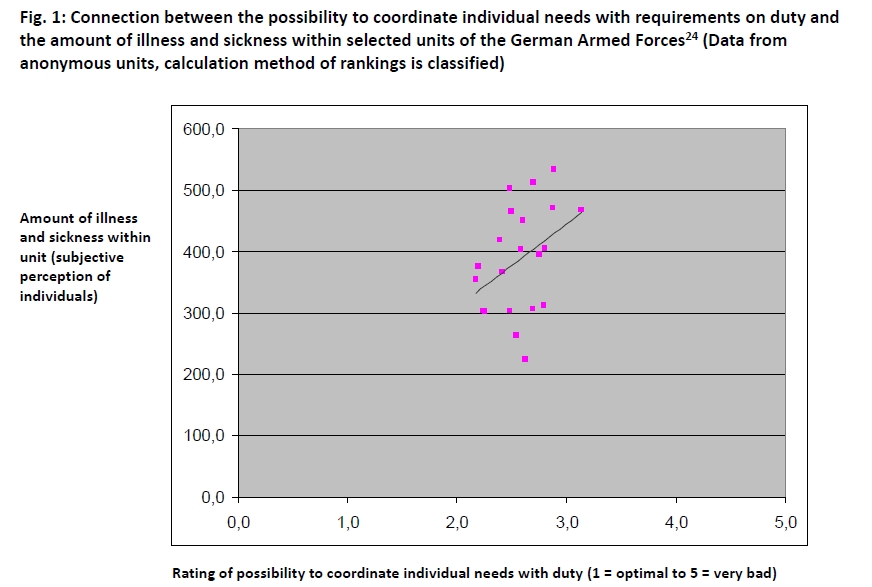
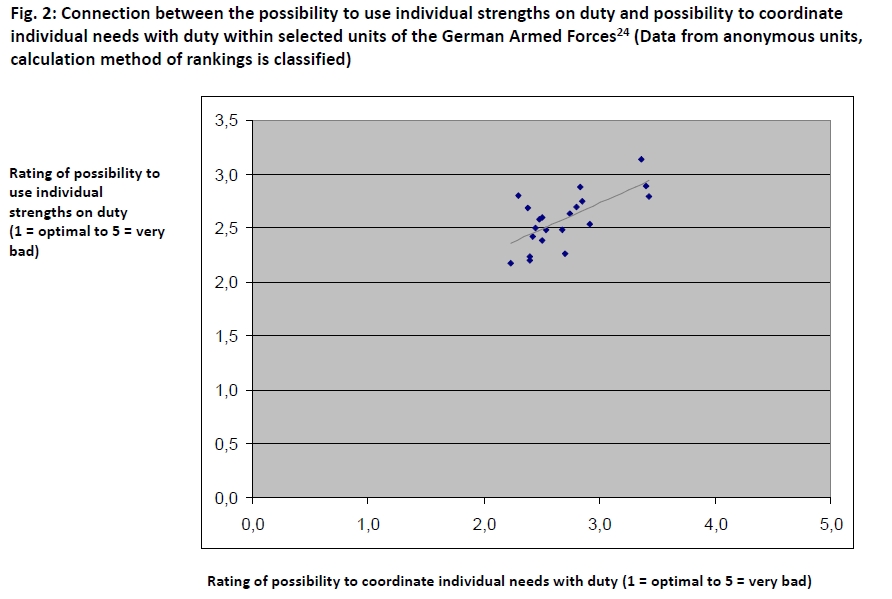
The German Armed Forces have been rolling out the BGM since 2016, but the completion has been delayed due to COVID-related events. Unfortunately, the BGM is sometimes mistaken for ‘back therapy training’ rather than an effective quality and productivity management tool. The AIG-Screen shows that there are correlations between psychosocial factors and health, for instance, a moderate correlation between the possibility to combine individual needs with daily duty on the one hand and the sum of illnesses subjectively perceived by participants (p ≤ 0.047, Spearman’s rho = 0.439; see Figure 1), which aligns with Maslow and Lewis’s5 theory. Furthermore, there is a strong correlation between the possibility to use one’s strengths on duty and the possibility to coordinate individual needs with daily duty (p ≤ 0.001, Pearson’s coefficient = 0.669; see Figure 2).
Correlations can also be found when analysing the data24 regarding the availability of working materials and parameters of wellbeing. According to the attractivity survey, which is conducted at three points in time within the German Armed Forces, wellbeing has increased steadily since 2013.25 Not only health but recreation/family also had a large impact on wellbeing among the surveyed soldiers. Health also affected workplace contentment, suggesting that the two factors influence one another.
Discussion
Limitations of the study include a small sample size arising from military classification restrictions. However, it has to be noted that aggregated data from several hundred personnel were used.
Results from the AIG-Screen Bw and other internal data or documents could be analysed in multiple ways, but this is not the case within most units. The topic seems to be treated as something that, in practice, is applied only to very few select groups (e.g. pilots within the Human Performance enhancement programme [HPE] within the German Armed Forces). In some units, BGM measures are implemented in a way that ensures each unit receives some form of ‘easily implemented’ measures, regardless of circumstances or actual needs. Here, the main BGM activities on duty are gymnastics and yoga, etc., implemented to ‘have done something’. So far, no detailed scientific analysis has been used to implement a scientifically guided approach in the German Armed Forces, and the question arises whether this is also true in other countries. Practitioners and superiors seem unable to adequately address the connections that appear to exist between leadership and interpersonal workplace stressors, or stressors that most likely arise from a lack of material and improper workplace organisation. This probably leads to a lack of practical solutions derived from these studies, the reasons for which will be outlined below.
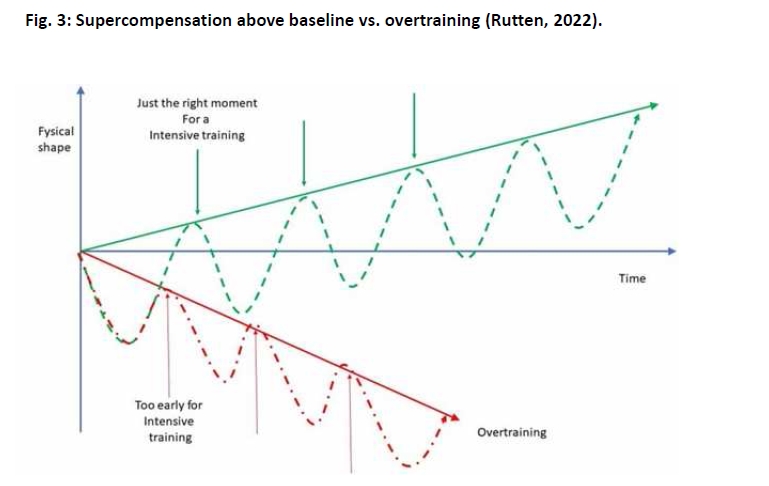
Results from the AIG-Screen Bw as well as the attractivity survey lead to several options for the German Armed Forces (and probably also armed forces in other countries), which are sometimes not easy to pursue due to internal obstacles, for example, some superiors are sceptical about yielding too much freedom of action, probably due to a fear of losing control or being overwhelmed by demands from inferiors. Also, the provision and acquisition of materials and infrastructure can cause problems and be a lengthy process, such as when the helmet needs to fit the radio circuit, or when lashes are in frequent contact with safety glasses, causing eye inflammation and so on. In some cases, duty is not compatible with attending sports or movement activities provided by the BGM programme, such as for personnel working in trades or at training grounds. Also, current projects within the units can lead to superiors neglecting their subordinates’ health and wellbeing, as they themselves need to deliver results, often resulting in decreased performance due to stress (as shown in Figure 3). BGM processes need to be optimised accordingly, especially regarding the scientific evaluation process, the communication of the BGM standard operating procedure and the actual implementation within military units. The key problem seems to be that healthy, thus performance-promoting conditions need to be incorporated into daily duties to improve operational capability.
To better outline the relationships among individual needs, regeneration/recreation and on-duty performance, the principle of supercompensation can be used.49 The model, which originates from sports science, can in principle also be transferred to work- and duty-related settings. It states that after strenuous activities, performance decreases due to fatigue, but then increases above the initial level. If no new strain occurs, performance returns to the starting level. If confronted with a new stimulus, performance increases and may establish a new, higher starting point. However, during a state of constant overwork/overload due to high workloads or other unfavourable factors, performance constantly decreases and the risk of injury and sickness increases (Figure 3).50
This leads to increased demand for the optimal organisation of work-related processes and healthy leadership, which cannot be met under constant overload of duty-related demands. The aforementioned model has direct implications for the German Armed Forces and most probably for other military settings. Regeneration must be made accessible, at both the physical and mental levels, and coping skills must also be trained to achieve optimal performance in military settings. Or, as one of the reviewers for this article phrased it: ‘The GAF should not be doing their opponent’s job for them by killing or injuring its own people, least of all in the non-combat setting’.
In summary, it can be said that mental and physical fitness are limiting factors in the fulfilment of military tasks, as the requirements in this respect are clearly psychological and physical. Adjusting these factors on duty is a difficult measure due to a lack of knowledge among leadership on how to address these circumstances, as well as problems with setting priorities for health and its implications for productivity. For the most part, using personnel and resources to perform daily duties will take priority over using them to improve working conditions.
The findings of the current study align with literature.5,6,18,40,42,44 Regarding health, especially psychosocial health, the results demonstrate a strong need to research further what actually constitutes workplace health in the military and, most importantly, to translate those findings into action. What are the demands with respect to the environment and workplace when aiming for optimal task fulfilment? Which influence factors are significantly involved? And what influence, if any, do leadership, lack of material resources, workflow organisation and process management, sports activities, nutrition, sleep, social surroundings, as well as the perception of armed forces within societies have? Do political or policy factors also influence the military work environment? These questions could be answered in more detail through surveys within the German Armed Forces if proper scientific monitoring, including the analysis of survey results and the actual addressing of identified problem areas, is implemented while at the same time fulfilling daily demands.
Corresponding Author: Johanna Weber, j.weber_@hotmail.de
Authors: J Weber1,2, M Elbe1
Author Affiliations:
1 ZMSBw
2 Institute for Preventive Medicine – Germany Armed Forces