

Residential and Inpatient Interventions for Military Veterans within Forensic and Secure Mental Health Services: A Scoping Review
Introduction Armed Forces veterans are at increased risk of developing mental health difficulties, particularly post-traumatic stress disorder (PTSD), depression, and substance use disorders (SUDs).1 This heightened vulnerability is closely linked to exposure to combat-related trauma as well as the complex psychological, social and occupational challenges associated with transitioning back into civilian life.2,3 Suicide rates among… Read more »
Evaluation of Self-Perceptions of Physical Demand and Physical Fitness of Volunteers during the Adaptation Internship of Reserve Officers of the 2nd Class of the Brazilian Air Force
Abstract The recruitment and mobilisation of higher education professionals for temporary military service occurs annually in the Brazilian Air Force occur annually. After the selection process, volunteers complete a Technical Adaptation Internship to prepare future junior officers for the specific conditions of military service. These courses generally last approximately two months and have high physical,… Read more »
The Gender Debate: Effects of 10-weeks Strength Training on Operational Readiness for Females in the Military
ABSTRACT Introduction: Military service is a physically demanding occupation, and fewer women than men meet the military fitness standards, especially in manual handling and load carriage. Therefore, integrating women into physically demanding military roles requires effective physical conditioning programs to ensure operational readiness. Methods: Twenty-eight female soldiers were randomly assigned to either a 10-week gender-specific… Read more »
Medical Corps Disease Mortality during the First World War: Australia vs. Turkey
Medical corps officers were often the ‘canary in the coal mine’ for infectious disease mortality in armies during the pre-antibiotic era. This means that medical officers could be among the first indicators of a serious medical problem (See https://wordhistories.net/2018/03/31/canary-coal-mine). Deployed forces, however, could experience exotic threats, such as malaria and cholera, that could kill both… Read more »
United States Service Members’ Resilience, Wellbeing and Social Support Resources Post-deployment
Abstract Introduction: Military service members encounter numerous stressors post-deployment. Unit cohesion, community, social connections and leadership can serve as resilience support systems and may help improve service members’ wellbeing. This research examines the perceived value of these support systems for service members post-deployment. Methods: A cross-sectional convenience sample of 78 United States military officers (n=54)… Read more »
Burnout, Life Satisfaction, and Social Exclusion Levels of Retired Non-Commissioned Officers and the Relationships Between These Phenomena: The Case of Türkiye
Abstract Background: Research on the social and psychological conditions of retired non-commissioned officers (NCOs) remains limited. Therefore, examining burnout, life satisfaction and social exclusion among retired NCOs is critical. Objective: This study aimed to measure levels of burnout, life satisfaction and social exclusion among retired NCOs in Türkiye and to examine the relationships among these… Read more »
Prevalence of Long-Term Health Conditions in Current-serving, Previous-Serving and Never-Serving Australians: An Age-Adjusted Comparative Analysis using 2021 Census Data
ABSTRACT Background Long-term health conditions (LTHC) are major contributors to morbidity and mortality in Australia and may be more prevalent in Australian Defence Force (ADF) veterans. Previous analyses are limited because they do not control for age and sex confounding or disaggregate by ADF service status. Purpose We aimed to estimate and compare the age-standardised… Read more »
The Influence of Psychosocial Health on Military Performance: Fit for Service?
Abstract When considering military fitness, the focus must be on psychological and physiological ability and thus suitability for service, determinants which are themselves influenced by health. Health, especially in the military context, is the product of several factors (including psychosocial ones), as will be highlighted in the current study. The influence of psychosocial health and… Read more »
Hookworm infections in the Military
Abstract Soil-transmitted helminths such as hookworm are rarely a problem for military units unless they directly contact faecally contaminated soil during tropical operations. Localised epidemics incapacitating small infantry units have been recorded in the Solomon Islands and Bougainville during World War II and in Vietnam, Grenada and Sierra Leone more recently. Scattered hookworm infection cases… Read more »
Editorial – The 1991 Gulf War
Thirty-five years ago, 1872 Australians, including Australian Defence Force (ADF) health personnel, served in the Persian Gulf between August 1990 and the ceasefire in February 1991. While primarily a Royal Australian Navy task group, involving HMAS Adelaide, HMAS Darwin, HMAS Sydney, HMAS Brisbane, HMAS Success and HMAS Westralia in maritime interdiction, sanctions enforcement and replenishment… Read more »
More on the Staff of Asclepius
In a 2010 issue of ADF Health I wrote an article More on the Staff and Serpent of Asclepius (1) describing Asclepian medicine and the Asclepian Temples with a short description of the wooden staff and entwining serpent of Asclepius. At the time I had not found any information on the origin, symbolism or nature… Read more »
Supporting Australian Veterans Presenting with Cognitive Concerns
Introduction Veterans frequently present to general practitioners and non-GP medical specialists with concerns regarding mood, thinking, memory, cognition concerns and in some cases even self-diagnosed dementia Often, the underlying cause is unclear The differential diagnosis might include an undiagnosed mental health condition, a sleep disorder, impacts from alcohol or drug use, dementia, a degenerative neurological… Read more »
Editorial – The Nature and Character of War
Editorial As we enter 2026, consideration needs to be given to various conflicts and touchpoints around the globe, from Ukraine to South Sudan, Middle East to the South China Sea While the Australian Defence Force has not been drawn directly into these conflicts, there remains the potential for escalation, for which we all need to… Read more »
Health Effects of Sport and Volunteering in a Military Context
Abstract When considering military fitness, the focus must be on psychological and physiological ability, which are themselves influenced by health. Health itself is a product of several factors, as will be highlighted in the current study. To assess health and its implications in a military context, a questionnaire was administered to 555 participants during and… Read more »
Building Strength at Home: Addressing Domestic and Family Violence to Prevent Suicide in Australian Defence Communities
Introduction The Royal Commission into Defence and Veteran Suicide has drawn national attention to the urgent need to address suicide among serving and ex serving members of the Australian Defence Force (ADF).1,2 The Commission report includes a series of important recommendations to reduce the prevalence of suicide, many of which are underway Nevertheless, one significant recommendation… Read more »
Relations Between Physical and Emotional Health and Psychological Stress in Trauma-Exposed Veterans with Emotional Disorders
Abstract Background: Exposure to potentially traumatic events (PTEs) is common, especially in veterans. There are psychological sequelae to PTE exposure, including stress and anxiety pathology, depressive symptoms, and PTSD. Identifying veterans at risk for elevated psychological distress following PTEs, as well as distress correlates, is critical to improving mental health screening efforts and minimising downstream… Read more »
Comparing Sense of Control between Veterans and Civilians using the Health and Retirement Study
ABSTRACT Background: Sense of control has been associated with age-related outcomes. Veterans may experience a reduced sense of control due to the sacrifices associated with military service—potentially contributing to increased health problems in this population. Purpose: This study seeks to understand how military service affects the sense of control in older veterans in the United… Read more »
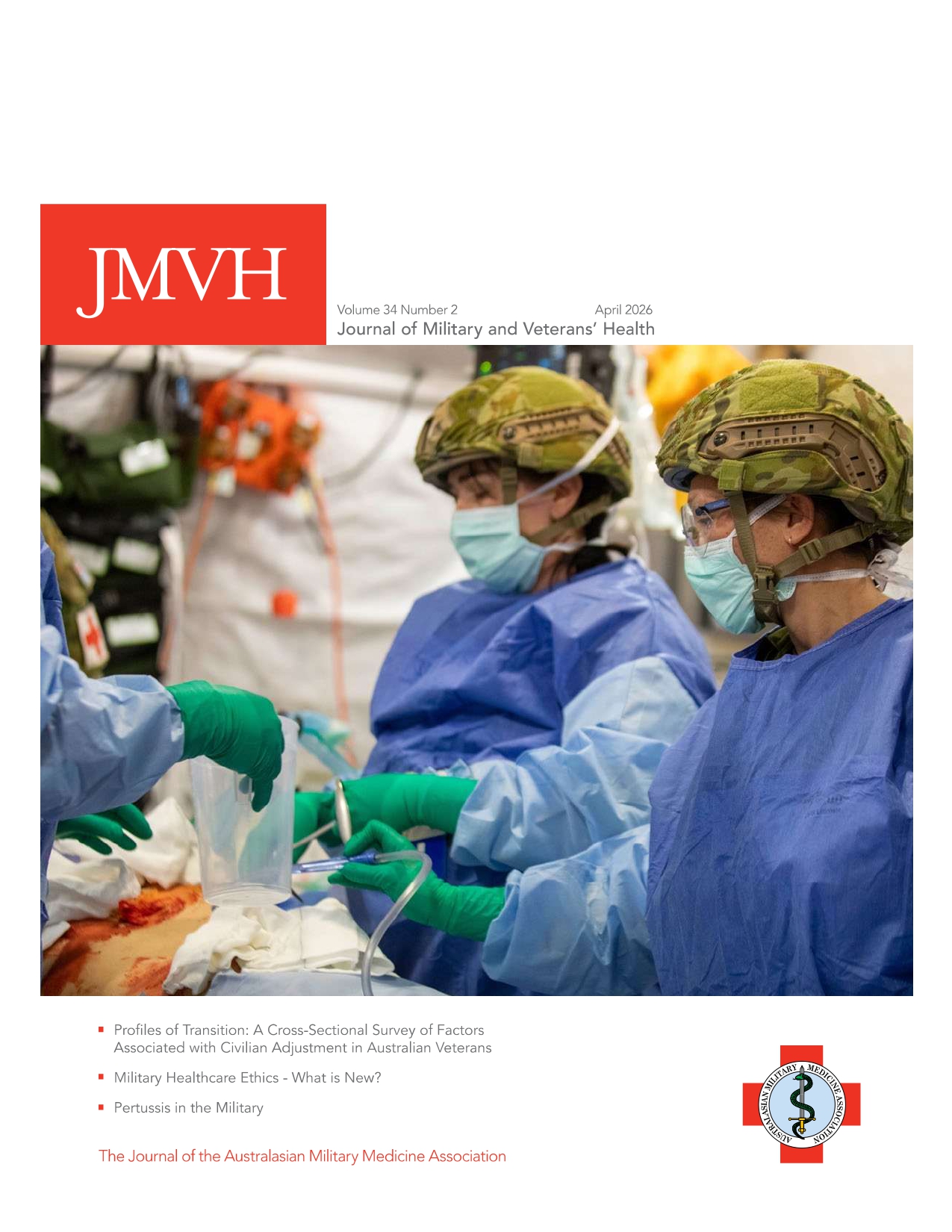
Profiles of Transition: A Cross-sectional Survey of Factors Associated with Civilian Adjustment in Australian Veterans
Abstract Background: This study builds on prior research suggesting that demographics and attributes can better predict positive or negative experiences in the military-to-civilian transition. Purpose: We measured differences in self-reported experience of military-to-civilian transitions on a range of in-service and post-service variables suggested in the literature. Materials and methods: Drawing on a survey of Australian… Read more »
Military Healthcare Ethics —What is New?
Abstract This paper reviews the field of military healthcare ethics since the 2022 review paper published in this journal. NATO STANAG, AMedP-8.19 Military Healthcare Ethics, was published in June 2025. ‘Dual loyalty’ remains at the heart of ethical tensions for military health professionals (MHPs). Current wars in Ukraine and the Middle East challenge the value… Read more »
Periodontitis Cases Superimposed with Mental Health Problems among Military Personnel
Introduction Periodontal diseases affect up to 90% of the global population and have become the most common oral health condition worldwide.1 Periodontitis, one of the well-known periodontal diseases, was estimated at around 62% and severe periodontitis at 23.6% among dentate adults between 2011 and 2020.2 Research on the correlation between periodontal disease and mental health… Read more »
Assessing spiritual wounds and injuries—Some Initial Thinking
Abstract This paper aims to provide some initial thinking on determining the basis for assessment of the existence, severity, and nature of a Spiritual Wound and Injury (SW&I) within an individual. The conditions, behaviours, and Red-Actions (serious, life-threatening, harmful) actions of an SW&I discussed in an earlier paper in this journal1 require a thorough and… Read more »
Mauled by a Lion – How Spiritual Wounds and Injuries Present
Abstract The mauling that some veterans suffer as a result of issues such as shame, anger, self-abuse and depression are very real, lasting and painful aspects of their lives. For a Religious/Spiritual Practitioner (RSP), or indeed any treating practitioner, to make a meaningful contribution towards treating a Spiritual Wound and Injury (SW&I) they must determine… Read more »
The PACT Act of 2022 Changed My Patient’s Life
To: President Biden and all who wrote and passed the PACT Act of 2022 to help veterans. From: David Bittleman, MD, Primary Care Internal Medicine Doctor at VA San Diego, CA. Date: August 7, 2023 J.W. a soft-spoken, Vietnam War Navy veteran has been my patient at the VA San Diego for about 10 years…. Read more »
Social Isolation of War Veterans with Post-Traumatic Stress Disorder Based on Emotional Inhibition: The Mediating Role of Rejection Sensitivity
Abstract War veterans experience significant social isolation due to problems in their cognitive-emotional process. Therefore, the present study aimed to determine the mediating role of sensitivity to rejection in the relationship between emotional inhibition and social isolation in veterans with post-traumatic stress disorder (PTSD). In this descriptive and correlational research, 300 veterans with PTSD, admitted… Read more »
Saint Longinus at the Cross – A Veteran’s Story
Abstract Although other historical and Biblical figures prior to St Longinus have demonstrated many aspects of a Spiritual Wound and Injury (SW&I), Saint Longinus is worthy of specific consideration on several levels. To start with, with his seven simple words, ‘Truly this was the Son of God,’ he is the first person to publicly declare… Read more »
The Case of The Soldier Who Failed to Return: Reflections on Psychodynamic Psychotherapy with Combat Veteran
Abstract The effects of war on combat veterans’ mental health are numerous and well established. Several effective interventions exist based on cognitive–behavioural therapy that aim to reduce the symptoms of anxiety, depression and PTSD that many veterans struggle with. However, little attention has been paid to psychodynamic psychotherapy and documenting its use in treating the… Read more »
Chemical Veterans’ use of Complementary and Alternative Medicines and Quality of Life: a Survey in Southeast Iran
Abstract Background: Chemical veterans are commonly faced with physical, psychological, occupational and social problems. These veterans use relatively high levels of complementary and alternative medicine. Purpose: The current study aimed to investigate the relationship between complementary and alternative medicines (CAM) usage and quality of life of chemical warfare veterans. Material and methods: Three hundred and… Read more »
Travelling Towards Transition – Considerations for the Military Family
Military-to-civilian transition is a complex and active process. Although researchers have concentrated on the experience of the serving member, there has been growing international recognition that transition involves and affects everyone in a military family.1-10 Everyone leaves the military at some point, so the journey out should be an expected one. Drawing on family science, we… Read more »
Experiences of a Prisoner of War: World War 2 In Germany
Re-Print Stephenson Vol 9 No 1 E Stephenson2 On 16 December 1943, I was sitting at the Navigator’s seat in a very noisy Lancaster bomber over Berlin when something occurred that changed the pattern of my life. We had just dropped 13,000 pounds of bombs… a 4,000 pound “cookie” plus incendiaries and we were stooging… Read more »
Can Communication Skills Training for Veteran’s Spouses Increase Positive Communication Patterns?
Fatemeh Bagheri, Maryam Amidi Mazaheri, Akbar Hassanzadeh Abstract Background: War veterans are at risk for lower relationship satisfaction and higher rates of separation and divorce. Addressing communication patterns between veteran’s spouses is crucial in promoting family relationships and marriage stability. Purpose: This study determines communication training’s effect on communication patterns and positive feelings in veteran’s… Read more »
Benefits and Employment and Care for Peer Support Staff in the Veteran Community: A Rapid Narrative Literature Review
C Deans Abstract Background: Veteran services increasingly use peers to support other veterans. There are hypothesised benefits for the service users, service system and peers. Purpose: This rapid narrative literature review sought recommendations for the employment of veteran peers via related reviews: one on the use of mental health peers, and one on the use… Read more »
Psychotropic Polypharmacy in Australian Vietnam War Veterans with Post-Traumatic Stress Disorder: A Descriptive Cohort Study
R Theal, S McLeay, J Gibson, B Lawford, R Mellor Abstract Background: Pharmacological management of complex psychological conditions and physical comorbidities in Vietnam veterans can be challenging, particularly when there are multiple prescribing clinicians. Purpose: To investigate the incidence of psychotropic polypharmacy in a cohort of Australian Vietnam veterans with post-traumatic stress disorder (PTSD). Methods:… Read more »
Post-Traumatic Stress Disorder and Killing in Combat: A Review of Existing Literature
Abstract Background: Killing during combat is a unique experience and, for the majority, is limited to military service. For those working with military and veteran populations, it is essential to be able to understand this experience and any psychological ramifications. Purpose: This review provides a synthesis of existing literature, addressing the specific question: what is… Read more »
Adjunct Activities for Mental Health Improvements for Veterans
T Watt, E Kehoe Abstract The disruptive and at times traumatic nature of military service can create mental health issues among veterans. Wounded, injured or ill personnel, even if their physical and psychological rehabilitation goes well, can experience an acute loss of purpose and structure that is provided during their military service, especially post-discharge. It… Read more »
Disability Reporting Among U.S. Immigrant Veterans: Findings and Implications
Abstract Background: This preliminary study offers the first health-related assessment of United States (US) immigrant veterans, who comprise a population of more than 500 000. It builds upon research showing that a number of variables relate to veterans’ health experiences, including race, ethnicity and socioeconomic status. Purpose: To assess levels of disability reporting among foreign-born… Read more »
Systematic Review of The Impact of Deployment on Respiratory Function of Contemporary International and Australian Veterans’
H Ighani, E Lawrence-Wood, SJ Neuhaus, A McFarlane Abstract Current international literature suggests a higher prevalence of respiratory conditions in military personnel during and following deployment to the Middle East for reasons that are not well understood. Therefore, a systematic review of research into the impacts of deployment on respiratory function among international and Australian… Read more »
Homeless Indigenous Veterans and the Current Gaps in Knowledge: The State of the Literature
J Serrato, H Hassan, C Forchuk Background & purpose: The unique experiences of homelessness for Indigenous Veterans are currently understudied. The purpose of this review was to assess the current literature on homelessness among Indigenous Veterans, to identify the gaps in the existing knowledge base and to provide an insight into future research. Materials &… Read more »
Combat, Posttraumatic Stress Disorder and Health of Australian Vietnam Veteran Conscripts and Volunteers in the Three Decades After Return
B O’Toole, K Pierse, B Friedrich, S Outram, M Dadds, S Catts Introduction Australia’s involvement in the Vietnam conflict from 1962 until troop withdrawal in 1972,1 placed Australians into longer periods of risk of contact with an enemy than at any time in Australia’s history since Gallipoli.2 The Australian Force Vietnam increased in size in… Read more »
Analgesic use in Vietnam Veterans’ with Musculoskeletal Pain
Analgesic use in Vietnam Veterans’ with Musculoskeletal Pain Lisa Kalisch Ellett, Nicole Pratt, Elizabeth Roughead Abstract Background: International studies suggest that high-dose opioid use is more common in veterans with post-traumatic stress disorder (PTSD) than those without in the treatment of musculoskeletal pain. Purpose: This article aims to examine the use of analgesics by… Read more »
Gulf War Illness in the 1991 Gulf War and Gulf Era Veteran Population: An Application of the Centers for Disease Control and Prevention and Kansas Case Definitions to Historical Data
E Dursa, S Barth, B Porter, A Schneiderman Introduction In the initial years following the 1990–1991 Gulf War, reports of a complex array of medically unexplained symptoms began to emerge among US Gulf War veterans.1,2 This cluster of symptoms, which included fatigue, pain, gastrointestinal symptoms, respiratory symptoms, dermatological symptoms, neurological symptoms and cognitive symptoms,3-9 collectively… Read more »
2025 AMMA Conference