

Residential and Inpatient Interventions for Military Veterans within Forensic and Secure Mental Health Services: A Scoping Review
Introduction Armed Forces veterans are at increased risk of developing mental health difficulties, particularly post-traumatic stress disorder (PTSD), depression, and substance use disorders (SUDs).1 This heightened vulnerability is closely linked to exposure to combat-related trauma as well as the complex psychological, social and occupational challenges associated with transitioning back into civilian life.2,3 Suicide rates among… Read more »
Evaluation of Self-Perceptions of Physical Demand and Physical Fitness of Volunteers during the Adaptation Internship of Reserve Officers of the 2nd Class of the Brazilian Air Force
Abstract The recruitment and mobilisation of higher education professionals for temporary military service occurs annually in the Brazilian Air Force occur annually. After the selection process, volunteers complete a Technical Adaptation Internship to prepare future junior officers for the specific conditions of military service. These courses generally last approximately two months and have high physical,… Read more »
The Gender Debate: Effects of 10-weeks Strength Training on Operational Readiness for Females in the Military
ABSTRACT Introduction: Military service is a physically demanding occupation, and fewer women than men meet the military fitness standards, especially in manual handling and load carriage. Therefore, integrating women into physically demanding military roles requires effective physical conditioning programs to ensure operational readiness. Methods: Twenty-eight female soldiers were randomly assigned to either a 10-week gender-specific… Read more »
Medical Corps Disease Mortality during the First World War: Australia vs. Turkey
Medical corps officers were often the ‘canary in the coal mine’ for infectious disease mortality in armies during the pre-antibiotic era. This means that medical officers could be among the first indicators of a serious medical problem (See https://wordhistories.net/2018/03/31/canary-coal-mine). Deployed forces, however, could experience exotic threats, such as malaria and cholera, that could kill both… Read more »
United States Service Members’ Resilience, Wellbeing and Social Support Resources Post-deployment
Abstract Introduction: Military service members encounter numerous stressors post-deployment. Unit cohesion, community, social connections and leadership can serve as resilience support systems and may help improve service members’ wellbeing. This research examines the perceived value of these support systems for service members post-deployment. Methods: A cross-sectional convenience sample of 78 United States military officers (n=54)… Read more »
Burnout, Life Satisfaction, and Social Exclusion Levels of Retired Non-Commissioned Officers and the Relationships Between These Phenomena: The Case of Türkiye
Abstract Background: Research on the social and psychological conditions of retired non-commissioned officers (NCOs) remains limited. Therefore, examining burnout, life satisfaction and social exclusion among retired NCOs is critical. Objective: This study aimed to measure levels of burnout, life satisfaction and social exclusion among retired NCOs in Türkiye and to examine the relationships among these… Read more »
Prevalence of Long-Term Health Conditions in Current-serving, Previous-Serving and Never-Serving Australians: An Age-Adjusted Comparative Analysis using 2021 Census Data
ABSTRACT Background Long-term health conditions (LTHC) are major contributors to morbidity and mortality in Australia and may be more prevalent in Australian Defence Force (ADF) veterans. Previous analyses are limited because they do not control for age and sex confounding or disaggregate by ADF service status. Purpose We aimed to estimate and compare the age-standardised… Read more »
The Influence of Psychosocial Health on Military Performance: Fit for Service?
Abstract When considering military fitness, the focus must be on psychological and physiological ability and thus suitability for service, determinants which are themselves influenced by health. Health, especially in the military context, is the product of several factors (including psychosocial ones), as will be highlighted in the current study. The influence of psychosocial health and… Read more »
Hookworm infections in the Military
Abstract Soil-transmitted helminths such as hookworm are rarely a problem for military units unless they directly contact faecally contaminated soil during tropical operations. Localised epidemics incapacitating small infantry units have been recorded in the Solomon Islands and Bougainville during World War II and in Vietnam, Grenada and Sierra Leone more recently. Scattered hookworm infection cases… Read more »
Editorial – The 1991 Gulf War
Thirty-five years ago, 1872 Australians, including Australian Defence Force (ADF) health personnel, served in the Persian Gulf between August 1990 and the ceasefire in February 1991. While primarily a Royal Australian Navy task group, involving HMAS Adelaide, HMAS Darwin, HMAS Sydney, HMAS Brisbane, HMAS Success and HMAS Westralia in maritime interdiction, sanctions enforcement and replenishment… Read more »
More on the Staff of Asclepius
In a 2010 issue of ADF Health I wrote an article More on the Staff and Serpent of Asclepius (1) describing Asclepian medicine and the Asclepian Temples with a short description of the wooden staff and entwining serpent of Asclepius. At the time I had not found any information on the origin, symbolism or nature… Read more »
Supporting Australian Veterans Presenting with Cognitive Concerns
Introduction Veterans frequently present to general practitioners and non-GP medical specialists with concerns regarding mood, thinking, memory, cognition concerns and in some cases even self-diagnosed dementia Often, the underlying cause is unclear The differential diagnosis might include an undiagnosed mental health condition, a sleep disorder, impacts from alcohol or drug use, dementia, a degenerative neurological… Read more »
Editorial – The Nature and Character of War
Editorial As we enter 2026, consideration needs to be given to various conflicts and touchpoints around the globe, from Ukraine to South Sudan, Middle East to the South China Sea While the Australian Defence Force has not been drawn directly into these conflicts, there remains the potential for escalation, for which we all need to… Read more »
Health Effects of Sport and Volunteering in a Military Context
Abstract When considering military fitness, the focus must be on psychological and physiological ability, which are themselves influenced by health. Health itself is a product of several factors, as will be highlighted in the current study. To assess health and its implications in a military context, a questionnaire was administered to 555 participants during and… Read more »
Building Strength at Home: Addressing Domestic and Family Violence to Prevent Suicide in Australian Defence Communities
Introduction The Royal Commission into Defence and Veteran Suicide has drawn national attention to the urgent need to address suicide among serving and ex serving members of the Australian Defence Force (ADF).1,2 The Commission report includes a series of important recommendations to reduce the prevalence of suicide, many of which are underway Nevertheless, one significant recommendation… Read more »
Relations Between Physical and Emotional Health and Psychological Stress in Trauma-Exposed Veterans with Emotional Disorders
Abstract Background: Exposure to potentially traumatic events (PTEs) is common, especially in veterans. There are psychological sequelae to PTE exposure, including stress and anxiety pathology, depressive symptoms, and PTSD. Identifying veterans at risk for elevated psychological distress following PTEs, as well as distress correlates, is critical to improving mental health screening efforts and minimising downstream… Read more »
Comparing Sense of Control between Veterans and Civilians using the Health and Retirement Study
ABSTRACT Background: Sense of control has been associated with age-related outcomes. Veterans may experience a reduced sense of control due to the sacrifices associated with military service—potentially contributing to increased health problems in this population. Purpose: This study seeks to understand how military service affects the sense of control in older veterans in the United… Read more »
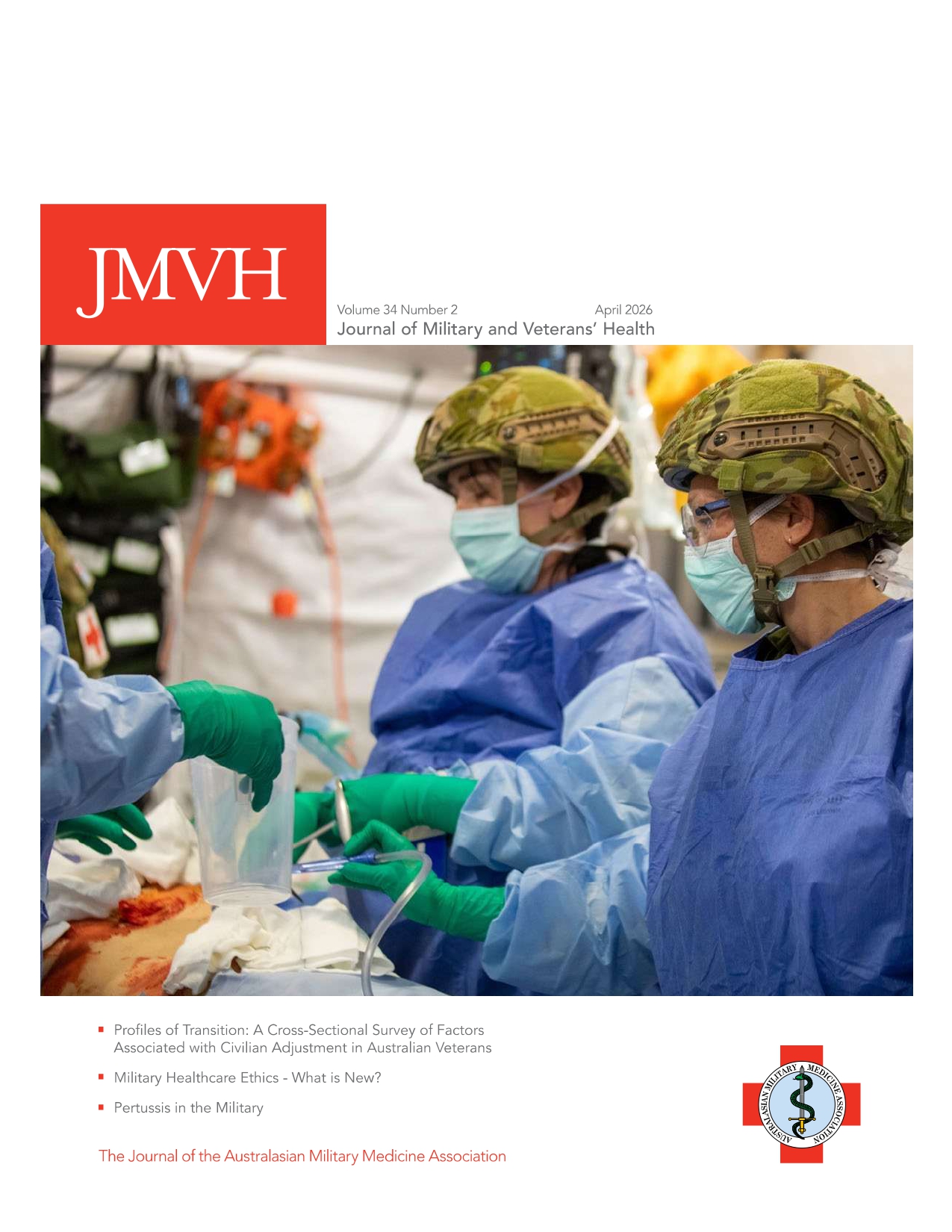
Profiles of Transition: A Cross-sectional Survey of Factors Associated with Civilian Adjustment in Australian Veterans
Abstract Background: This study builds on prior research suggesting that demographics and attributes can better predict positive or negative experiences in the military-to-civilian transition. Purpose: We measured differences in self-reported experience of military-to-civilian transitions on a range of in-service and post-service variables suggested in the literature. Materials and methods: Drawing on a survey of Australian… Read more »
Military Healthcare Ethics —What is New?
Abstract This paper reviews the field of military healthcare ethics since the 2022 review paper published in this journal. NATO STANAG, AMedP-8.19 Military Healthcare Ethics, was published in June 2025. ‘Dual loyalty’ remains at the heart of ethical tensions for military health professionals (MHPs). Current wars in Ukraine and the Middle East challenge the value… Read more »
Periodontitis Cases Superimposed with Mental Health Problems among Military Personnel
Introduction Periodontal diseases affect up to 90% of the global population and have become the most common oral health condition worldwide.1 Periodontitis, one of the well-known periodontal diseases, was estimated at around 62% and severe periodontitis at 23.6% among dentate adults between 2011 and 2020.2 Research on the correlation between periodontal disease and mental health… Read more »
The Dark Night of the Veteran’s Soul – Understanding the Impact of Spiritual Wounds for Australian Veterans
M Davies Abstract Background: Figures from the Department of Veterans’ Affairs indicate there may be over 30,000 Australian veterans that have or may yet develop some form of service-related mental illness. There is a growing body of evidence that there is a spiritual dimension to soldiers’ wounds. Purpose: The purpose of this paper is to… Read more »
Tobacco Use in a National Sample of United States Service Member and Veteran Students
D Albright, K Fletcher, K Thomas, J McDaniel, A Diehr, J Bertram, D Cobb Abstract This study explored tobacco use in a national sample of service member and veteran students enrolled in postsecondary institutions with the purpose of informing the development of a tobacco cessation initiative by identifying factors associated with the use of cigarettes,… Read more »
Veterans’ attitudes towards discussing sexual practices and sexual orientation with therapists
M Vendlinski, G Simons, J Yen, S Larsen Abstract Background: It is widely recommended that sexuality be discussed during health-care assessments and treatment. Health-care providers often do not raise the topic of sexuality, even though patients typically welcome these conversations. Purpose: The current study examines whether veterans report having discussions about sexuality with their psychotherapists…. Read more »
The Psychological Adjustment Experience of Reintegration Following Discharge from Military Service: A Systematic Review
M Romaniuk, C Kidd Abstract Background: Previous literature has noted a substantial proportion of veterans experience difficulty reintegrating into civilian society following discharge from military service, which may have a significant impact on their psychosocial functioning. Purpose: This review aimed to identify, describe and thematically synthesise literature on veteran reintegration following discharge from military… Read more »
Comorbidity Risks of a Cohort of Vietnam Veterans Diagnosed with Post-Traumatic Stress Disorder
T Bullman, A I Schniederman Abstract Background: Research has demonstrated that posttraumatic stress disorder (PTSD) is associated with increased risk of other mental diseases. Studies have also reported increased risk for cardiovascular diseases associated with PTSD. Purpose: This study examined cause-specific comorbidity risks among a cohort of Vietnam veterans diagnosed with PTSD. Material and… Read more »
Examining Moral Injury Awareness in a Clinical Setting
M Kopacz, G L Charpeid, L A Hollenbeck, J Lockman Abstract Moral injury is a relatively novel clinical construct recognized as a focus of concern in some military veteran populations. This short communication presents findings from a descriptive survey examining awareness of moral injury in a clinical setting specialized in veteran health services and treatment…. Read more »
A Needs Assessment for Developing a Web-based Social Support Program for Student Veterans
P Adams, HS Lee, B Holden Introduction According to the United States Office of Accountability,1 more than 5 million members will transition out of the military by the year 2020. Many of these veterans are looking to higher education as their next step to re-enter civilian life. Since 2009, more than 1.4 million military veterans… Read more »
A Comparison of Poisoned Patients at Military and Veterans Administration Hospitals
S Carstairs, S Nordt, J Ziegler, F Cantrell Introduction The state of California is home to greater than 168,000 active-duty military personnel, more than any other state in the United States of America1. Additionally, there are more than 2 million military veterans in California2, many of whom utilise Veterans Administration hospitals for their healthcare3. Little,… Read more »
Dispositional Anger and Experiential Avoidance in Veterans with PTSD
A Santanello, M Toohey, O Van Orden, M Soll, S Batten Background: Anger is often indirectly addressed in posttraumatic stress disorder (PTSD) treatment despite reports that traumafocussed therapy may not be suf cient in improving anger responses1 Thus, it is possible that anger in the context of PTSD might be related to additional factors such… Read more »
Serum Level of Nutritional Antioxidants are Decreased in Veteran Smokers with COPD
Corrine Hanson, Elizabeth Lyden, Lisa Weissenburger-Moser, Jeremy Furtado, Debra J. Romberger and Tricia D. LeVan Introduction Chronic Obstructive Pulmonary Disease (COPD) is the third leading cause of death in the U.S. and worldwide,1-4 resulting in an economic and social burden that is both substantial and increasing. Veterans are a group of people who are disproportionately… Read more »
Risk of Suicide Among Veterans with Traumatic Brain Injury Experiencing Homelessness
B. Palladino, A. E. Montgomery, M. Sommers, J. D. Fargo Introduction Suicide is the tenth leading cause of death in the United States; during 2013 more than 41,000 individuals died as a result of self-inflicted injury, a rate of 13 suicide deaths per 100,000 individuals1. The rate of suicide among the 22 million veterans in 2013 was almost three… Read more »
Effects of deployment on mental health in modern military forces: A review of longitudinal studies
Abstract Background. Earlier studies presenting evidence that operational deployment negatively affects mental health outcomes among military personnel and veterans generally have lacked conclusiveness, largely because of cross-sectional or retrospective design. Purpose. To review longitudinal studies investigating mental health outcomes of military personnel deployed in recent conflicts. Methods. MEDLINE database was searched using relevant keywords and… Read more »
Comparing PTSD Among Returning War Veterans
Military personnel experiencing combat in Iraq and Afghanistan are suffering wounds that are much greater in number and variety than those endured by veterans of earlier wars. This circumstance is due, in part, to advances in medical science and technology. Soldiers, sailors and marines who suffered such severe wounds in earlier wars simply died because… Read more »
Assessing Suicide Risk in Veterans: The Role of the Nurse Practitioner
Abstract Background: Statistics have shown that veteran men and women are at greater risk for suicide than the general population. In order to decrease the incidence of suicide in veterans, nurse practitioners (NPs) and other health care professionals must not only become more aware of the risk factors for veteran suicides but also develop strong… Read more »
2025 AMMA Conference