

Abstract:
Counterinsurgency operations over a century ago were marked by casualty lists dominated by infectious diseases, not combat injuries. For decades, Dutch soldiers fought in Aceh Province of the then Netherlands East Indies (NEI, now Indonesia) to incorporate the Muslim Sultanate into their colonial empire. Mortality rates of up to 160/1000 in 1874 were more than 10 times that experienced by Dutch soldiers in the Netherlands and largely consisted of infectious diseases such as cholera and malaria. The Philippine Insurrection, which followed the Spanish–American War of 1898–99, was a long guerrilla war fought by US Army soldiers throughout the Philippine Islands. Disease mortality exceeded combat losses, but was not at the same scale (mortality 18/1000 in 1901) as those seen earlier by the Dutch in Aceh. By the early 20th century, infectious disease mortality during colonial counterinsurgency operations was much lower due to a better understanding of micro-organisms, even if chemotherapy was still largely a promise for the future. Infectious disease casualties were previously important in Southeast Asia and will become so again in unprepared military groups that ignore the hard lessons of history.
Key words: historical epidemiology, military mortality, geography, malaria, cholera
The Sultanate and Acehnese resistance continued for many decades after the Dutch Annexation. The colonial forces were now, in effect, besieged in Banda Aceh, losing some 150 men each month from cholera.1
Counterinsurgency is a form of attritional warfare in which there is a large imbalance between the two opposing forces. Historically, this occurred in the 19th century when colonial empires forcibly incorporated smaller political groups in Africa and Asia. Known from Rudyard Kipling as the ‘savage wars of peace’, these small-scale conflicts often incurred proportionally large casualty rates.2 Imperial conflicts against tribal opponents can be seen as critical to the formation of tropical medicine in the 19th century, which initially was directed at keeping soldiers and administrators healthy in hot climates.3 Mortality rates during the extended Dutch efforts to conquer Aceh in northern Sumatra and the USA colonisation of the Philippines following the Spanish–American War were examined as examples of the human cost of counterinsurgency warfare. In both cases, infectious diseases were the predominate killers of soldiers. Although tropical medicine rapidly evolved in the latter half of the 19th century to better address microbial diseases, the threat of infectious disease to unprotected soldiers persists for those unwilling to learn the harsh lessons of earlier counterinsurgency campaigns.
In the 19th century, Aceh was a small Muslim Sultanate wedged between the British and Dutch Empires, which was the source of most of the world’s pepper. When the Anglo–Dutch treaty of 1871 traded British interests in Sumatra for Dutch occupation of the Gold Coast in West Africa, wars resulted with the Dutch trying to incorporate Aceh into the Netherlands East Indies and the British fighting the Ashante for what eventually became Ghana.1,4 Neither conflict went well. A sequence of colonial wars resulted in a decades-long struggle between empires seeking to extinguish the independence of local political entities. The initial Dutch efforts were repulsed by the Acehnese, prompting a naval blockade, which was then resumed with greater military forces. The 1874 campaign drove out the Sultan of Aceh, who soon died of cholera. Many of the Dutch soldiers, whose influence was largely limited to a few urban centres, while irregular forces controlled the countryside, also died. Various strategies for raising local military forces, which became more common in later history, were tried to both co-opt and control the Acehnese population.5 Eventually, a targeted pattern of village burning and selective killing by General Van Heutz crushed Aceh in 1898–1904. However, the province remained restive and unreconciled to its subordinate status.6 Aceh is still, more than a century later, at times subject to armed conflict.7
Dutch casualties in Aceh made colonial service a high-risk proposition compared to staying in the Netherlands, as seen in Figure 1. Mortality in Dutch soldiers in Aceh peaked at more than 10 times the stable rates in the Netherlands, as denoted in the original military statistics collected by Prof Curtin in his landmark 1989 study Death by Migration.8 Although it is not possible to completely differentiate disease and combat deaths, the predominate causes of death were from infectious diseases, particularly enteric infections such as cholera. Mortality was always high when soldiers were in the field away from their barracks, as in 1874, when mortality peaked at 160/1000. As fighting ebbed and medical officers became more familiar with better ways to provide clean water to soldiers, the deaths from cholera fell, even though it remained a major killer of the displaced civilian communities in Aceh.1,9 By the beginning of the 20th century, it was still risky for Dutch soldiers to take part in campaigns in the NEI. However, one’s chances of dying were not as extreme as earlier in the 19th century, before prophylactic quinine for malaria and immunisations for typhoid fever.3,10
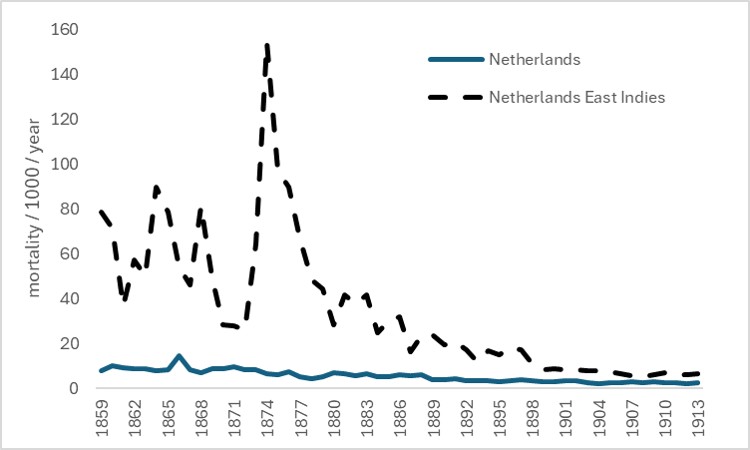
Figure 1: Mortality rates in Dutch soldiers either in the Netherlands or NEI (Indonesia) in the 19th century from contemporary statistics collected from sources by PD Curtin.8 Mortality during active operations in Aceh was still largely due to infectious diseases such as cholera and malaria.
The US Army had not experienced mass casualties since the Civil War, as most of the 19th century involved frontier duties to suppress various American Indian tribes.11 The Spanish–American War, 1898–1899, changed the USA’s global outlook and gave it an inherited empire from Spain, which included the Philippines. During the War, the main lethal infectious disease was typhoid fever in recruit camps, which accounted for >80% of all deaths.12 Death in the US Army on such a scale was shocking to a public not expecting to see mass burials of flag-draped coffins in Arlington National Cemetery, as in Figure 2. The short, sharp conflict against Spain, remembered mostly for Admiral Dewey sinking the Spanish fleet in Manila, morphed into an ugly counterinsurgency war against the Filipinos, who had not expected to be annexed by the USA. Conflict in Luzon was driven by the same elite group that dominated local politics, but this made it difficult to arrange an archipelago-wide guerrilla war.13 Deploying a mixture of US Army regular and volunteer forces peaking at nearly 60 000 total strength, the independence movement was crushed in Luzon by 1902, and this pacification process was gradually transferred to other islands. This worked for the colonial authorities, except in the south, where Muslim Moro tribes were fiercely independent and reminiscent of similar groups on Aceh.14 Violent suppression conducted largely by Philippine Scouts and Constabulary led by a young John Pershing crushed the Moros in their mountain refuges. It enabled Pershing to advance to the rank of senior officer during World War I.
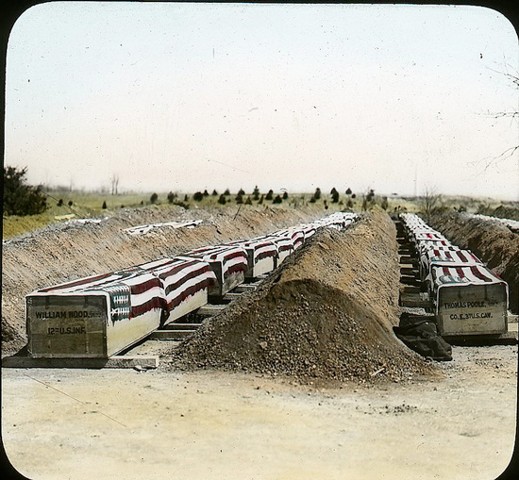
Figure 2: Photograph of US Army dead from the Spanish–American War about to be buried in Arlington National Cemetery, Virginia, USA in 1899. The vast majority of those dying in US colonial wars were from infectious diseases, particularly typhoid and yellow fever. photographer EB Thompson. In the public domain https://www.flickr.com/photos/dcplcommons/4225801231
The racial composition of casualties matters in counterinsurgency warfare, and much of the later fighting was done by Filipino soldiers led by US Army officers. Figure 3 shows the mortality rates, which were predominantly due to infectious diseases such as malaria and typhoid fever. The scale of mortality in the Philippines was very similar (<20/1000 per year) to that occurring at the same time in Dutch soldiers in Aceh. There was a substantial mortality risk premium paid by US soldiers in the Philippines compared to their comrades stationed in the USA, as well as by the Filipino soldiers recruited locally by the US Army.15 As the insurgency waned, however, all three groups’ mortality rates fell such that by the end of the first decade of the 20th century, there was little mortality differences, all of which were under 10/1000 per year. Some of this was due to advances in tropical medicine as universal typhoid and smallpox vaccines became mandatory for soldiers. Prophylactic quinine reduced malaria risk, but this risk remained substantial during rural patrol duties. Better military barracks with screening to keep out mosquitoes and water sources free of faecal contamination made the life of the US soldier in the Philippines almost as safe as service back in Texas or Hawaii.
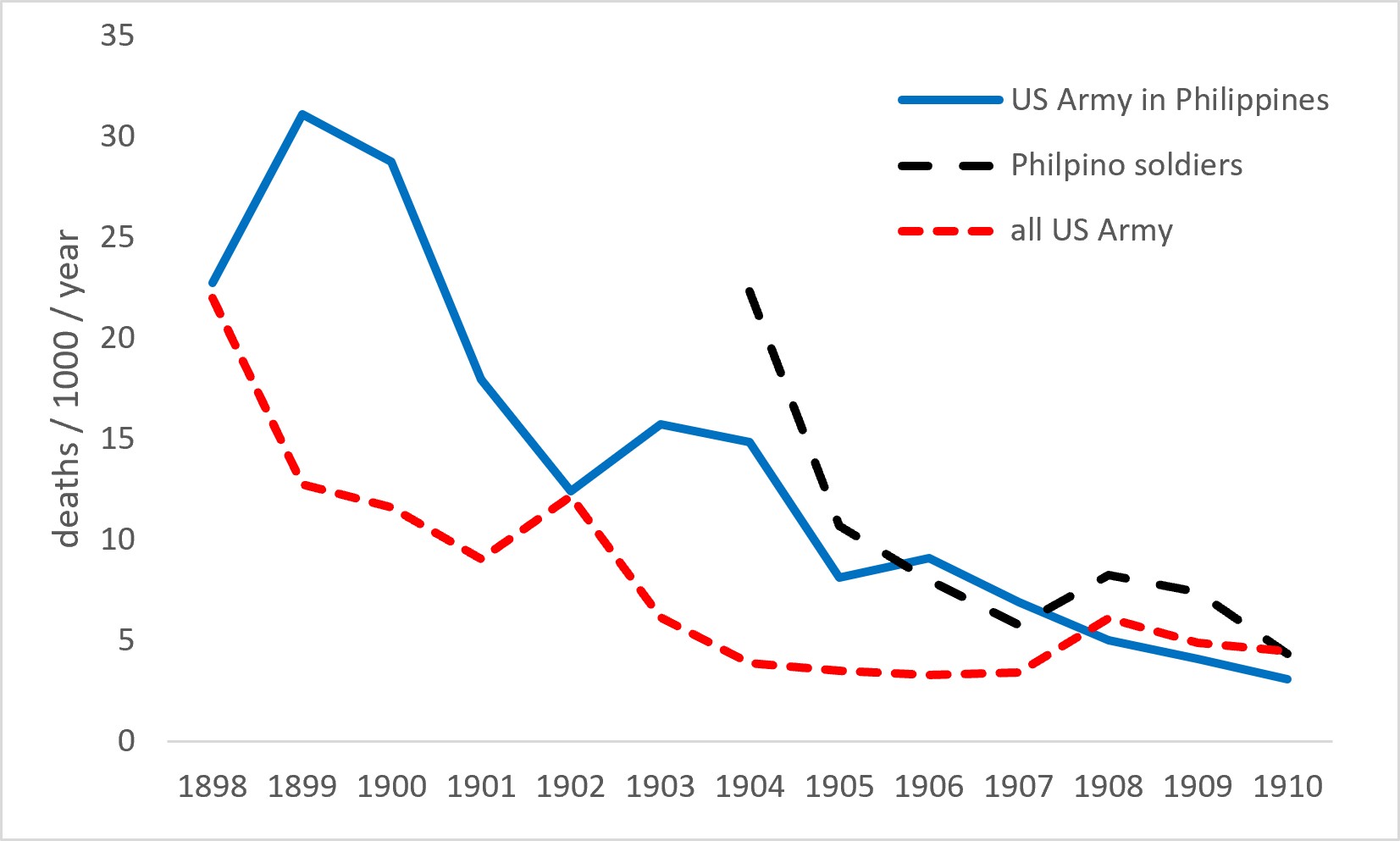
Figure 3: Mortality rates in US Army soldiers in the USA or Philippines and Filipino soldiers recruited into the US military during the beginning of the 20th century during the Spanish–American War (1898–99) and the subsequent Philippines Insurrection (1900–13). Taken from Annual Reports of the US Army Surgeon General.15
Counterinsurgency wars of the 19th century were difficult and often indecisive conflicts marked by large numbers of western soldiers pursuing small groups of local militia across tropical environments known for infectious diseases. Logistics determined what was operationally possible, but colonial wars were more than a dangerous blood sport for European adventurers. Infectious diseases hung over all tropical operations but were beginning to yield to scientific interventions from the mid-19th century, when the Pasteurian revolution conceptually replaced miasma-based theories of disease with those of micro-organisms. Quinine, in appropriate doses, could suppress malaria infections in large troop formations, giving the Union Army a critical advantage over its Confederate opponents.16 Quinine was poorly tolerated, but it would take a major military scientific effort during the Second World War for it to be superseded by synthetic alternatives.17 Typhoid fever was the predominant killer of the Spanish–American War, but within a decade, all US Army soldiers were being immunised with a good, but reactogenic vaccine.12 Cholera was stopped by insisting that soldiers have safe water sources, even if this basic hygiene measure failed when soldiers were confined in World War II prisoner of war camps with captors mentally stuck in the 19th century.18 The physiological treatment of cholera’s dehydration would have to await further scientific discoveries of salt exchange in the human gut by CAPT Phillips of the US Navy at midcentury, which yielded life-saving oral rehydration salt packets.19 Measles was a great killer of western soldiers, but after World War I, most had encountered the virus as children and did not have to wait until the later 20th century for measles vaccine to arrive.20 Tetanus was a major threat to soldiers during World War I. However, the temporising use of millions of doses of horse antiserum gave way by the Second World War to effective toxoid immunisation.21 Tetanus was only a problem in Second World War armies that refused to immunise against it, such as the Imperial Japanese Army. As shown in the mortality graphs, military medicine eventually developed means to prevent or treat them. The lesson of 19th-century colonial warfare is not that modern armies can ignore such terrible examples. However, well-prepared groups of soldiers can even enter tropical areas known for high rates of infectious disease casualties and conduct operations when necessary. The lesson of history is to adequately immunise and prepare soldiers before sending them into the tropics, as the current infectious disease ecology is still very similar to that faced by our predecessors in the 19th century.
Author affiliations: Australian Defence Force Infectious Disease and Malaria Institute, Gallipoli Barracks, Enoggera, Queensland, Australia
University of Queensland, School of Public Health, Brisbane, Herston, Queensland, Australia
Funding: No specific funding was given for this work. The author is an employee of the Australian Defence Force, a retired US Army officer and claims no conflicts of interest.
Disclaimer: The opinions expressed are those of the author and do not necessarily reflect those of the Australian Defence Force or the US Department of Defence.