

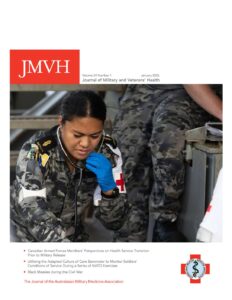
Volume 34 Number 1

Download the whole edition here.

Canadian Armed Forces Members’ Perspectives on Health Service Transition Prior to Military Release

Abstract In Canada, military-to-civilian transition (MCT) involves transitioning from military to civilian primary care. This is an important but underexplored aspect of MCT. We investigated releasing military members’ perspectives on the transition from military to civilian primary care by analysing previously collected interview data from 69 Canadian military members. We found that participants were apprehensive… Read more »

By Ashley Catherine Williams , Catherine Donnelly , David Pedlac and Heidi Cramm In   Issue Volume 34 Number 1 Doi No https://doi-ds.org/doilink/05.2025-31899449/JMVH

Assessing the Role and Employability of Military Advanced Practitioners in Deployed Pre-hospital Setting: A Qualitative Interview Study

Key messages APs support healthcare delivery and workforce flexibility in deployed PHEC environments. Military APs are autonomous and have the potential to operate independently in the Defence Medical Service and remote pre-hospital care. Multi-professional trust is key to AP autonomy in military pre-hospital care, but standardised roles and careers are needed to overcome hierarchical barriers… Read more »

By Elizabeth Paxman , Joanne Turnbull and Jane Prichard In   Issue Volume 34 Number 1 Doi No https://doi-ds.org/doilink/06.2025-15437394/JMVH

Utilising the Adapted Culture of Care Barometer to Monitor Soldiers’ Conditions of Service during a Series of NATO Exercises

Abstract Background: Working conditions have a significant impact on job-related performance, and in the military context, this can affect the outcome of exercises and missions. Therefore, the scientific recording and consequentialist improvement of soldiers’ conditions of service is important. Purpose: This study aims to contribute to a deeper understanding and potentially improve the wellbeing and… Read more »

By Philipp Georg Schnadthorst , Felix Weinreich and Lisa Geerkens In   Issue Volume 34 Number 1 Doi No https://doi-ds.org/doilink/07.2025-28331255/JMVH

Black Measles during the Civil War

Abstract Black measles (Rubeola nigra) was understood to be an infrequent, severe subtype of measles defined by a very dark, nearly confluent rash in the 19th century. During the US Civil War (1861–65), measles epidemics killed many military recruits on both sides, with a case-fatality rate of 2%. Medical officers described black measles as appearing… Read more »

By G. Dennis Shanks In   Issue Volume 34 Number 1 Doi No https://doi-ds.org/doilink/06.2025-76698846/JMVH

Military Mortality on Pacific Islands: Implications for Future Armed Conflicts

Abstract: Future armed conflict in the Indo-Pacific region may see small detachments of soldiers deployed on isolated Pacific Islands for extended periods. Historical experiences with such deployments, particularly during World War II, are reviewed to give insight into possible medical problems and their countermeasures. The 8th Division of the Second Australian Imperial Force (2 AIF)… Read more »

By G. Dennis Shanks MD, MPH In   Issue Volume 34 Number 1 Doi No https://doi-ds.org/doilink/08.2025-56489434/JMVH

We Dare Not Fail: Preparing Junior Military Medical Officers for 21st-Century Conflict

‘The mothers and fathers of America will give you their sons and daughters…with the confidence in you that you will not needlessly waste their lives. And you dare not. That’s the burden the mantle of leadership places upon you… It is an awesome responsibility. You cannot fail. You dare not fail…’ – General H Norman… Read more »

By Mason Hill Remondelli , Joseph Rhee , Matthew J Bradley , Rebekah Cole and Eric A Elster In   Issue Volume 34 Number 1 Doi No https://doi-ds.org/doilink/07.2025-81824585/JMVH