
Abstract
This paper proposes a SW&I Spiritual Health Protocol–Provisional (SW&ISH–P) that will expand on the spiritual aspects of the treatment and management of Spiritual Wounds and Injuries (SW&I) previously discussed in this journal.1 It is set against the fundamental principle that the SW&I is likely to occur within a broader injury context and, as such, must be delivered as part of a bio-psycho-social-spiritual approach within a continuum of care, from screening to treatment.2
The protocol will firstly define a form of SW&I handover between Defence and the Department of Veterans Affairs (DVA). Following this, it will explore options for well-developed, validated and monitored care. This will include a review of existing spiritual and other approaches to spiritual health care. There will also be an examination of the purpose of treating SW&I, and a discussion of how such spiritual and religious activity sits within a secular state. Finally, and based on the assumption that each of these approaches has utility and value, they will be set in a broader management protocol proposed for the appropriate and directed care of SW&I. The SW&ISH–P is provisional; although it is based on research to date, it will require further development that is outside the scope of this paper. This will include confirming the steps identified to date and developing a more comprehensive set of treatment and management approaches. Commentary and advice from readers will be most welcome.
Introduction
In a previous paper in this journal, a soldier was lying on a table, surrounded by several practitioners.1 Each practitioner would be highly skilled in their field and would undoubtedly take every step to restore that soldier to fighting condition, so they could return to battle or to service in general. Unfortunately, that may not be fully possible, and the soldier may have to be medically discharged. Of course, it may not be quite so dramatic. At some point in their journey, the soldier may reach a point when professional, family or other issues lead them to transition to a Reserve role voluntarily or leave the Service completely. In both cases, the Department of Veterans Affairs (DVA) takes over their care, predominantly utilising civilian commercial firms and organisations.
What of the case of a soldier who wondered whether God still loved him as he ‘had to’ shoot two insurgents who were about to attack his position?3 He is possibly suffering from a Spiritual Wound and Injury (SW&I). This condition can be helped, in part, by complementary disciplines such as psychology or psychiatry. However, ultimately, the treatment will also require the professional skill and training of a Religious/Spiritual Practitioner (RSP). There are several aspects to meeting this soldier’s needs. The first is a handover between Defence and DVA. In the case of a soldier with a medical or psychological condition, aspects of the individual’s case history and medical notes are shared between the two agencies. This does not occur with their spiritual history or circumstances. The second is the delivery of well-developed, validated and monitored care. Finally, there is the management of appropriate, directed care for their SW&I. In some cases, this does occur, but it is at best ad hoc and driven mainly by the veteran. The process lacks a body of accepted treatment methodologies, management or support from the DVA, or any formalised support from any of the major faith groups.
Aim
This paper proposes a SW&I Spiritual Health Protocol–Provisional (SW&ISH–P) for the treatment of SW&I. In particular, the paper aims to develop a provisional working model of a process that can be applied by RSP and supporting healthcare professionals.
Methodology. The paper is based on the management of spiritual damage as part of a holistic bio-psycho-social-spiritual approach within a continuum of care, from screening to treatment.2 Initially, it is important to discuss where the treatment of SW&I sits within a modern, western and secular state such as Australia. From this position, the paper will build the protocol in three steps. The first step will be to discuss the SW&I handover between Defence and DVA. The second is to explore options for well-developed, validated and monitored care. This will entail reviewing existing spiritual and other approaches to spiritual health care. Finally, and assuming each of these approaches has utility and value, they will be integrated into a broader management protocol that establishes a vision for the appropriate and directed care of SW&I.
Limitation. The SW&IA–P is provisional; although it is based on research to date, it will require further development that is outside the scope of this paper. This will include confirming the processes identified to date and developing a more comprehensive set of treatment and management approaches. It is anticipated that pilot activity will also be necessary to validate this model, although this requires further analysis outside the scope of the paper.
Spiritual care in a secular state
There is an argument that a modern, democratic, and secular state such as Australia should not seek or accept a role in the spiritual care, treatment and management of serving Defence personnel and veterans. Many countries, such as Australia, subscribe to the concept of the separation of church and state. This concept is often credited to the writings of the English philosopher John Locke (1632–1704), with the term itself taken from Thomas Jefferson’s (1743–1826) writings on a wall of separation between church and state.4,5 It is essentially a philosophical and jurisprudential concept that argues for political distance between religious organisations and the executive and bureaucratic organs of a nation-state. In Australia, this concept is supported by the Constitution (Section 116), which directs that the ‘Commonwealth shall not make any law for establishing any religion, or for imposing any religious observance, or for prohibiting the free exercise of any religion…’6
There is, however, one compelling argument why a secular state such as Australia should not only seek, but wholeheartedly accept a role in the spiritual care, treatment and management of serving Defence personnel and veterans. This argument is based on the concept of restoration. Restoration is the act of restoring something to a person who has previously been deprived of it; it is the return of something lost or stolen.7 Imagine if the soldier on the stretcher had suffered from a badly broken leg. Treating this is a medical procedure, and the doctors would have followed a well-practised, standard protocol for resetting the bone. The soldier would then have been evacuated to a field or general hospital for recovery. During this period, medical staff would have helped the soldier restore their leg to its former state.
Most militaries go to extraordinary lengths to care for injured soldiers. Some of this is to preserve the morale of the overall group by demonstrating that they will be cared for if they are wounded or injured while placing themselves in danger. Pragmatically, the bigger concern is personnel management and maintaining the unit or organisation’s capability to fight. Ultimately, Defence medical and healthcare services aim to return injured personnel to a fighting state as soon as possible. As the ADF Health Strategy notes, the Defence Health System, in collaboration with health industry and academic partners, will be critical to ensuring the ADF’s health capability is ready to meet these emerging challenges.8 There is no presumption that individuals will be better/stronger/faster than before treatment or that purely cosmetic issues will be managed.
Once the soldier leaves the service, any future care passes to DVA, whose role will be to support the physical wellbeing and quality of life of eligible persons and their dependents through health and other care services that promote early intervention, prevention, and treatment, including advice and information on health service entitlements.9 DVA assumes responsibility for the restoration or ongoing care of the soldier’s leg without any presumption of improving or enhancing the veteran’s capabilities beyond their initial state.
Defence has long recognised that spirituality is part of some soldiers’ lives and that this needs to be supported. For example, the Royal Australian Army Chaplains’ Department personnel have served on every deployment since WW1 and today have over 100 military Chaplains. Their role is to provide spiritual, religious, and pastoral support to all ADF personnel and their families in a range of peacetime and operational environments. Additionally, they provide timely, accurate and relevant advice to Commanders and staff on matters relating to spiritual, religious and pastoral wellbeing, personal morality, ethics, character formation and morale.10
In the event of a SW&I while serving, the role of the Defence Chaplain will be to treat or manage the individual to return them to duty. Uniquely, Defence Chaplains offer ecumenical support, representing their respective faiths while providing spiritual guidance to members of any faith, as well as to agnostics and atheists. Defence Chaplains do not seek to convert, evangelise, proselytise or foster their specific faith or religion in general.
Following evidence given before the Royal Commission into Defence and Veteran Suicide, DVA recently recognised the important role that chaplains can play in suicide prevention and care. A pilot program was launched to support veterans and families undergoing complex or challenging transitions from ADF Service. The program sought to utilise serving and transitioned ADF Chaplains to provide this care, as they are familiar with veterans’ and their families’ experiences and the context of military life.11 The SW&I concept is new, but it is not an overdiagnosis of existing conditions as an arbitrary step to distinguish it from moral injury (MI) or PTSD or to establish some form of religious or spiritual agenda. The critical point that the volume of scholarship makes clear is that traumatic events significantly affect an individual’s spirituality.
There is no suggestion that Governments have a role in fostering the growth and spread of religion. This is about managing injury and damage that has occurred while individuals were serving their nations. These injuries are multidisciplinary and cross medical, moral and spiritual borders.
SW&I – Spiritual health care approaches
Typical approaches to SW&I care are detailed in the World Health Organization’s (WHO) International Classification of Diseases (ICD) under the heading of pastoral care. This provides a good basis for the treatment and management of SW&I. It notes:
‘An expression of pastoral care that includes personal or familial counsel, ethical consultation, a facilitative review of one’s spiritual journey and support in matters of religious belief or practice. The intervention expresses a level of service that may include counselling and catechesis for example, and the following elements may be identified:—emotional/spiritual counsel, ethical consultation, religious counsel/catechesis, spiritual review, death and dying pastoral ritual/worship. This intervention contains the pastoral expressions of informal prayer and ritual for individuals or small groups, and the public and more formal expressions of worship, including Eucharist and other services, for faith communities and others. Elements of this intervention may include: (a) private prayer and devotion, bedside Communion and Anointing services, and other sacramental and ritual expressions; (b) public ministry—Eucharist/Ministry of the Word, funerals, memorials, seasonal and occasional services.’12
Ultimately, spiritual, medical and healthcare efforts aim to restore injured personnel to fighting capability and, as a secondary goal, to a life as close as possible to their previous state. Practitioners in these fields may also aim to build physical and mental resilience, enabling individuals who may be exposed to the same conditions again to cope better and survive.
The order and sequence are important here. Individuals who have a mental illness may be vulnerable and easily swayed towards a particular approach. From a medical perspective, this may lead veterans to seek alternative opinions for subsequent treatment of their conditions. Sadly, not all practitioners offering such options may be helpful. The same applies to an SW&I. An SW&I is not an easy pathway to evangelism or proselytisation, despite an RSP’s calling, mission or zeal. The first order of business is to address the SW&I at hand and to seek to return the individual to a religious and spiritual schema as close as possible to the pre-event or incident state.
As a secondary goal, there may be an opportunity to deepen the individual’s faith or religious understanding, helping them build spiritual resilience to cope with the same conditions if faced again. If an individual then chooses a more fulsome spiritual path and a closer relationship with God, that is wonderful. Still, it is not the aim of SW&I management, nor is this something a government-based and publicly funded veteran’s administration is responsible for doing. The cut-off point for management and treatment of a SW&I should be restoration.
Noting the preceding discussion, a structure such as the SW&IAT–P is important for three reasons:
- Foundational. The proposed SW&IAT is a multifaith tool and is not based on or subject to any religious doctrine, dogma or belief. It seeks to establish a common language for managing SW&I across religious groups and for supporting secular discipline. The focus is squarely on the overall structure for managing treatment, not on the treatment itself, whether secular or religious.
- Descriptive. After a medical or psychological practitioner assesses a client or patient, they will develop a written management or treatment plan. The RSP also needs to develop similar plans. In doing this, the RSP provides documentation of their approach, which may be necessary for later treatment issues, including the handover of the patient between treating professionals. It is unlikely that this will be a purely sequential approach, but at various points, one of the disciplines will need to lead the treatment regime for a period. Accordingly, a seamless handover between practitioners will be essential, while maintaining the confidentiality protocols inherent in each discipline.
- Platform. The SW&IAT–P also serves as a platform for the integrated use of the treatment methodologies discussed below.
Moral injury management tools
It is important to note that effects on spirituality following a traumatic event are currently looked at through an MI lens. This paper argues that such events should be examined on a separate scale, although spiritual treatments in an MI setting will be considered under the heading ‘spirituality.’ Likewise, only MI treatments that may be useful, even if they address spiritual issues, will be considered for review. Several treatment and management approaches can be considered. Many MI treatment and management tools exist in mental health, in particular, PTSD tools. Again, this is hardly surprising given MI’s roots in PTSD and its strong scientific focus. It does, however, tend to restrict the use of the tools to appropriately trained medical and psychological personnel. These tools are summarised in Annex A. The American Psychological Association strongly recommends three PTSD treatment tools.13 These tools also have utility for MI treatment and may be considered for use in the management of SW&I.
Cognitive Processing Therapy (CPT). One of psychology’s most fundamental, empirically validated treatment tools, CPT promotes recovery from PTSD by directly modifying maladaptive cognitions developed following the traumatic event.14 These maladaptive cognitions can include incorrect interpretations of the event that lead to self-blame or distorted views of the self or the world (e.g., ‘nobody can be trusted’). Maladaptive cognitions are repeatedly challenged through cognitive restructuring techniques to help individuals develop more balanced and healthy appraisals of the traumatic event, themselves and the world around them.15 CPT is a specific type of cognitive behaviour therapy that helps patients learn how to modify and challenge unhelpful beliefs related to the trauma.16
Cognitive Behaviour Therapy (CBT). CBT focuses on the relationship among thoughts, feelings and behaviours; targets current problems and symptoms; and aims to change patterns of behaviours, thoughts and feelings that lead to difficulties in functioning. CBT is typically delivered over 12 to 16 sessions, in either an individual or group format.13
Developed as a PTSD tool, CBT can be used in treating patients diagnosed as suffering from MI.17 Psychologists will employ a range of techniques to help patients alleviate symptoms and enhance their functioning. This may include psychoeducation and other interventions to help patients understand their condition and to normalise their symptoms and experiences during the traumas. Specifically, with MI, practitioners will explain and normalise the patient’s experiences and the range of emotional reactions that people have during and after a morally injurious event. This will be linked to steps that rebuild the individual’s life by reclaiming previously valued and enjoyed activities after a trauma. Intrusive memories will be assessed through imaginal reliving or written narratives of the trauma memory. This may lead to a less threatening perspective on the event by providing information previously unavailable to the patient.17
Prolonged Exposure (PE). Exposure is a commonly used intervention strategy that helps individuals confront their fears. PE is a specific type of CBT that teaches individuals to approach trauma-related memories, feelings and situations gradually.18 Additionally, a case report by Wyatt Evans et al. notes that PE can successfully treat moral injury-based PTSD.19 The report describes the facilitation of moral healing for a US Army soldier with combat-related PTSD in a 3-week intensive outpatient PE program. While PTSD symptoms were reduced from pre- to post-treatment, even more substantial treatment gains were observed in the soldier’s functional changes, engagement with values-based activities and reported willingness to embrace moral pain.19
PE is typically delivered in 8–15 weekly individual sessions over about 3 months. Imaginal exposure occurs in session, with the patient describing the event in detail in the present tense, guided by the therapist. Together, the patient and therapist discuss and process the emotion raised by the imaginal exposure in the session. The patient is recorded while describing the event, allowing them to listen to the recording between sessions to process their emotions further and practice breathing techniques. In vivo exposure, confronting feared stimuli outside of therapy, is assigned as homework. The therapist and patient together identify a range of possible stimuli and situations connected to the traumatic fear, such as specific places or people.20
Spiritual management tools
If an individual is assessed as suffering a SW&I by using an assessment tool such as SW&IAT–P, then many potential techniques that have a spiritual/faith /religious approach can be used. These fit into two broad categories. The first are very similar to secular tools, although they can be applied in a multifaith environment. The scope of these assessments is described in Annex A, with three notable tools highlighted below.
Multifaith tools. In many cases, these are modifications of existing approaches. Examples of this include Spiritually Integrated CPT (SICPT) and Religiously Integrated Cognitive Behaviour Therapy (RCBT). As their roots lie in the base psychological tools, for example, CPT and CBT, their use is restricted to trained psychologists or psychiatrists, albeit ones with a degree of spiritual and religious understanding or background. Three multifaith tools of note include:
Spiritually Integrated CPT (SICPT). CPT has been further developed to integrate aspects of clients’ spiritual beliefs, practices, values and motivations. Spiritually Integrated CPT (SICPT) utilises spiritual concepts and rituals, including compassion, grace, spiritually guided imagery, repentance, confession, forgiveness, atonement, blessing, restitution and making amends.14 The team that developed SICPT included:
Clinical psychologist, an active-duty military psychologist, a psychiatrist, and a VA (US DVA) Chaplain, all with expertise in designing and/or researching spiritually integrated treatments aimed to produce an empirically validated treatment for PTSD, to incorporate clients’ spiritual beliefs, practices, values and motivations.14
Structured Pastoral Care (SPC). SPC is based on David Benner’s concepts of therapeutic counselling in a Christian context with narrowly focused goals in a time-limited setting.21 SPC is also known as a Structured Chaplain Intervention (SCI) and is a tool designed to treat MI among veterans with significant PTSD symptoms.22 It is a 6- to 12-week, one-on-one treatment delivered in 12 50-minute sessions. SPC is a religion-specific intervention with Christian, Jewish, Muslim, Buddhist and Hindu versions. It utilises the original scriptures in each of these five major religious traditions to address the major symptoms of MI. A limited study found that SPC delivered by chaplains is effective in reducing MI symptoms, but also improving PTSD symptoms as well.22
Pastoral Narrative Disclosure (PND). PND is presented as an MI treatment that addresses a complex trauma-related syndrome involving a correlation of biological, psychological, social and spiritual symptoms that can have a substantial impact on health and wellbeing.2 With this tool, treating professionals seek to use the sacrament of penance to acknowledge the moral pain veterans experience after returning from combat. PND was designed for mental health-trained clergy and Clinical Pastoral Education-trained healthcare and military chaplains. It is based on an eight-step process that includes spiritual counselling, guidance, and educational intervention: rapport, reflection, review, reconstruction, restoration, ritual, renewal and reconnection.2
Rituals. The second category is most closely described as rituals. These are religious activities that are drawn from a particular religion or faith. Most faith groups have a rich vein of such rituals, although in some cases these rituals can be conducted only by designated individuals at specific times of the year. Nonetheless, when applied appropriately to the right people in the right circumstances, such rituals possess great depth, majesty, and meaning and can deliver a powerful effect. Examples of these rituals include:
Islam—Tawbah. Tawbah is the Islamic concept of repenting to God after any sins and misdeeds. It is mentioned over 70 times in the Qur’an and has an entire chapter (Surah) devoted to the subject, At-Tawbah. Repentance and forgiveness are a direct matter between the individual and God, requiring no intercession. To complete a Tawbah, an individual is expected to complete six elements, including regret for past evils, wrongs and failure to obey Allah.23
Judaism—Teshuva. A Jewish soldier in WW2 who was among the US troops who encountered Dachau Concentration Camp recalled:
‘I was a liberator of Dachau during World War II. When I approached the barbed wire fence of the camp, I was overcome by the stench of rotting flesh. As the smell of rot entered my nostrils, I lost my faith in God. I could no longer believe it. I have since been an atheist.’24
After many years of personal suffering, his pathway to redemption was through a Jewish forgiveness ritual. In Judaism, forgiveness is a duty or a mitzvah and is mentioned in the Torah. Yom Kippur, or the Day of Atonement, is the principal time for this and is considered one of the most important days in the Jewish calendar. As part of this process, Jews place great emphasis on acts of repentance or teshuva. Interestingly, the format of this is very similar to the Islamic act of Tawbah. Still, it includes four elements: reflecting on wrongs, seeking forgiveness, praying and turning to the Torah for guidance.25
Christianity—Reconciliation. The Sacrament of Reconciliation, also known as ‘Confession’ or ‘Penance,’ is an opportunity for an individual to renew their faith. During the ritual, sins are privately recounted to a priest, who acts as an administrator in the reconciliation between God and the sinner. It is also an opportunity for self-reflection and to take responsibility for one’s actions. Largely a Roman Catholic rite, it may be conducted weekly before they receive the Eucharist or during seasons such as Lent or Advent.26
SW&I management of spiritual care
DVA. As discussed, DVA will ultimately be responsible, on behalf of the Commonwealth Government, for restoring veterans’ spiritual health following an SW&I. Yet, the responsibility for this remains unfulfilled. With only minor, largely passing comments, the volumes of DVA communication remain silent on the issue of spiritual health or care. That said, there was a policy that sought to address this. In 2023, the Department announced a Veterans’ Chaplaincy Pilot Program. DVA acknowledged that,
‘Evidence before the Royal Commission into Defence and Veteran Suicide has highlighted the important role that ADF Chaplains can play in suicide prevention and care. This pilot will extend that support with a focus on veterans and families undergoing complex or challenging transitions from ADF Service.’27
The delivery concept for the program was to utilise current or former ADF Chaplains, as this is the support that ex-service organisations and veterans have principally requested.27 In due course, this pool of chaplains was to be expanded by utilising ‘civilian’ Chaplains. While this was an excellent initial start, the program has two inherent and significant limitations:
-
- Aid to civil community. Defence’s primary role is the defence of the nation. In the event of serious internal unrest, Defence is also empowered under Section 119 of the Constitution and Section 51 of the Defence Act 1903 (Cth) to act, when directed, for the protection of that state against domestic violence. This is referred to as Defence Aid to the Civil Power (DACP).28 Outside of this, the use of Defence personnel to support the civilian community is covered under a policy known as Defence Assistance to the Civil Community (DACC). Generally, this falls into two categories: emergency support for major disasters, such as bushfires or floods, and non-emergency, short-term support for a community, such as high-profile events.29
The use of serving ADF Chaplains within the scope of the proposed program places them outside of the scope of the DACP and DACC statutory framework. As such, they and the Commonwealth Government, will be unprotected against any liabilities arising from their actions.
-
- Workload. Defence’s pool of chaplains is quite small, with only 312 personnel serving across three Services, despite over 60000 personnel.30,31 In many cases, these chaplains are in operational units, removed from high concentrations of veterans, such as south-east Queensland. It seems unlikely that such a small pool will have any significant capacity to support veterans, given that the 2021 Census estimates the veteran population of Australia at almost 600 000.32
Although the Veterans’ Chaplaincy Pilot Program is still in operation, its expansion is stalled, with the future unknown. Nonetheless, there is clearly a need for some form of sponsored assistance to veterans, commensurate with the support offered for medical and mental health issues.
Enduring need. Although the Veterans’ Chaplaincy Pilot Program is a long-overdue and excellent initiative, it will not meet the need for a national approach to veterans’ spiritual care and restoration following a SW&I. The answer to providing nationwide spiritual care for veterans lies in the plethora of religious and faith organisations across Australia. Although the 2021 Census notes a decline in religious affiliation, religions and faith groups across Australia still have a significant organisational and brick-and-mortar presence.33 Within Christianity alone, there are an estimated 11 000 churches nationwide.34
Regarding the Chaplaincy program, it has been noted that civilian religious organisations are generally unable to replicate the service provided by Defence chaplains, as they lack familiarity with veterans’ and their families’ experiences and the context of military life.27 Undoubtedly, there is an element of truth in this. Zachary Moon argued in 2019 about the key role communities of faith could play in veterans’ spiritual health.35 Importantly, however, he warned these communities of faith that they would need to improve on their limited understanding of military experiences and culture. This includes issues of moral anguish, guilt, shame, disgust and contempt, as well as traumatic experiences within the unique culture of a military setting. Failure to do this would significantly diminish the efficacy of any attempt to establish ministries with veterans and military families.35
DVA has noted that it will, in due course, provide education on some aspects of this to civilian faith organisations, with a focus on suicide prevention.27 This is an incredibly important and topical area, given the Royal Commission on Veterans Suicide. However, the effective participation of civilian faith organisations requires more than that.
One example of this is the often-asked question, ‘But why don’t you just shoot to wound rather than kill?’36 A simple enough question that is largely driven by movies and television, but one that demonstrates a fundamental lack of understanding about combat. There is no suggestion that civilian RSPs need a deep understanding of weapon characteristics, tactics, Laws of Armed Conflict or Rules of Engagement; however, they require at least an understanding of how these factors may shape a veteran’s actions. This could be easily taught to civilian faith groups and RSP under the auspices of a DVA-led program.
SW&I Spiritual Health Protocol–Provisional (SW&ISHP–P)
Given that many of the treatments above have been in practical use for extended periods or have been validated by professional bodies, they can be assumed to have some validity and usefulness. In many cases, they are likely to meet SW&I’s management and treatment needs. As the SW&I concept evolves, additional treatment approaches may emerge. Still, for now, the more compelling issue is the need for a broader management protocol to ensure appropriate, directed care for SW&I. The SW&I Spiritual Health Protocol – Provisional (SW&ISHP–P) may provide that vision, as it is set specifically within the SW&I paradigm and recognises the importance of both head and heart spiritual issues.1
The proposed protocol is provisional since it, like the SW&IAT–P, still requires review and assessment by the practitioner community. For now, its provisional use needs to be set against the following requirements:
- Multidisciplinary. Any significant incident that occurs in an operational circumstance will be a complicated mix of physical, cultural, emotional, moral, mental and spiritual issues. It will often occur in the most tumultuous and catastrophic circumstances. It is also very unlikely that the issue will be related to a single factor, but rather to a confusing blend of issues that will change over time. For example, mental or spiritual issues may not emerge as major challenges until after a serious physical wound has healed. This means that mental, physical, moral and spiritual issues may need to be addressed concurrently and in a multidisciplinary manner.
- Shared reporting. The ‘team-like’ nature of the treatment will require all personnel involved to have access to shared information and reporting. Although additional privacy protocols will need to be established, spiritual, moral, medical, and other allied professionals may meet to discuss cases and contribute to the veteran’s medical files as required. While the needs of confessional sanctity are not in question, medical and psychological personnel will expect treating spiritual practitioners to operate under the same communication processes they use to both send and receive/store information. This will be a significant change in behaviour for many spiritual practitioners.
- Multifaith/treatment agnostic. The SW&ISHP–P is a process, and while it is focused on spiritual care, it is also multifaith and accepting of agnostic and atheist beliefs. Likewise, the SW&ISHP–P does not favour or support any one treatment approach. Spiritual health care is, and must always be, initially driven by the patient/client’s needs, not organisational preferences for religion or treatment types.
For now, it is proposed that the SW&ISHP–P will comprise six steps. It is important to note the continuum of care that is demonstrated here. Defence responsibility for spiritual health and recovery of any SW&I commences at the earliest stage of a soldier’s transition to Service life and continues until that soldier becomes a veteran. At that point, the responsibility is handed over to DVA. The six steps in this process are (See Annex A):
- Spiritual preparation. There are two times when Spiritual Preparation is valuable. The first is during recruitment or basic training. The purpose of this preparation is not evangelising or proselytising but rather the provision of information. Here, soldiers, both with and without faith contexts, receive initial information about the services offered by Army Chaplains in peace and war. This is currently conducted at both basic recruit and officer training facilities. The second time is predeployment. The purpose of this training is to prepare soldiers for the types of TPEs and SW&I that they may encounter.
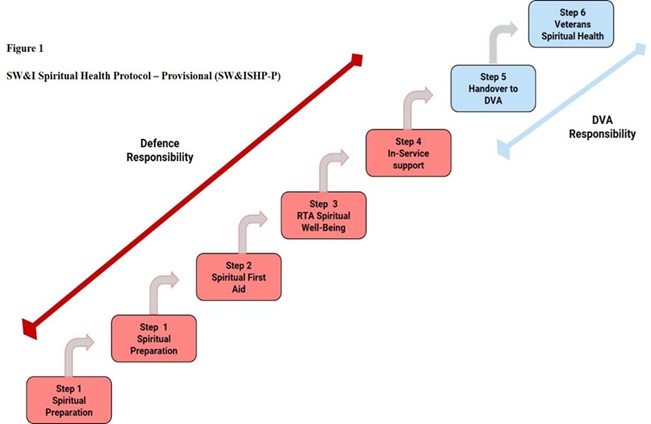
2. Spiritual first aid. As the name implies, this is the immediate supportive action applied following a traumatic event that may lead to a SW&I. Unit or deployment group chaplains should deliver this as part of a coordinated response by a multidisciplinary team following a major engagement, event or incident. One critical tool that will need to be developed to support this is an Initial Spiritual Health Report (ISHR). The ISAR would provide the Chaplain and supporting medical and psychological personnel with a first review of a soldier’s specific circumstances following an event and would serve as key initial documentation for the soldier’s subsequent treatment as a veteran. A SWI&AT would support the ISAR.
3. Return to Australia (RTA) Spiritual Wellbeing Program. The RTA program would be designed to prepare soldiers who may need spiritual support during their RTA. The program would be held in a theatre and consist of two components. The first component could be a video that discusses potential spiritual issues a soldier may face on RTA. The second would be a thorough review of the soldier’s spiritual circumstances while deployed, and the possible family/home/unit circumstances on RTA. In this case, a diagnostic tool known as the Return Spiritual Health Report (RSHR) would need to be developed. The RSHR will provide the Chaplain and supporting medical and psychological personnel with a summary of the soldier’s specific spiritual circumstances as they occurred in theatre. The RSHR will be included in the soldier’s medical documentation and provided to the relevant chaplaincy support function upon RTA.
4. In-service spiritual support. If ongoing support during the member’s career is required, then this can be provided through the existing Defence Chaplaincy network. If a soldier requires specific faith support for a religious grouping outside of existing representation within Defence, unit and formation chaplains could reach out to relevant community groups to facilitate this. In this case, a diagnostic tool known as an Ongoing Spiritual Health Report (OSHR) will need to be developed.
5. Handover to DVA. Once a soldier has decided to transition to civilian life, DVA will facilitate responsibility for their overall wellbeing. Currently, when a soldier transitions to DVA’s care, their relevant health documents are provided to DVA to support the determination of ongoing care requirements. To facilitate this, transitioning soldiers will usually need to complete transition documentation and attend medical and dental appointments. The same might apply to a SW&I. The soldier could be given the option to speak to a Chaplain before transition. If the soldier requests ongoing spiritual care, then the DVA should be made aware of this need. Establishing this handover process between Defence and DVA will also require significant interdepartmental consultation and policy development. To support this, a diagnostic tool known as a Handover Spiritual Assessment Report (HSAR) will also need to be developed.
6. Veteran’s spiritual health. For as long as required, the veteran will be supported by DVA and through outsourced providers and faith groups. As discussed, spiritual health care will aim to restore the veteran to their initial state without any presumption of improving or enhancing the veteran’s approach to spirituality.
Conclusion
The proposed SW&ISH–P accepts that many of the MI and spiritual health-based treatments discussed in this paper have been in practical use for extended periods or have been validated by professional bodies. As such, they can likely be assumed to have some validity and usefulness, and to meet the management and treatment needs of SW&I. The more compelling issue is the need for a broader management protocol that sets a vision for the appropriate and directed care of SW&I. SW&ISHP–P may provide that vision, as it is specifically set within the SW&I paradigm and recognises the importance of both head and heart spiritual issues.
For this to be successful, there needs to be a much clearer handover between Defence and DVA matters of spiritual health. This does not occur now. This will be difficult as many religions and faith groups will struggle with issues of confidentiality and the sanctity of the confessional. RSP will also need to meet the professional communication expectations of their peers in psychology and medicine, who will expect a measure of shared reporting and patient summaries. Both areas can be managed and will be critical to a fulsome and coherent approach to veteran spirituality.
There should be no doubt that the Commonwealth Government, through agencies such as DVA, is responsible for veterans’ spiritual health. In the same way that the DVA is ultimately accountable for a veteran’s leg injuries and for restoring them to their previous state, they should also be held responsible for SW&I. There should, however, be no presumption of spiritual health support beyond restoration. While evangelism and proselytisation are aspects of the vision or mission of many religions, they are not appropriate in this context and fall outside DVA’s scope.
Despite laudable initiatives such as the Veterans’ Chaplaincy Pilot Program, DVA cannot expect to meet the spiritual health needs of over 600,00 veterans. In a medical sense, DVA already understands this and virtually all its medical services are outsourced to commercial or other government providers. Church and faith groups, as part of a broader treatment protocol, play a significant role.
Annex A – Moral injury and spiritual management tools
| Moral injury treatment and management tools | |||
| Name | Outline | Year | Principal contributors |
| Person-centred therapy (PCT) | Person-centred therapy, also referred to as non-directive, client-centred or Rogerian therapy, was pioneered by Carl Rogers in the early 1940s. This form of psychotherapy is grounded in the idea that people are inherently motivated towards achieving positive psychological functioning. (Yao and Kabir, 2023). | 1940s | Carl Rogers |
| Cognitive behaviour therapy (CBT) | CBT focuses on the relationship among thoughts, feelings and behaviours; targets current problems and symptoms; and focuses on changing patterns of behaviours, thoughts and feelings that lead to difficulties in functioning (APA, 2017b). | 1960 | Aaron Beck |
| Cognitive processing therapy (CPT) | CPT promotes recovery from PTSD by directly modifying maladaptive cognitions developed following the traumatic event (APA, 2017a). | 1980 | Patricia Resick |
| Repetitive transcranial magnetic stimulation (RTMS) | Induction of finger and foot movements through the use of a magnetic coil placed on the motor cortex. Transcranial magnetic stimulation (TMS) is a neurophysiological procedure for non-invasive stimulation of the nervous system (Chail, 2018) | 1985 | Anthony Barker |
| Eye Movement Desensitisation and Reprocessing (EMDR) Therapy | A structured therapy that encourages the patient to briefly focus on the trauma memory while simultaneously experiencing bilateral stimulation (typically eye movements), which is associated with a reduction in the vividness and emotion associated with the trauma memories (APA, 2017e). | 1987 | Francine Shapiro |
| Narrative exposure therapy (NET) | Narrative exposure therapy is a treatment for trauma disorders, particularly in individuals suffering from complex and multiple trauma. It has been most frequently used in community settings and with individuals who experienced trauma as a result of political, cultural or social forces (such as refugees) (APA, 2017f). | 1990 | Maggie Schauer, Thomas Elbert, & Frank Neuner |
| Prolonged exposure (PE) | Prolonged exposure is a specific type of cognitive behaviour therapy that teaches individuals to gradually approach trauma-related memories, feelings and situations (APA, 2017c). | 1991 | Edna Foa |
| Stress Inoculation Training (SIT) | SIT consists of three overlapping phases. The first, conceptualisation, is an educational phase that emphasises the development of a warm, collaborative relationship through which careful assessment and problem reconceptualisation are carried out. The second, skill acquisition and rehearsal, targets and develops a repertoire of palliative and instrumental coping skills to reduce anxiety. A table of common cognitive coping skills is included to exemplify the range of coping skills employed. The final phase, application and follow-through, focuses on activities that transfer coping skills to real life and prevent relapse (Meichenbaum & Deffenbacher, 1988). | 1998 | Donald H. Meichenbaum and Jerry L. Deffenbacher |
| Trauma-focused CBT (TF-CBT) | TF-CBT is a conjoint parent–child treatment that uses cognitive behavioural principles and exposure techniques to prevent and treat posttraumatic stress, depression and behavioural problems. This review defined TF-CBT, differentiated it from other models, and assessed the evidence base (de Areliano et al., 2014). | 2006 | Judith A. Cohen, Anthony P. Mannarino & Esther Deblingher |
| Brief eclectic psychotherapy (BEP) | Brief eclectic psychotherapy for PTSD (BEPP) is an evidence-based therapeutic approach that combines and integrates elements from psychodynamic, cognitive behavioural and directive psychotherapy. Psychoeducation is conducted jointly with the patient and their partner (Gersons & Schnyder, 2013). | 2013 | Berthold Gersons |
| Moral injury reconciliation therapy (MIR) | Spiritually integrated psychotherapy starts with a person’s story rather than a disease or condition. It seeks to build a transdiagnostic integration of psychological and theological disciplines and resources (Cronshaw, 2021). | 2018 | Lewis Jeffery Lee |
| Written exposure therapy (WET) | Written Exposure Therapy is a manualised exposure-based psychotherapy for PTSD that is recommended by the US DVA Clinical Practice Guideline (Sloan & Marx, n.d). | 2019 | Denise M. Sloan & Brian P. Marx. |
| Adaptive disclosure therapy (ADT) | Adaptive disclosure is a brief manualised therapy developed specifically to address trauma in military service members. Adaptive disclosure includes many elements of other CBTs for PTSD to target combat and operational traumas specific to service members: life-threatening experiences, traumatic loss and moral injury (Litz, 2021). | 2021 | Brett Litz |
| Spiritual treatment and management tools | |||
| Name | Outline | Year | Principal contributor |
| Tawbah | The Islamic concept of repenting to God for any sins and misdeeds. To complete Tawbah, an individual must complete six elements (Rassool, 2021). | Islam | |
| Sacrament of Reconciliation | Also known as ‘Confession’ or ‘Penance,’ it is an opportunity for an individual to renew their faith. During the ritual, sins are privately recounted to a priest, who acts as an administrator in the reconciliation between God and the sinner (Scroope, 2022). | Christianity – Roman Catholicism | |
| Teshuva | In Judaism, forgiveness is a duty or a mitzvah and is mentioned in the Torah. Yom Kippur, or the Day of Atonement, is the principal time for this and is considered one of the most important days in the Jewish calendar (BBC, 2023). As part of this process, Jews place great emphasis on acts of repentance, or teshuva (BBC, 2023). | Judaism | |
| Devi Aparadha Kshamapana Stotram | A prayer recited to seek forgiveness from the Goddess Mother for any mistakes committed knowingly or unknowingly. (Sanatan Veda, n.d.) | Hindu | |
| Kshama (Sanskrit) or Khama (Pali) | Traditionally, in Buddhism, forgiveness is practised by repeating phrases of forgiveness towards oneself, towards those who have harmed us, and towards those we have harmed (MacDonnell, 1892, pp. 77-78). | Buddhist | |
| Structured Pastoral Care (SPC) | SPC is also known as a Structured Chaplain Intervention (SCI) and is a tool designed to treat MI among veterans with significant PTSD symptoms. Utilises the original scriptures in each of the five major religious traditions to address the major symptoms of MI (Benner, 2003). | 1993 | David Benner |
| BSS | Based on James Fowler’s (1974) stages of faith, the BSS treatment model argues that a potentially morally injurious event constitutes a transgression and a violation of sacramental beliefs. It is an interfaith tool that can be used with religious and nonreligious participants and is facilitated by mental health providers, chaplains or pastoral counsellors. BSS focuses on reducing spiritual distress (Fowler, 1974; Fowler & Dell, 2006; Harris, 2011). | 2000 | J Irene Harris |
| Religious Integrated Cognitive Behavioural Therapy (RICBT) | RICBT follows the essential format and approach of CBT. It differs because it uses the patient’s religious tradition as a major foundation to identify and replace unhelpful thoughts and behaviours to reduce depressive symptoms. Some specific tools used in RICBT include scripture memorisation, contemplative prayer, challenging thoughts, using the patient’s religious resources and involvement in the religious community (Pearce et al., 2015) | 2015 | Michelle Pearce |
| Pastoral Narrative Disclosure (PND). | A MI treatment that addresses a complex trauma-related syndrome involving a correlation of biological, psychological, social and spiritual symptoms that can have a substantial impact on health and wellbeing. With this tool, treating professionals seek to use the sacrament of penance to acknowledge the moral pain veterans experience after returning from combat (Carey & Hodgson, 2018). | 2018 | Lindsay Carey and Timothy Hodgson |
| Spiritually Integrated CPT (SICPT) | SICPT uses the spiritual concepts and rituals of compassion, grace, spiritually guided imagery, repentance, confession, forgiveness, atonement, blessing, restitution and making amends (Pearce et al., 2018). | 2018 | Michelle Pearce |