

ABSTRACT
Introduction: Military service is a physically demanding occupation, and fewer women than men meet the military fitness standards, especially in manual handling and load carriage. Therefore, integrating women into physically demanding military roles requires effective physical conditioning programs to ensure operational readiness. Methods: Twenty-eight female soldiers were randomly assigned to either a 10-week gender-specific physical training program (GEN: n=15) or to a control group that maintained regular military physical training (CON: n=13). Strength and endurance tests were assessed in conjunction with military-specific load-carriage tests. Results: The GEN group showed significantly better improvements than CON for strength and power (all d >2.57; p >3.98 x 10⁻⁵), 2.4 km run (d=0.70±0.23; p=1.46 x 10⁻⁶), curl-ups (d=0.38±0.38; p=0.0499) and push-ups (d= 1.13±0.79; p=0.0073). For the military-specific testing, GEN displayed large improvements when compared to CON for lift-and-place (3.8 ± 1.5 repetitions; d=2.21; p=4.56 x 10⁻⁵), battle manoeuvre (7.5 ± 4.1 m; d=1.44; p=0.0008), lift-and-carry (1.1 ± 0.7 repetitions; d=1.29; p=0.0023) and 4 km endurance march (87.4 ± 41.6 s; d=1.87; p=0.0004). Moderate to strong relationships were observed between changes in endurance and lower-body strength and a range of other tests (r ≥0.51). Conclusion: Female soldiers generally performed better when assigned to a gender-specific physical training program compared to CON after 10-weeks of prescribed physical training. Training is recommended to target endurance and lower-body strength, enhancing manual handling and load carriage to improve operational readiness among female soldiers.
Word count: 238 (max 250)
Key words: load carriage; endurance; manual handling; lower-body power
INTRODUCTION
In the New Zealand Army, women currently account for approximately 15% of total regular force personnel.1 Service personnel, regardless of gender, are required to serve under the same conditions and to participate equally in all duties. The Land Combat Fitness Test (LCFT) is the New Zealand Army’s combat fitness test performed by all soldiers regardless of gender. Data indicate that more females have failed the LCFT than their male counterparts over the last 5 years (59.5 vs 39.5%). This sex-based difference is predominantly due to the ‘lifting and carrying’ components of the LCFT. Manual handling is considered an essential task in the military. A review of the Australian Army identified that ~79% of physically demanding tasks across employment categories were classified as manual material handling, including lifting, digging, carrying, pushing and pulling.2 In addition, data from the New Zealand Defence Force and Australian Army reveal that proportionally, significantly more women are injured than men, with the majority of injuries occurring during physical training.3,4
When considering military training, gender-neutral training (male and female personnel together) has typically been implemented and supported by militaries.5,6 Gender-neutral combat training is typically implemented by requiring all soldiers to perform the same core tasks and achieve the same minimum level of combat fitness, regardless of age or gender. However, there is growing evidence that gender-neutral basic military training is a risk factor for overuse injury in women.7-9 A study examining the risk factors for injury during basic training in the United States Army reported twice the number of training-related injuries in women than men. This finding was attributed to the lower aerobic capacity in female recruits.10 In 1997, gender-neutral training for British Army recruits saw male and female recruits trained and assessed to a common standard.5 These authors subsequently reported that a 9% decrease in the number of women recruited into the British Army was observed, and overuse injuries sustained by women over the 4-month basic training more than doubled from 4.7% to 11.1%.
Given issues related to recruitment, injury rates and the successful attainment of standards for essential military manual handling tasks, gender-specific training has become a warranted topic in the military. Women typically have lower muscle mass, higher body fat and lower aerobic capacity than males.7,11-13 These sex differences are associated with lower muscle strength and endurance, placing female soldiers at a disadvantage compared with men when carrying out combat-specific tasks such as lifting, manual handling and marching with a load.11,14,15 Evidence demonstrates that concurrent resistance and aerobic training is the optimal training structure, facilitating adaptation to meet the physical demands of military service and reducing musculoskeletal injury risk.16,17 Further, a systematic review by Knapik and colleagues (18) reported that the greatest improvements in load-carriage performance were observed when load-carriage training was accompanied by whole-body strength and aerobic training; however, gender-specific physical training that incorporates resistance training has not been investigated in the New Zealand Army (NZA). Therefore, this study aimed to determine whether gender-specific physical conditioning produces greater improvements in fitness than gender-neutral training and whether these improvements translate to both physical and operational fitness and performance in the NZA.
Materials and methods
Participants
Thirty-two female soldiers agreed to participate and were randomised via simple random assignment to either a 10-week female gender-specific physical training program (GEN; n=16) or a control group that performed standard military physical training (CON; n=16). Twenty-eight soldiers completed the 10-week course with attrition due to deployment, with 15 completing the GEN (age 32.6±7.1 y, weight 68.1±8.0 kg, height 167.5±5.9 cm) and 13 completing the CON (age 31.8±7.4 y, weight 67.7±8.3 kg, height 167.2±6.0 cm).
Procedures
The primary goal of the GEN was to increase the strength and endurance of the muscles involved in lifting and load carriage. In all cases, resistance training was individually prescribed, relevant to experience level and performed with proper technique. The CON maintained standard physical training practices ubiquitously prescribed across the NZA, including high volumes of low-intensity endurance training and bodyweight exercise circuits (Table 1). Of note, the CON group did not participate in any specific strength training, whereas the GEN group performed the prescribed 10-week specific strength and conditioning program outlined in Table 2. All exercise sessions were directly supervised by an Army Physical Training Instructor (PTI). Defence Force subject-matter experts qualified in strength and conditioning oversaw the entire program, monitored research participants’ progress and modified training as needed.
Both groups participated in a series of pre- and post-tests that included maximal box squat strength, maximal bench press strength, and a loaded countermovement jump (CMJ). Both groups participated in a series of pre- and post-tests that included components of the NZA Required Fitness Level (RFL) and the LCFT. The RFL components included push-ups, curl-ups and a 2.4 km run. Components of the LCFT included lift-and-place, battle manoeuvre, lift-and-carry and a 4 km endurance march. Participants were fully informed of the procedures and signed a consent form before the start of the study, which was approved by the NZDF Ethics Committee.
Table 1. Weekly training schedule session outline for the prescribed 10-week gender-specific physical training program.
| Week | Mon | Tues | Weds | Thurs | Fri | Sat | Sun |
| WEEK 1 | Pre Testing | Pre testing | Strength Program Introduction | Phase 1: Power/Strength [Contrast] + HIIT | Patrol March (Patrol Order) 5kg 4km | Active Recovery | OFF |
| WEEK 2 | Phase 1: Strength + HIIT: UL/LL Combination | M.A.S Running (Maximal Aerobic Speed Format) 2.5km | 30min Pool Swim/Walk + Mobility | Power Circuit | Load Carriage (Pack) 10kg 4km | Active Recovery | OFF |
| WEEK 3 | Phase 1: Strength + HIIT: UL/LL Combination | M.A.S Running 2.5km | 20min Bike “Spin” & 20min Pool Mobility | Phase 1: Power/Strength [Contrast] + HIIT | Patrol March (Patrol Order) 7kg 5km | Active Recovery | OFF |
| WEEK 4 | Phase 1: Strength + HIIT: UL/LL Combination | M.A.S Running 3km | 30min Pool Swim/Walk + Mobility | Power Circuit | Load Carriage (Pack) 15kg 4-5km | Active Recovery | OFF |
| WEEK 5 | Phase 1: Strength + HIIT: UL/LL Combination | M.A.S Running 4km | 20min Bike “Spin” & 20min Pool Mobility | Phase 1: Power/Strength [Contrast] + HIIT | Patrol March (Patrol Order) 7-10kg 6km | Active Recovery | OFF |
| WEEK 6 | Spin Class 40min | M.A.S Running | OFF | Group Walk | Pool + Stretch | Active Recovery | OFF |
| WEEK 7 | Phase 2: Strength + HIIT: UL/LL Combination | M.A.S Running 3km | 30min Pool Swim/Walk + Mobility | Phase 2: Power/Strength [Contrast] + HIIT | Load Carriage (Pack) 20kg 5km | Active Recovery | OFF |
| WEEK 8 | Phase 2: Strength + HIIT: UL/LL Combination | M.A.S Running 2.5km | 20min Bike “Spin” & 20min Pool Mobility | Power Circuit | Patrol March (Patrol Order) 7-10kg 7km | Active Recovery | OFF |
| WEEK 9 | Phase 2: Strength + HIIT: UL/LL Combination | M.A.S Running 4km | 30min Pool Swim/Walk + Mobility | Phase 2: Power/Strength [Contrast] + HIIT | Load Carriage (Pack / Patrol Order Combination) 7kg/20kg 6km | Active Recovery | OFF |
| WEEK 10 | Phase 2: Strength + HIIT: UL/LL Combination | M.A.S Running 3km | 20min Bike “Spin” & 20min Pool Mobility | Power Circuit | Recovery | Active Recovery | OFF |
| WEEK 11 | Post Testing | Post testing | |||||
| NOTE: | Program dependant on injury and experience | Distance dependant on pre-run time | Aprox Recovery / Unload: | Program dependant on injury and experience | Incremental Load Aprox | Individual recovery options |
HIIT: High-intensity interval training. UL/LL: Upper-limb or Lower-limb. MAS: Maximal aerobic speed running format of training. Patrol Order: Clothing and military equipment used for tactical patrolling (excludes backpack)
Table 2. Control group weekly training schedule session outline for regular unit physical training over 10-weeks.
| Week | Mon | Tues | Weds | Thurs | Fri | Sat | Sun |
| Week 1 | Pre Testing | Pre testing | Recovery Flush | Battle PT (60min) | Full body conditioning Mix (45-60min) | ||
| Week 2-10 | Full Body Circuit (45min) | Aerobic Conditioning (45min) | Fitness testing OR Sport and recreational activities (45-60min) | Battle PT (60min) | Full body conditioning Mix (45-60min) | ||
| Week 11 | Post Testing | Post testing | |||||
| NOTE: | Body weight and functional movements | Running, swimming, bike, PTI: Directed (PTI Choice) | Fitness testing if required. Sport activities individual choice. | Aerobic/strength-endurance mix. Carry-lift-place | Running, body-weight exercises, weights, ropes, cardio machines. PTI: Directed (PTI Choice) |
PTI: physical training instructor, PT: physical training
Strength and power testing
Lower-body strength (2–6RM box squat):
Following a warm-up comprising 5-minutes of static cycling, five minutes of static and dynamic stretching, a maximal box squat test of two to six-repetition maximum (2–6 repetition maximum [RM]) was used to determine strength pre and post the intervention.19 The test required participants to squat with an Olympic bar placed over the top of the shoulders and back, to a 90° knee angle determined by the buttocks resting on a box. The 2–6 RM achieved was used to estimate the 1 RM using the Epley Formula (1 RM = [1 + 0.0333 x reps] x weight lifted [kg]).
Upper-body strength (2–6RM bench press):
A 2-6 RM bench press test was used to determine upper-body strength pre- and post-training. For the squat, a 2–6 RM was selected, as this is the lifting range where maximal strength can be achieved with a reduced risk of injury. The test required participants to lower a weighted Olympic bar to a 90° elbow angle, as determined by the upper arms being parallel to the ground while supine on a bench. The bar was then pushed back up until the arms were straight. The 2–6 RM achieved was used to estimate the 1 RM using the same Epley Formula applied to the 1 RM squat.
Power (countermovement jump CMJ, adjusted to 30% 1RM squat):
Participants were required to perform two sets of three jump squats with a load equivalent to 30% of the maximal box squat immediately after the squat test. Participants were required to lower to a 45° angle at the knee, then jump explosively upward for maximum height in one fluid movement. An elastic band was placed at the 45° knee angle position under the buttocks to confirm the appropriate depth. Power (Watts) was measured with a Gymaware™ optical encoder (Kinetic Performance Technology, Canberra, Australia).
Army required fitness level (RFL)testing
The standard RFL evaluation was conducted by NZA PTIs pre- and post-intervention. This evaluation consisted of three key components: 1) curl-ups, 2) push-ups and 3) a 2.4 km road run as outlined by Edgar and colleagues.20 Briefly, aerobic fitness was assessed using the 2.4 km road run, with the run times measured using a stopwatch to the nearest second. A curl-up protocol evaluated core muscular endurance and was performed with participants in a supine position on a standard curl-up mat on the gym floor, knees bent at 90º with feet flat on the floor. A PTI counted completed repetitions. There was no time limit on repetitions; however, they were to be completed continuously, with a pause of only 1–2 seconds between repetitions. Push-ups assessed upper-body muscular endurance. A repetition was counted by a PTI every time the full range of motion was completed until failure. For both push-ups and curl-ups, one warning was given for an incomplete repetition prior to participants being stopped by the PTI.
Land component fitness test (LCFT), operational readiness test
A modified LCFT operational readiness evaluation was conducted by NZA PTIs pre and post the 10-weeks of training. This evaluation consists of four key components: 1) jerry can lift-and-place, 2) battlefield manoeuvre, 3) jerry can lift-and-carry and 4) battlefield endurance 4 km march/run. Modifications allowed physical capacity in each area to be quantified rather than just a pass/fail, as is standard practice. For all components of the test, the soldier was required to wear military-issue clothing and footwear, body armour and a rifle weighing 20 kg. Five minutes of rest were allowed between each component of the LCFT.
Lift-and-place test
For the lift-and-place test, a water-filled jerry can weighing 20 kg was placed 1 m from the side of a 1.40 m platform. On a verbal ‘Go’ command, participants started from a standing position behind a mark 1 m away from the platform and lifted the jerry can onto the platform. To prevent injury, participants were directed to use their free hand to assist with the lifting. Once the jerry can was stable on the platform, the participant stepped back so that both feet were behind the one-metre mark, which counted as one repetition. Participants were instructed to complete as many repetitions as possible in 2 minutes, with the total number of repetitions recorded.
Battlefield manoeuvre
For the battlefield manoeuvre test, a 50 m area was marked at 10 m intervals. The soldier’s start and finish position for each repetition was kneeling on one knee with the opposed leg supporting, the weapon raised and aimed in the firing position at the shoulder. On a verbal ‘Go’ command, participants were required to stand up and run to the first ten-metre mark, finishing in the same firing position (kneeling unsupported). Participants held the weapon at the shoulder in a firing position for an individual 3-second count (fire-one, fire-two, fire-three) before standing and progressing with the assessment. Participants were instructed to complete as many repetitions as possible in 2 minutes, and the total distance was recorded in metres.
Lift-and-carry test
For the lift-and-carry test, two 20 kg jerry cans were placed on one side of a 25 m grid for each individual being assessed. On the verbal command ‘Go’, participants lifted the two jerry cans and commenced walking 25 m to the opposite side of the grid. On reaching the far side of the grid, participants placed the jerry cans on the ground, stepped forward, turned around, lifted the jerry cans and returned to the starting line. Participants were instructed to complete as many 25-m repetitions as possible in 2 minutes, which were recorded.
Battlefield endurance (4 km)
The battlefield endurance test was an individually timed 4 km endurance time trial. The test track was on a sealed flat road, with markers at 1, 2, 3 and 4 km. Soldiers were instructed to complete the 4 km course as quickly as possible, with their time recorded in minutes.
Statistical analyses
Descriptive statistics for the groups are shown as mean ± SD values, while Cohen’s d effect sizes are represented as mean ±95% confidence intervals. All statistical analyses were performed using the Statistical Package for the Social Sciences (V. 27.0, SPSS Inc., Chicago, IL), with statistical significance set at p ≤0.05. To determine whether there were differences between groups in the physical performance measures, a two-way repeated-measures analysis of variance (ANOVA) was performed for Group (GEN or CON) and Time (pre and post) on the performance data. Analysis of the distribution of residuals was verified visually with histograms and also using the d’Agostino-Pearson test of normality. Magnitudes of the standardised effects between pre and post-physical tests were calculated using Cohen’s d and interpreted using thresholds of <0.20, 0.20, 0.50 and 0.80 for trivial, small, moderate and large, respectively. Effects were deemed unclear if the 95% confidence intervals overlapped the thresholds for both small positive and negative effects (d ±0.2). To assess relationships among metrics, Pearson’s r-values were calculated with thresholds of 0.3, 0.5 and 0.7 for high, moderate and low correlations, respectively.
Results
Normality was confirmed for the test measures (d’Agostino-Pearson, p >0.05). There were no differences in age, height, weight or performance data prior to the intervention (p >0.05), except for curl-ups. The strength and lower-body power data are presented in Table 3. The improvement in the GEN group was superior to the CON group for maximal lower-body strength (26.5%; 23.0±7.9 kg), maximal upper-body strength (11.1%; 5.7±2.0 kg), and maximal lower-body power (26.0%; 538.7±196.3 W). For the RFL test components, compared with the CON group, GEN decreased the 2.4 km run time by 6.5% (44.7±14.8 s) and increased curl-ups by 12.8% (10.7± 9.6 repetitions) and push-ups by 20.0% (2.4±1.7 repetitions; Table 3). These numbers corresponded to a 93% pass rate for female soldiers in the GEN group, compared with 69% in the CON group.
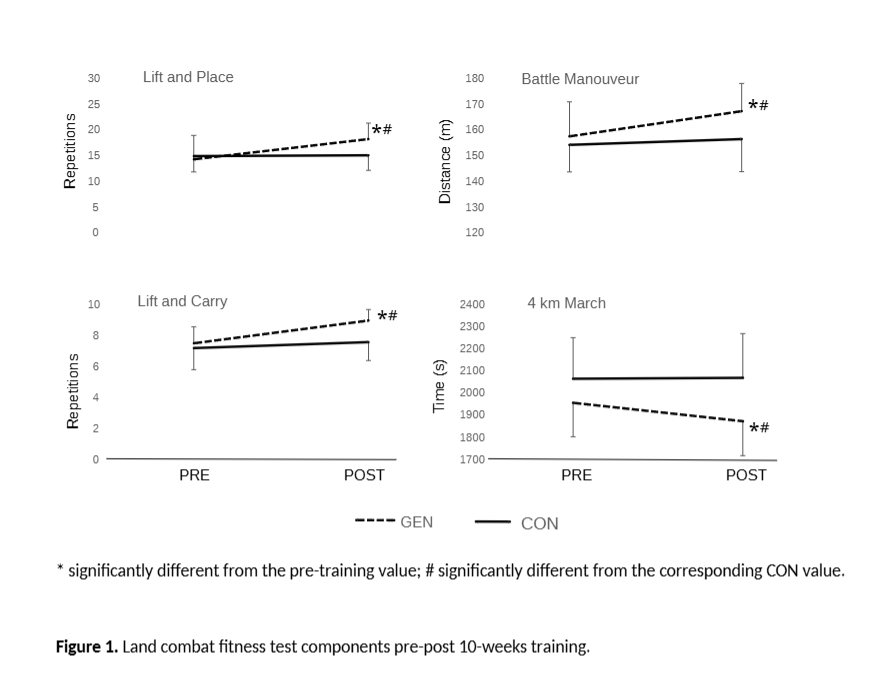
For the LCFT, the GEN demonstrated large significant improvements relative to the CON group for the lift-and-place (26.1%; 3.8±1.5 repetitions; d= 2.21; p =4.56 x 10⁻⁵), battle manoeuvre (4.7%; 7.5±4.1 m; d= 1.44; p =0.0008), lift-and-carry (12.1%; 1.1±0.7 repetitions; d =1.29; p =0.0023), and 4 km endurance march (4.6%; 87.4±41.6 s; d+ 1.87; p =0.0004; see Figure 1).
Table 3. Strength and power and required fitness level test performance changes across a 10-week training program between the gender-specific physical training program group (GEN, n=15) and control group (CON, n=13).
| Pre-training | Post-training | % Δ pre-post | Interaction effect |
Effect size (Cohen’s d) |
||||||
| Strength and power | ||||||||||
| Box squat 1 RM (kg) | GEN | 97.8 ± 42.2 | 120.1 ± 38.6 *, # | 26.6 | 1.37 x 10⁻⁵ | 2.58 ±0.89 | ||||
| CON | 84.2 ± 11.8 | 83.5 ± 10.2 | -0.6 | Large | ||||||
| Bench press 1 RM (kg) | GEN | 47.1 ± 13.6 | 53.3 ± 14.3 * | 12.6 | 2.59 x 10⁻⁵ | 2.57 ±0.92 | ||||
| CON | 50.5 ± 7.1 | 50.9 ± 7.1 | 0.9 | Large | ||||||
| Counter movement jump (W) | GEN | 1550 ± 260 | 2090 ± 312 *, # | 30.2 | 3.98 x 10⁻⁵ | 3.02 ±1.10 | ||||
| CON | 1484 ± 242 | 1486 ± 240 * | 0.1 | Large | ||||||
| Required fitness level | ||||||||||
| 2.4 km run (min:s) | GEN | 12:14 ± 1:18 | 11:34 ± 1:11 * | 5.5 | 1.46 x 10⁻⁶ | 0.70 ± 0.23 | ||||
| CON | 11:42 ± 0:42 | 11:47 ± 0:41 | 0.7 | Moderate | ||||||
| Curl-ups (repetitions) | GEN | 98 ± 25 # | 109 ± 14 *, # | 13.9 | 0.0499 | 0.38 ± 0.38 | ||||
| CON | 71 ± 24 | 71 ± 24 | 0.2 | Small | ||||||
| Push-ups (repetitions) | GEN | 17 ± 7 | 21 ± 6 * | 29.7 | 0.0073 | 1.13 ± 0.79 | ||||
| CON | 20 ± 5 | 21 ± 6 * | 7.5 | Large | ||||||
* significantly different from the pre-training value; # significantly different from the corresponding CON value. Quantitative descriptions of the Cohen’s d are based on thresholds of <0.20, 0.20, 0.50 and 0.80 for trivial, small, moderate and large, respectively.
When pre- and post-test data were combined, there were high correlations between maximal upper-body strength and maximal lower-body strength (r =0.74; p =1.11 x 10⁻¹⁰) and between performance in the battle manoeuvre and the curl-up test (r =0.81; p =2.49 x 10⁻¹⁴). Interestingly, the battlefield endurance 4 km march showed no moderate or strong relationships with any of the other tests (all r-values ≤0.38), indicating that this test assessed a relatively independent physical capacity. When the change scores for all tests were examined, there was a strong linear relationship between the change in maximal lower-body strength and the change in lower-body power (r =0.91; p =9.65 x 10⁻¹²), such that an increase of 1 kg in lower-body strength approximated a 22.3 W improvement in lower-body power. Overall, the improvement in the 2.4 km road run was at least moderately related (r ≥0.51) to seven of the 10 tests performed. Similarly, the improvement in maximal lower-body strength was at least moderately related (r ≥0.51) to six of the tests.
Discussion
The results of this study demonstrate that the ability of female soldiers to perform physically demanding military occupational tasks can be significantly improved following a 10-week periodised training program including resistance training. Maximal occupational load carriage, as measured by the lift-and-place and the repetitive lift-and-carry task, improved in the GEN group relative to the control group that followed standard military training. Load-carriage performance also increased, as demonstrated by a reduction in time to complete the 4 km march carrying a total weight of 20 kg. This study illustrates the performance gains female soldiers can achieve through a gender-specific physical training program and provides military leaders with insights into policies to fully integrate women into combat occupations.
The physiological demands on female soldiers in combat roles have increased due to the evolution of modern warfare, and there is a need for strength and conditioning programs to address these challenges. The physical requirements for combat readiness include lifting and carrying heavy loads in hostile environments. In military-oriented studies, it has been reported that women have up to 55% less muscle strength than men in both the upper and lower body.10,13,21 When considering most physical and military occupational performance variables, it has also been shown that sex differences are present, which disadvantage women,11 and predispose female soldiers to fail to attain required combat fitness standards.22 The traditional focus on aerobic exercise in military training may lead to inadequate preparation for high-intensity tasks, resulting in injuries and lost training days.23
This traditional approach to military training has focused on high volumes of low-intensity endurance training,11 which often compromised training adaptations, especially for women.17 Although the preference for high-volume, low-intensity endurance training in the military is common, high-intensity activities such as carrying heavy loads and sprinting for short durations are typical of military tasks and are related to muscular strength. Herein, we demonstrated that the standard physical training practice prescribed by the NZA did not significantly improve either upper- or lower-body strength. Modern military operations are increasingly physically demanding, requiring maximal strength and power to optimise military readiness.24 In this study, it was evident that operational readiness is likely enhanced through the prescribed strength and power training, with demonstrable improvements in load carriage and manual handling tasks. Varra and colleagues reported that upper-body maximal strength was strongly and positively correlated with moderate (29 kg) and heavy (45 kg) load-carriage performance.14
Recent studies with both recruits16 and active-duty soldiers25 have supported the use of both whole-body strength and aerobic training. Of note, maximal strength, power and oxygen uptake have been reported as important predictors of operational performance.26,27 Our data highlighted that standard military training was relatively ineffective at improving aerobic fitness (2.4 km road run), with no significant decrease in run time observed in the CON group. It was also apparent from the overall group data that improvements in aerobic conditioning were associated with improvements across a range of other tests, including the curl-up from the RFL fitness test, as well as the lift-and-place, battlefield manoeuvre and the battlefield endurance 4 km march from the LCFT operational readiness test.
Low levels of aerobic fitness have also been linked to injury during combat training.23 To reduce injuries, periodised training programs for female soldiers that include both aerobic and resistance training, incorporating strength, agility, and power components, are recommended.28,29 In studies of workload tolerance and injury frequency in the military, female soldiers exerted themselves more than their male counterparts when performing typical tasks aimed at achieving a specified output and experienced fatigue earlier than males.21 Furthermore, fatigue is a major underlying cause of injuries, and female soldiers are more prone to being injured than males when conducting similar military tasks.30 Therefore, training to enhance endurance and aerobic fitness is clearly indicated. Additionally, previous research has shown that 8 weeks of physical training that combines aerobic and resistance training results in changes in bone biomarkers indicative of increased bone mass,31 an important consideration when developing exercise programs for female soldiers who are at increased risk of stress fractures compared to males.8 As such, appropriate training is essential to ensure both operational readiness and health during and after military careers.32
To address the strength limitations of female soldiers compared to males reported in a military context,10,13,33 the current study aligns with previous studies showing that conditioning programs consisting of resistance and cardiovascular training in female soldiers improve physical performance, including adaptations in strength, power and endurance. Nindl and colleagues reported that a 6-month conditioning program that included resistance training improved lifting and load carriage,33 but 22% still fell short of the requirements for military occupational specialties. Our data show that improvements in lower-body strength were associated with improvements in other tests, including lower-body power, the 2.4 km road run, load and carriage and the battlefield endurance 4 km march. Therefore, resistance training is a valuable stimulus for women to enhance their strength and successfully undertake military tasks. We also showed that changes in 2.4 km run performance were linked to the lift-and-place, the battlefield manoeuvre and the battlefield endurance 4 km march. These data align with Withrow and colleagues, who linked 2-mile (~3.2 km) run performance with a loaded tactical foot march.15
The ultimate goal of any military PT program should extend beyond achieving measurable improvements in physical fitness tests. It should include considerations of daily mission requirements, operational tempo and the safety and effectiveness of training.28 Soldiers require a strong foundation of fitness encompassing a range of physical capabilities for operational readiness and health. As women increasingly participate in diverse military roles, the importance of appropriately tailored physical training is paramount. Appropriate strength and conditioning programs are required to meet the physical demands of military tasks and mitigate injuries. In this study, a female-specific physical training program improved fitness components to a greater extent than the regular training program, reinforcing the importance of incorporating resistance exercises into training designed to improve operational readiness.11 Participants demonstrated significantly greater improvements in strength, power, aerobic capacity and specific military fitness tests, which could ultimately lead to lower injury rates, decreased attrition and enhanced operational readiness. Aerobic fitness and lower-body strength and power should form the foundation of training programs designed to enhance operational readiness for female soldiers.