

Introduction
Armed Forces veterans are at increased risk of developing mental health difficulties, particularly post-traumatic stress disorder (PTSD), depression, and substance use disorders (SUDs).1 This heightened vulnerability is closely linked to exposure to combat-related trauma as well as the complex psychological, social and occupational challenges associated with transitioning back into civilian life.2,3 Suicide rates among veterans remain significantly higher than the general population, highlighting the critical need for effective, evidence-based interventions that address both symptom reduction and functional recovery.4
Residential and inpatient programs for veterans represent a critical but under-researched component of mental health care. Most of the evidence focuses on community-based interventions, leaving a relative gap in understanding the unique needs and outcomes associated with inpatient treatment for veterans who may be more severely mentally unwell. Focusing on these programmes allows exploration of how intensive, structured interventions operate within settings that manage higher‐acuity, higher‐risk presentations, offering insight into their role within the broader continuum of veteran mental health care.
This is particularly relevant for veterans in prison or forensic services, who often spend extended periods within systems where secure environments intersect with particularly complex clinical presentations. Veterans may become involved in prison or forensic mental health services for a range of reasons linked to their military experiences and post-service difficulties. Exposure to combat-related trauma, moral injury, prolonged hypervigilance and repeated deployments can contribute to the development of PTSD, depression, SUDs and difficulties with emotional regulation.5 Those leaving the military often face a significant disruption to their sense of identity, as the structured, collective and purpose-driven nature of military life is replaced by a civilian environment with fewer clear roles or expectations. Loss of camaraderie, changes in social networks and difficulties translating military skills into civilian contexts can intensify this identity crisis. Once veterans leave the structured military environment, earlier vulnerabilities, including the effects of adverse childhood experiences, can resurface or interact with service-related stress or trauma. These challenges can contribute to emotional distress, reduced self-esteem, and difficulties reintegrating into community and family life, which in turn can lead to mental health issues.6 Military sexual trauma (MST), a term defined as sexual assault or repeated sexual harassment during military service, represents a significant and distinct risk factor for the development of PTSD. Women veterans are disproportionately affected, and MST has been shown to confer an even greater likelihood of developing PTSD and experiencing more severe symptomatology than combat exposure alone.7
When untreated or insufficiently supported, these conditions can increase the likelihood of behaviours that bring veterans into contact with the criminal justice system, including aggression, impulsivity or substance-related offences. Additional factors such as chronic pain, homelessness and social isolation can further exacerbate risk. Importantly, many veterans who enter forensic or criminal justice services have had limited engagement with mental health treatment beforehand or have faced significant barriers to accessing appropriate care. Research shows that veterans involved in the justice system frequently report unmet clinical needs, low help-seeking prior to offending, and difficulties navigating or trusting civilian services, particularly when experiencing PTSD, SUDs or traumatic brain injury.8,9,10 As a result, forensic and secure settings often become default points of intervention, underscoring the need for tailored, trauma-informed and veteran-competent approaches within these environments.
This scoping review brings together evidence on residential and inpatient care for veterans, focusing on evidence-based PTSD psychotherapies, integrated substance misuse treatment and trauma-informed models. It examines programme effectiveness alongside patient, provider and system-level factors that influence engagement, outcomes and sustainability in intensive treatment settings. Synthesising the existing literature provides a foundation for developing a tailored, trauma-informed forensic inpatient pathway that should better address veterans’ complex needs.
Search methods
An information specialist at Nottinghamshire Healthcare NHS Foundation Trust conducted a comprehensive search of relevant databases up to 27 November 2025 to identify international evidence on best practices for treating armed forces veterans with mental health conditions in residential or inpatient settings. The following databases were searched:
- MEDLINE Ovid (from 1946 onwards)
- APA PsycInfo Ovid (from 1806 onwards)
- HMIC Health Management Consortium Ovid (from 1979 onwards).
Results were restricted to papers published in English between 2005 and 2025. The search results were combined and deduplicated in an EndNote database. The search strategies are available in Appendix 1.
Appendix 1: Search strategies
| Platform and database: Ovid Medline® ALL <1946 to November 26, 2025> | ||
| 1 | *Veterans/ | 19367 |
| 2 | Veterans Health/ | 2127 |
| 3 | Veterans Health Services/ | 324 |
| 4 | veteran$.ti,ab. | 51147 |
| 5 | ((ex or former) adj2 (military or service* or forces or soldier*)).ti,ab. | 718 |
| 6 | or/1-5 | 53675 |
| 7 | Hospitals, Veterans/ | 7042 |
| 8 | *Hospitalization/ or *Inpatients/ | 65076 |
| 9 | (inpatient* or in-patient* or admission* or hospitali?e* or hospitali?ation*).ti,ab. | 2998155 |
| 10 | ((resident* or admit*) adj2 (ward* or hospital*)).ti,ab. | 20966 |
| 11 | Hospitals, Psychiatric/ or Psychiatric Department, Hospital/ | 32983 |
| 12 | ((mental or psych*) adj2 (hospital* or facilit* or ward* or setting* or inpatient*)).ti,ab. | 47301 |
| 13 | Residential Treatment/ or exp Residential Facilities/ | 64708 |
| 14 | or/7-13 | 3115087 |
| 15 | mental disorders/ or exp anxiety disorders/ or exp obsessive-compulsive disorder/ or mood disorders/ or “bipolar and related disorders”/ or depressive disorder/ or exp personality disorders/ or “schizophrenia spectrum and other psychotic disorders”/ or affective disorders, psychotic/ or paranoid disorders/ or psychotic disorders/ or exp schizophrenia/ or exp substance-related disorders/ or “trauma and stressor related disorders”/ or combat disorders/ or exp psychological trauma/ or stress disorders, post-traumatic/ or stress disorders, traumatic, acute/ | 863147 |
| 16 | ((mental* or psychiatric* or psychological) adj2 (disorder* or ill* or condition* or disease* or diagnos* or patient*)).ti,ab. | 256641 |
| 17 | (depression or bipolar or schizo* or psychosis or psychoses or psychotic or addiction or “substance use disorder*” or “obsessive compulsive” or OCD or ptsd or cptsd or “stress disorder*” or “anxiety disorder*” or “mood disorder*” or “combat disorder*” or “personality disorder*”).ti,ab. | 902117 |
| 18 | ((drug* or alcohol or substance*) adj2 (disorder* or misuse or abuse* or addict* or depend*)).ti,ab. | 166024 |
| 19 | or/15-18 | 1542342 |
| 20 | 6 and 14 and 19 | 3376 |
| 21 | (guidance or guideline* or “best practice*” or standard*1 or “evidence base*”).ti,ab. | 2291578 |
| 22 | evidence-based practice/ or evidence-based medicine/ or evidence-based nursing/ | 95190 |
| 23 | *”Delivery of Health Care”/ | 71027 |
| 24 | (“treatment model*” or “treatment pathway*” or “service model*” or “service strateg*”).ti,ab. | 10428 |
| 25 | 21 or 22 or 23 or 24 | 2406012 |
| 26 | 6 and 14 and 19 and 25 | 451 |
| 27 | limit 26 to (english language and yr=”2005 -Current”) | 359 |
| Platform and database: Ovid HMIC Health Management Consortium <1979 to September 2025> | ||
| 1 | ((ex or former) adj2 (military or service* or forces or soldier*)).ti,ab. | 57 |
| 2 | exp Ex servicemen/ | 87 |
| 3 | 1 or 2 | 133 |
| 4 | limit 3 to yr=”2005 -Current” | 63 |
| Platform and database: Ovid APA PsycInfo® <1806 to November 2025 Week 3> | ||
| 1 | military veterans/ | 18949 |
| 2 | veteran$.ti,ab. | 28800 |
| 3 | ((ex or former) adj2 (military or service* or forces or soldier*)).ti,ab. | 766 |
| 4 | or/1-3 | 30899 |
| 5 | hospitalized patients/ | 16045 |
| 6 | hospitalization/ | 10164 |
| 7 | (inpatient* or in-patient* or admission* or hospitali?e* or hospitali?ation*).ti,ab. | 269361 |
| 8 | ((resident* or admit*) adj2 (ward* or hospital*)).ti,ab. | 2416 |
| 9 | psychiatric hospitals/ | 8879 |
| 10 | psychiatric units/ | 2683 |
| 11 | ((mental* or psych*) adj2 (hospital* or facilit* or ward* or setting* or inpatient*)).ti,ab. | 54436 |
| 12 | psychiatric hospital admission/ | 2258 |
| 13 | psychiatric hospitalization/ | 8524 |
| 14 | or/5-13 | 302443 |
| 15 | psychiatric patients/ | 30118 |
| 16 | affective disorders/ or “emotional and behavioral disorders”/ or schizoaffective disorder/ | 21899 |
| 17 | mental disorders/ or anxiety disorders/ or bipolar disorder/ or obsessive compulsive disorder/ or personality disorders/ or psychosis/ or “stress and trauma related disorders”/ or “substance related and addictive disorders”/ | 219945 |
| 18 | exp schizophrenia/ | 105653 |
| 19 | exp posttraumatic stress disorder/ | 45923 |
| 20 | ((mental* or psychiatric* or psychological) adj2 (disorder* or ill* or condition* or disease* or diagnos* or patient*)).ti,ab. | 234671 |
| 21 | (depression or bipolar or schizo* or psychosis or psychoses or psychotic or addiction or “substance use disorder*” or “obsessive compulsive” or OCD or ptsd or cptsd or “stress disorder*” or “anxiety disorder*” or “mood disorder*” or “combat disorder*” or “personality disorder*”).ti,ab. | 669385 |
| 22 | ((drug* or alcohol or substance*) adj2 (disorder* or misuse or abuse* or addict* or depend*)).ti,ab. | 125440 |
| 23 | or/15-22 | 903511 |
| 24 | (guidance or guideline* or “best practice*” or standard*1 or “evidence base*”).ti,ab. | 399748 |
| 25 | (“treatment model*” or “treatment pathway*” or “service model*” or “service strateg*”).ti,ab. | 6548 |
| 26 | evidence based practice/ or best practices/ | 29899 |
| 27 | health care delivery/ | 23980 |
| 28 | or/24-27 | 429407 |
| 29 | 4 and 14 and 23 and 28 | 246 |
| 30 | limit 29 to (english language and yr=”2005 -Current”) | 175 |
To ensure a comprehensive review, we supplemented database searches with citation searching. This helped capture key evidence that might have been missed due to variations in indexing or terminology, enhancing the completeness of the review.
Study selection
Articles were included in this review if they focused on the treatment, management or rehabilitation of military veterans within residential or inpatient settings, with particular attention to forensic or secure mental health services. Given the limited research on veteran care in secure hospitals, the inclusion criteria were intentionally broad, encompassing studies from the United Kingdom (UK), the United States (US), Canada and Australia. Both quantitative and qualitative studies were eligible, along with programme evaluations and implementation reports, to ensure a comprehensive understanding of service models and treatment outcomes. Articles that exclusively examined outpatient, primary care, telehealth or community-based interventions were included only if their findings were relevant to informing residential programme design (e.g., trauma therapy adaptations, peer mentor roles, cultural considerations).
Several categories of literature were excluded to maintain a clear focus on the mental health treatment needs of working-age veterans in inpatient or forensic settings. Articles centred primarily on physical health issues, smoking cessation or chronic pain management were omitted, as these fell outside the scope of the review. Similarly, papers focused predominantly on prescribing practices, including those examining electroconvulsive therapy (ECT) or transcranial magnetic stimulation (TMS), were excluded because the review prioritised psychosocial, therapeutic and environmental models of care rather than simply biomedical interventions. To ensure population relevance, studies not focused on veteran populations were excluded, along with articles examining age groups outside the scope of the proposed service, including older adults in nursing home settings and children or adolescent populations.
Results of the search:
Our searches yielded 597 records, which were reduced to 488 after duplicates were removed. Following title and abstract screening, 430 records were excluded. The remaining 56 articles were assessed in full text, resulting in the exclusion of 32 studies, of which two were unable to be retrieved. Four studies were included from citation searching. In total, 27 studies were included in the review.
Studies that were not programme-level were excluded from the main analysis, but some were reviewed for background relevance. These articles provided valuable insights into veteran culture, trauma-informed care principles, peer support and multidisciplinary team functioning, and were discussed in the review to offer broader contextual understanding.
PRISMA study flow diagram
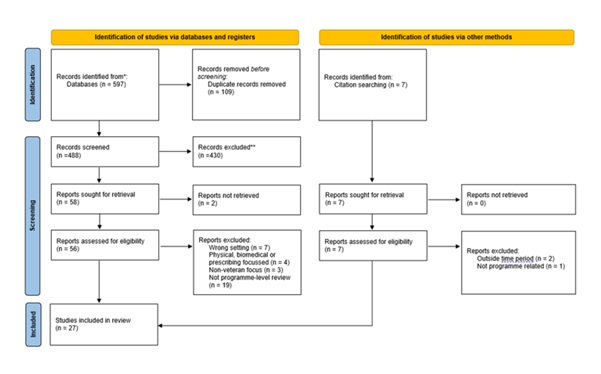
* The following databases were searched:
- MEDLINE Ovid (from 1946 onwards).
- APA PsycInfo Ovid (from 1806 onwards).
- HMIC Health Management Consortium Ovid (from 1979 onwards).
** Articles excluded based on study abstract due to irrelevance:
- Non-veteran populations
- Over 65 years or under 18
- Physical health focus
- Community (non-residential)
Overview of selected evidence
Following the systematic screening and selection process outlined in the PRISMA diagram, the remaining articles represent the most relevant evidence on residential and inpatient treatment programmes for veterans with complex mental health needs. The literature highlights both the effectiveness of residential interventions and the operational characteristics that support positive outcomes.
Of the 27 studies included, the vast majority (n=21) were from the US, five from the UK and one from Canada. No studies from Australia met the inclusion criteria for the review. Study sizes varied considerably, ranging from five participants to as many as 10 832 veterans.
Furthermore, the included studies varied widely in populations, settings, time periods and methodological approaches. Due to this heterogeneity, statistical pooling of results was not appropriate. Instead, key findings have been synthesised descriptively using a narrative approach.
A full summary of the included articles can be found in Appendix 2.
Appendix 2: Summary of articles
| Author(s) | Year | Country of origin | Population | No of participants | Treatment location | Method / Design | Overview |
| Alexander JA, et al. | 2005 | US | Patients with SMI | 1638 | VA Hospital | Observational study | Cross-functional team processes associated with patient functional improvement |
| Cook JM, et al. | 2015 | US | Staff from PTSD treatment providers | 198 | VA Hospital | Semi-structured interview | Implementation of evidence-based treatments |
| Cook JM, et al. | 2015 | US | Staff from PTSD treatment providers | 201 | VA Hospital | Web-based survey | Implementation of evidence-based treatments |
| Cook JM, et al. | 2014 | US | Staff from PTSD treatment providers | 179 | VA Hospital | Qualitative Interviews | Changes in implementation of two evidence-based psychotherapies observed |
| Cook JM, et al. | 2020 | US | Staff from PTSD treatment providers | 526 | VA Hospital | Longitudinal study | Implementation of evidence-based psychotherapy treatments over time |
| Cook JM, et al. | 2020 | US | Staff from PTSD treatment providers | 159 | VA Hospital | Web-based survey | Provider attitudes vs perceptions of EBP for PTSD compared |
| Currier JM, et al. | 2014 | US | Combat-related PTSD patients | 805 | VHA Residential PTSD programme | Longitudinal residential study | Trajectories of change and predictors of treatment response identified |
| Forbes D, et al. | 2008 | US | Combat-related PTSD patients | 4339 | Various | Naturalistic observational study | Comparison of programmatic intervention models |
| Grau PP, et al. | 2022 | US | Veterans in residential PTSD programs | 10 832 | Residential PTSD centres | Cohort study | Treatment response trajectories in residential PTSD treatment models |
| Goodman M, et al | 2016 | US | Non-psychotic veterans at high risk of suicide | 91 | VA medical centre | RCT | DBT vs TAU for suicidal veterans |
| Hale AC, et al. | 2019 | US | Veterans in residential PTSD program | 123 | Residential PTSD centres | Observational study | Predictors of change in cognitive processing therapy examined |
| Haller M, et al. | 2016 | US | Veterans with alcohol use disorder & PTSD | 179 | Various | Comparative study | Pre-treatment differences between residential and outpatient settings examined |
| Harrison AJ, et al. | 2017 | US | Residential substance use patients | 189 | VA medical centre | Observational study | Interpersonal styles in relation to outcomes evaluated |
| Isobel S, Edwards C | 2017 | UK | Nurses | 5 | Acute Inpatient MH Unit | Mixed method case study | Implementation of trauma-informed care |
| Keating S, et al. | 2021 | US | Veterans with complex SUDs | 130 | VA healthcare system | Program evaluation | Residential care model effectiveness assessed |
| Kelly U, et al. | 2014 | US | Veterans in mental health settings | n/a | n/a | Review | Trauma-informed care strategies described |
| Koval RD, et al. | 2016 | US | Veterans in inpatient MH beds | VA medical centre | Program implementation evaluation | Readmission rates assessed | |
| Madigan A, et al. | 2020 | UK | UK Veterans with PTSD | 8 | Combat stress treatment centres | Observational study | Factors facilitating treatment completion identified |
| Menefee DS, et al. | 2016 | US | Inpatient veterans | 584 | VA Hospital | Implementation & evaluation | Patient perceptions and outcomes assessed for trauma-focused treatment |
| McDonagh JG, et al. | 2019 | US | Programme evaluation | n/a | VHA acute psychiatric inpatient unit | Program evaluation study | Cultural change and recovery program implementation examined |
| Murphy D, et al. | 2015 | UK | UK military veterans with a diagnosis of PTSD | 246 | Combat Stress treatment centres | Observational study | Mental health & functional impairment outcomes after 6-week program |
| Murphy D, et al. | 2016 | UK | UK veterans with military-related PTSD | 401 | Combat Stress treatment centres | Observational study | Long-term treatment responses described |
| Sloan PA, et al. | 2010 | US | Programme evaluation | n/a | Veterans Affairs (VA) medical center | Comparative study | Psychiatric hospitalist models and continuity of care compared |
| Thompson JM, et al. | 2011 | Canada | Regular Force veterans | 3154 | Various | Survey | Transition to civilian life |
| Turgoose D, et al. | 2018 | UK | UK veterans in substance misuse program in prison | 33 | UK Prison | Case study | Feasibility of case management |
| Shue SA, et al. | 2023 | US | Acute inpatient mental health units | n/a | MH Units | Implementation study | Factors impacting recovery-oriented treatment planning |
| Sripada RK, Walters HM. |
2023 | US | VA residential PTSD patients and providers | 24 + 12 | Residential VA treatment centers | Survey / observational | Patient and provider perspectives on treatment |
Results
Benefits of peer support
Peer support consistently emerges as a core mechanism of engagement and recovery within veteran residential models. Veteran peers enhance trust, bridge cultural gaps with staff, model recovery and increase the credibility of treatment recommendations. In US Veterans’ Affairs (VA) residential PTSD and SUD programmes, peer specialists are integral and have been associated with improved engagement, retention and outcomes.12 Peers normalise traumatic experiences, challenge avoidance and foster hope, functioning as cultural translators rather than adjunct staff. In forensic contexts, where shame, stigma and mistrust of professionals are heightened, peer mentors may be uniquely positioned to enhance engagement.
This is supported by Sripada and Walters,13 who found that shared military experience, peer support, and cohesive multidisciplinary team (MDT) functioning strengthened trust and adherence in VA residential programmes. UK qualitative evidence similarly highlights the importance of cohort dynamics in residential settings. Madigan et al.14 highlighted four main factors that support successful treatment: relationships within the cohort, group dynamics, shared experiences, and a sense of containment. However, residential settings may also amplify pre-existing behaviours, such as an unwillingness to display vulnerability, meaning staff must take an active role in fostering psychological safety and encouraging openness.
Importance of the MDT
Evidence indicates that coordinated MDT working across psychology, psychiatry, nursing, occupational therapy, social work, physical health care and peer support is associated with improved engagement, functional outcomes and discharge planning.15,16
Substance use disorders
Substance use disorders (SUDs) are highly prevalent among veterans, who are almost twice as likely as civilians to experience alcohol-related problems,17 with risk often increasing following transition to civilian life.18 Residential settings provide a substance-free, structured environment that supports early abstinence, stabilisation, reduced exposure to triggers and intensive integrated care.
Evidence from the UK further supports the use of veteran-specific forensic interventions. Turgoose et al.19 demonstrated improved engagement and functional outcomes within a veteran-tailored forensic case management model. Although limited by its small sample size, lack of a control group and lack of long-term follow-up, the study provides some support for using integrated, veteran-focused case management with high-risk groups in forensic settings. It highlights the need for larger-scale research in this area.
There may also be benefits to treating comorbid conditions concurrently. For example, programmes like the Individualised Addictions Consultation Team (I-ACT) show the benefits of combining substance use and mental health care in a single, coordinated approach.20
Importance of staff training and attitude towards treatments
Delivering coherent care requires staff training beyond routine inpatient competencies. Longitudinal VA studies indicate that sustained training, supervision and organisational readiness are essential for the consistent implementation of evidence-based therapies.21 Where staff lacked familiarity with interventions and training pathways were inconsistent, uptake and delivery were variable. In contrast, clinicians with specialised trauma-focused training or experience working with complex veteran populations demonstrated greater confidence, competence and adherence to structured interventions, resulting in higher and more consistent implementation.22
Clinicians’ attitudes towards evidence-based therapies, including the perceived credibility and relevance of interventions such as Cognitive Processing Therapy (CPT) and Prolonged Exposure (PE), significantly influence whether these approaches are adopted and consistently implemented.21,23,24
Cook et al.25 similarly found wide variation in the implementation of evidence-based interventions across VA residential PTSD programmes, largely driven by organisational factors such as leadership, training infrastructure and service readiness. This highlights that treatment fidelity depends not only on clinician competence but also on the wider system in which care is delivered.
Benefits of structured routines
Effective residential programmes require predictable weekly structures balancing stabilisation, skills development, trauma processing, occupation and social connection. Evidence from the US VA Residential Rehabilitation Treatment Programmes indicates that veterans benefit from structured routines, community meetings, grounding and regulation groups and access to trauma-focused therapy when they are clinically ready. Furthermore, occupational therapy is central to sensory regulation, identity reconstruction and functional recovery, while structured physical activity and meaningful programming enhance engagement.
Importance of being trauma-informed
The physical and relational environment must be trauma-informed, as inpatient settings can inadvertently replicate powerlessness and unpredictability, risking re-traumatisation.26 Predictability, transparency and proportional security practices are therefore essential, particularly for veterans whose trauma may involve moral injury and hierarchical power dynamics. Environmental adaptations such as sensory spaces and calming décor enhance regulation and engagement. The ward culture should explicitly acknowledge and value veteran identity, using language and visual materials that reflect shared experience without reinforcing harmful aspects of military conditioning. Although forensic security requirements must be met, these should be delivered in a way that remains relational, respectful and proportional. Studies indicate that trauma-informed and recovery-oriented implementation improves staff-patient relationships and increases veteran participation in treatment planning, while fostering ward cultures associated with greater safety and reduced conflict.16,27-29
Benefits of residential vs outpatient care
Residential care is particularly helpful for veterans with complex trauma, psychosocial instability or high forensic risk. Compared to outpatient services, those entering residential programmes often present with more severe substance use, functional difficulties and social instability, reflecting higher overall complexity.30 These individuals may progress more slowly, highlighting the need to match treatment intensity to clinical need and provide ongoing assessment.31,32 As a result, progress in residential or inpatient settings may be slower or more variable, reinforcing the importance of flexible, individualised care.
Menefee et al.33 found that a 30-day inpatient trauma-focused programme for veterans with PTSD and complex presentations, including comorbidity and suicidality, was well tolerated with relatively high completion rates, suggesting inpatient care can support stabilisation in severe cases where engagement with outpatient treatment may be more difficult.
Studies from the UK show that intensive residential programmes can significantly reduce PTSD, depression, anxiety, anger, alcohol misuse and functional impairment, with peer support and consistency improving outcomes.34,35 In contrast to outpatient care, residential settings allow veterans to stabilise before trauma processing, receive high-intensity support and practise coping strategies in a controlled environment.
Treatment offers
Regarding the therapeutic interventions that should be provided within residential care, CPT, PE and Eye Movement Desensitisation and Reprocessing (EMDR) remain the most strongly supported psychological treatments for veteran PTSD. While adjunctive approaches, such as mindfulness and Dialectical Behaviour Therapy (DBT), have been explored for veterans with complex presentations, including suicidality and emotional dysregulation, evidence supporting their effectiveness beyond standard multidisciplinary care is less robust.36,37
Treatment response and completion are influenced by factors such as PTSD severity, comorbid depression, substance use and functional impairment.3,38,39
Importance of continuity of care
United States VA evidence consistently identifies continuity of care as a key predictor of reduced relapse, reoffending and suicide risk. Veterans in forensic and high-risk settings require coordinated transitions between services, involving health, justice and social care systems. In the UK, this includes community mental health teams (CMHTs), NHS Op COURAGE services, probation, the Ministry of Justice, housing providers, veteran charities, where applicable, and multiagency public protection arrangements (MAPPA). Comparable integrated pathways are provided through the VA in the US, Veterans Affairs Canada (VAC) and associated provincial services in Canada, and the Department of Veterans’ Affairs alongside state-based health and justice services in Australia. Aftercare should include peer support, psychological follow-up, vocational input and rapid re-engagement pathways if the veteran begins to deteriorate.
Discussion
Overall, the literature demonstrates that well-designed residential veteran programmes provide an integrated therapeutic ecosystem that combines trauma-focused, culturally informed care, interdisciplinary collaboration, peer support and complementary interventions, resulting in improved engagement, symptom reduction, identity reconstruction and recovery for high-need forensic veteran populations.
Although the available literature is limited, especially in forensic contexts, consistent themes emerge across inpatient mental health units, VA residential programmes and trauma-informed systems of care. These themes provide a foundation for understanding what makes therapeutic environments effective, why veteran culture matters and how system-level pressures shape what is possible.
Currently, no mental health trust in England offers a dedicated inpatient programme for veterans (FOI request, 2025), and veterans receive standard care that may not adequately address their distinct clinical presentations or military cultural needs.
While the reviewed VA studies benefit from relatively well-resourced systems, the UK operates under very different structural constraints. NHS mental health services, including forensic settings, are under sustained pressure from workforce shortages, increasing demand and rising patient acuity, reflecting a broader mismatch between service capacity and need.40 These pressures directly affect therapeutic environments, limiting opportunities for staff training, reflective practice and meaningful occupational rehabilitation. Initiatives often require sustained investment, yet turnover and staffing pressures combined with cost-cutting measures limit their implementation. Any proposed residential model for veterans must therefore be realistic about resource constraints and may need to rely on innovations such as staff learning multiple roles, having peers help run groups, partnerships with the third sector, and structured weekly programmes that do not depend on high staffing ratios. The organisational context will heavily shape what can be delivered and how reliably.
Despite evidence supporting the effectiveness of residential PTSD treatment, particularly for veterans with complex clinical presentations, recent service developments have seen a move towards less resource-intensive models of care. Reflecting this shift, Combat Stress has transitioned from residential PTSD programmes in favour of more flexible treatment pathways, including the Veterans’ Intensive Chronic Trauma Recovery (VICTOR) programme and a structured outpatient service. VICTOR provides intensive trauma-focused treatment delivered virtually over two weeks, while the outpatient pathway offers weekly face-to-face appointments lasting 60–90 minutes.41 Although this transition is likely to offer advantages in terms of accessibility and service efficiency, it may also reflect the lower costs associated with delivering treatment virtually or on an outpatient basis compared with residential care. Emerging evidence suggests that such approaches may achieve outcomes comparable to residential treatment. Craig et al.42 compared outcomes for veterans receiving residential PTSD treatment with those participating in a Virtual Intensive Outpatient Program and found no significant differences in the degree of improvement of PTSD symptoms between the two groups, despite the virtual cohort presenting with higher baseline symptom severity. Both treatment modalities were associated with significant improvements in PTSD and depressive symptoms. These findings suggest that intensive virtual interventions may offer an effective alternative to residential care and support the development of more accessible and flexible treatment models for veterans with PTSD. Nevertheless, the evidence base for intensive virtual treatment remains relatively limited compared with the more established literature supporting residential programmes, and further research is required to determine the long-term effectiveness, cost-effectiveness and suitability of these approaches for veterans with complex needs. Furthermore, while intensive outpatient programmes may represent a viable alternative to residential care, they do not address the needs of veterans whose psychiatric presentations, by virtue of their severity and complexity, necessitate treatment within acute inpatient or forensic mental health settings.
A substantial proportion of the literature on veteran mental health focuses on PTSD, trauma and SUDs, reflecting the high prevalence and complexity of these conditions within this population. Residential programmes and evidence-based interventions have been developed and evaluated primarily in these areas, guiding effective treatment strategies. However, veterans also experience a range of other psychiatric conditions, including affective disorders such as bipolar affective disorder and anxiety and a range of psychotic disorders, for which there is comparatively little evidence on effective residential or integrated treatment approaches. A small number of studies, for example, examining veterans with bipolar affective disorder in primary care or specialty mental health settings (e.g., Sloan et al.43), suggest that these populations have unique needs. Yet, systematic research on programme-level interventions for these conditions remains limited. This gap highlights the importance of expanding the scope of research and service design to address the full spectrum of veteran mental health needs.
A key limitation across the reviewed literature is the lack of demographic diversity within study samples. Across the reviewed literature, women veterans were markedly underrepresented, typically comprising approximately 5–10% of participants in large US residential PTSD cohorts and less than 5% in UK residential treatment studies, with many programme-level evaluations failing to report gender composition altogether. This is despite recent data indicating that the proportions of women in the US and UK regular forces are 17.9% and 11.9%, respectively.44,45 This limits the generalisability of findings to women veterans and other underrepresented groups. There is also limited consideration of intersectional factors such as ethnicity, sexual orientation or cultural background. Future research should prioritise more diverse and representative samples and examine whether residential and inpatient PTSD interventions are equally effective across different demographic groups or require adaptation to meet varied needs.
An additional limitation is variation in how the term ‘veteran’ is defined across national contexts, which complicates the comparison and synthesis of findings. In the US, veteran status is typically linked to service in an operational or deployment context. In contrast, in the UK, a veteran is defined as anyone who has served in the armed forces for as little as one day. These differences mean that study populations labelled as ‘veterans’ may differ substantially in terms of military exposure, combat experience and post-service needs. To address this, the search strategy incorporated alternative terms, such as ‘ex-forces’, ‘ex-services’, and ‘former military personnel’, to capture relevant UK and international literature. Nevertheless, it is acknowledged that variations in terminology and reporting may have led to some relevant studies being missed.
A final consideration is the fundamental difference between residential treatment programmes, typically voluntary, recovery-oriented environments and inpatient hospital settings, where veterans may be admitted under mental health legislation and therefore detained against their will, for assessment or treatment. This distinction has important implications for the applicability of the literature reviewed. Residential programmes assume a degree of motivation, autonomy and readiness for engagement, whereas detained inpatients may present with lower insight, higher levels of risk and limited choice in their participation. Coercive elements of hospital care can affect therapeutic alliance, willingness to engage in trauma-focused work, and the feasibility of incorporating certain programme components such as unstructured peer activities or community-based occupational interventions. Consequently, while many principles of residential care, trauma-informed practice, multidisciplinary collaboration and veteran cultural competence remain highly relevant, their implementation within a secure inpatient environment requires adaptation to address risks, legal constraints and reduced patient agency.
Conclusion
This review demonstrates that while the evidence base for residential treatment programmes for veterans is limited compared with the extensive literature on community-based care, the existing studies converge on several principles highly applicable to forensic and long-stay secure environments. Veterans who enter prison or forensic mental health services often have complex pathways characterised by cumulative trauma exposure, identity disruption following military transition, and high rates of PTSD, substance misuse and physical comorbidity, factors that increase vulnerability to offending and clinical deterioration. The central literature shows that the most effective veteran-focused programmes, regardless of country or clinical setting, emphasise trauma-informed, predictable environments, integrated multidisciplinary care, strong peer support and rehabilitation models that rebuild functioning, identity and purpose. These principles translate well to secure settings, where structured environments, longer lengths of stay and intensive staffing can be leveraged to deliver high-quality, evidence-based interventions that many community services struggle to provide consistently.
At the same time, literature highlights the importance of understanding military culture, addressing social disconnection and providing meaningful occupation, all of which are critical to engagement, recovery and risk reduction for veterans in secure care. System-level barriers, including under-resourced inpatient pathways in the NHS and variable access to complementary therapies, present ongoing challenges but also opportunities for innovation within forensic hospitals that already host skilled MDTs and specialised rehabilitation teams. Taken together, the evidence suggests that developing a comprehensive, trauma-informed, culturally competent inpatient programme for veterans in secure care is both justified and timely. Such a programme has the potential to address an unmet need, improve clinical outcomes and reduce recidivism.