


ABSTRACT
Purpose: This study investigated the work, leisure and sport physical activity levels among military personnel and the relationship with their mental wellbeing.
Materials & methods: A sample of 490 officers from the Air Guard, Coast Guard, Regiment and Reserve formations of the Trinidad and Tobago military participated in this cross-sectional study. Participants ranged in age from 18–64 years, with an uneven gender split (76 females and 414 males). Participants completed self-reported surveys: the Baecke Habitual Physical Activity Questionnaire (BHPAQ) and the World Health Organization Wellbeing Index (WHO-5) questionnaire.
Results: The average total physical activity level was 60%, and the average wellbeing level was 47%. More specifically, across the physical activity domains, participants reported a relatively high work index (3.50 ± 0.606), moderate sport (2.70 ± 0.570) and leisure index (2.78 ± 0.603). Standard multiple regression analysis showed the overall model was significant (F(3, 486) = 5.445, p = 0.001), explaining 3.3% of the variance in wellbeing (R² = 0.033, adjusted R² = 0.027). Among the predictors, the work index emerged as the strongest predictor of wellbeing (β = 0.155, p = 0.001).
Conclusion: This study revealed significant but weak associations between the leisure, work and sport domains in relation to subjective wellbeing. This research sheds new light on physical activity and wellbeing patterns within Caribbean military populations. It provides key insights into specific factors the military organisation can target to improve wellbeing.
Keywords: military populations, mental wellbeing, military support
INTRODUCTION
Anecdotal accounts from within the Trinidad and Tobago Defence Force (TTDF) revealed the presence of high levels of lifestyle-related diseases among military personnel. However, no previous quantitative assessments of domain-specific physical activity behaviours and wellbeing among military personnel have been conducted in Trinidad and Tobago or within the Caribbean, more broadly. Military jobs primarily depend on officers maintaining standards of physical fitness, weight and body composition. Upholding these standards helps military personnel withstand the physical demands of their environment while lowering the risk of injury on duty. Appropriate diet, rest and exercise are listed as the performance triad factors that promote physical fitness, optimal body composition, psychological wellbeing and overall health.1 In fact, research has shown that those who engage in regular physical activity have reported a higher quality of life, wellbeing and overall mood.2 Maintaining the physical and mental wellbeing of military personnel has significant, long-term public health implications. A healthy military is directly linked to enhanced disaster response capabilities, and regional security and stability.3
Physical activity demands of military personnel
The TTDF has a broad mandate that encompasses national security, civil assistance during natural disasters and emergencies, and international obligations to participate in peacekeeping missions and humanitarian crises abroad (Trinidad and Tobago Defence Force Formations, n.d. https://ttdf.mil.tt). The amount of physical activity required in military service therefore depends on the duties assigned. Some tasks demand significant physical effort, while others require minimal effort. For example, combat operations and training require soldiers to maintain a high level of physical fitness, which may increase injury risk.4 Alternatively, some administrative roles require prolonged periods of inactivity at a desk, leaving little time for physical activity. Additionally, physical activity levels may vary by rank. In sum, maintaining healthy physical activity levels might become challenging for some military personnel, particularly in branches of the services that involve administrative duties. The current military environment may therefore not support optimal physical activity levels for service members because many tasks have been reallocated due to increased reliance on technology, reducing manual labour.5
Consequences of physical inactivity and sedentary behaviours
Research has revealed significant negative consequences of physical inactivity and sedentary behaviours among military personnel. According to US research, the military population experienced an increase in obesity.5 US military studies conducted between 1975 and 2015 indicate that body mass index increased in a nearly linear manner among both Army basic trainees on entry to service since 1975.6 A review that examined the determinants of obesity in military populations showed that obesity was significantly more common in men, over the age of 34, in lower ranks, married officers and members of specific ethnic groups (e.g., African-American and Hispanic communities).7 Obesity and overweight are associated with other co-morbidities such as type 2 diabetes and hypertension, as well as lower life expectancy, decreased productivity at work, and joint and back problems.8 Studies on the prevalence of hypertension within the active-duty armed forces personnel of Brazil found that compared to the general population, which had a prevalence of 12%, the Air Force had a prevalence of 22%.9
According to the World Health Organization (WHO), good mental health and wellbeing means being able to manage stress in daily life and use one’s skills to work and benefit society.10 The stressors experienced by military personnel during deployment are different and potentially more traumatic than those encountered by civilians. Some of these high-risk experiences have been shown to affect service members’ wellbeing as they adjust to civilian life.11,12 Long-term stressors can harm a person’s physical and mental wellbeing, impairing their ability to function and grow as individuals even when they are not on the job.13 Some of the unavoidable stressors that military personnel must confront at times include insufficient food or sleep, poor hygiene, physically demanding jobs, erratic schedules and exposure to traumatic or violent events. Additional stressors in the work and life domains include negative leadership, work-family conflict, moves to foreign residence, financial difficulties, post-deployment reintegration, and risk of psychological and physical combat injuries/death.14-16 These factors can exacerbate the stress that military personnel experience.
Studies on the relationship between PA and the mental health of military personnel have been primarily conducted on veterans,17 with little research on active-duty military personnel. Furthermore, most research on the wellbeing of military personnel has been conducted on US service members. This is largely because a substantial body of research on service member wellbeing has developed as a result of prolonged conflicts in which the US has been involved over many decades.12 Consequently, the breadth of research literature, although evident,18 is not nearly as substantial within other countries. At present, the wellbeing of the military armed forces within the Caribbean region is yet to be investigated.
This research study’s aims were drawn from anecdotal reports of an increased incidence of lifestyle-related diseases linked to physical inactivity, sedentary behaviours and poor nutrition habits within the TTDF. However, limited research has examined the physical activity patterns and wellbeing of military populations within developing countries, and none in the Caribbean context. Additionally, no previous quantitative assessment of domain-specific physical activity and wellbeing in Caribbean military personnel has used validated instruments. As such, the main objective of this study was to determine the physical activity and wellbeing behaviours of the TTDF personnel. More specifically, the study sought to determine the leisure, work and sport/physical activity patterns of TTDF service members, and explore relationships between these and their subjective wellbeing. We hypothesised that higher levels of domain-specific leisure, work, sport and overall physical activity would be positively associated with subjective wellbeing.
Materials and methods
Participants
A total of 653 participants attempted the survey via an online link. However, 163 invalid questionnaires were excluded due to non-completion. As a result, 490 valid questionnaires were completed, for a response rate of approximately 75%. The convenience sampling method with strata was used to collect data from 490 TTDF members (76 females and 414 males) who participated in this study (Table 1). The population was divided into subgroups (i.e., Regiment, Coast Guard, Air Guard and Reserves), and a quota determined for the sample size based on the eligible population of each subgroup. Participants ranged in age from 18 to 64 years, with most falling in the 25 to 34-year-old (37.3%) and 35 to 44-year-old (35.7%) age brackets. Participants represented various branches of the TTDF, including the Regiment (61.2%), Coast Guard (27.1%), Air Guard (9.0%) and Reserves (2.7%). Regarding the highest level of education attained, most participants (47.8%) completed secondary school, while ~20% completed a degree from a tertiary-level institute (15.7% had a bachelor’s degree and 5.1% graduate or professional degree). Most participants were junior officers (73.3%), followed by senior officers (19.2%) and commissioned officers (7.6%).
Procedure
This cross-sectional study assessed participants’ physical activity levels and wellbeing. All participants provided informed consent, and the University of Trinidad and Tobago Research Ethics Committee approved the study (UTT-T/83/24). Data were collected via online surveys, which were developed and distributed using secure survey software (Qualtrics, Provo, UT, USA). The survey link was emailed to all TTDF members who met the study criteria, including being at least 18 years old, on active duty and having completed all initial military entry training. Participants learned the study’s purpose and voluntary nature via pre-distributed digital awareness posters. All participants were also informed that their identities and individual survey responses would remain anonymous, and that no TTDF personnel would have access to survey responses. The survey took participants approximately 10 minutes to complete.
Physical activity questionnaire
Physical activity levels were assessed using the Baecke Habitual Physical Activity Questionnaire (BHPAQ) (19). The BHPAQ evaluates an individual’s physical activities for the past 12 months. The questionnaire comprises 16 questions organised into three indices: 1) the work index, which measures physical effort and movement during work tasks, 2) the sport index, which evaluates structured physical activity in sports, and 3) the leisure index, which evaluates general daily activities outside of work and sport. For the work and leisure indices, questions are scored using a 5-point Likert scale. For the sport index, responses are weighted by sport type, intensity level, frequency and duration. Each physical activity domain score ranges from 1 to 5 points, with higher scores corresponding to higher levels of physical activity. Research evidence has shown adequate construct validity and reliability of this instrument.19,20
Wellbeing questionnaire
Wellbeing levels were assessed using the World Health Organization Wellbeing Index (WHO-5) questionnaire, which evaluates a participant’s emotional wellbeing over 14 days.21 The WHO-5 is a survey tool used to gauge respondents’ subjective wellbeing and identify psychological distress.21 Research evidence supports the instrument’s adequate internal consistency.21 The WHO-5 questionnaire requires participants to respond to five items that evaluate mental wellbeing rather than symptoms, and is considered a valid and reliable indicator of mental health in a clinical context.21 Each question is scored using a 6-point scale.
Data and statistical analysis
All data were collated in Microsoft Excel, and negatively worded items were reverse-coded before analysis. Participants with incomplete survey responses were removed from the sample. Descriptive statistics summarised participants’ demographic characteristics. Subscale scores were analysed and reported as mean ± SD or frequency (%) means. A linear regression analysis was used to quantify the direction and strength of the relationship between wellbeing (dependent variable) and total physical activity scores (independent variables). Additionally, a standard multiple regression analysis was conducted to evaluate the extent to which each BHPAQ domain (work, sport, and leisure) independently predicted participants’ wellbeing scores. This multiple regression approach was selected because the BHPAQ is a theory-based model with distinct but complementary indices, making simultaneous entry appropriate for assessing each domain’s unique contribution to wellbeing. All assumptions for each regression analysis were tested and met for each analysis. Statistical significance for all analyses was set at α = 0.05. All analyses were performed with JASP software (Version 0.19.3, JASP Team, 2025).
Results
Physical activity and wellbeing
Participants’ average total physical activity score was 9/15 points (~60%; Table 2). Across the three physical activity domains, work-related physical activity was highest (average = 3.50/5 points), followed by leisure-related physical activity (average = 2.78/5 points), and sport-related physical activity (2.70/5 points). Physical activity levels varied across demographic categories. Participants in the 25 to 34-year-old and 18 to 24-year-old age groups had the highest average physical activity scores, scoring 9.4 points (~63%) and 9.3 points (~62%), respectively (Figure 1). Males demonstrated higher physical activity levels (9.1 points or ~61%) than females (8.3 points or ~55%; Figure 2). By rank, commissioned officers reported the highest physical activity levels (9.6 points or ~64%). The overall average wellbeing score for all participants was 11.8/25 points (~47%; Table 2). Wellbeing scores showed variation across demographic categories. Younger participants, particularly those aged 18–24 years, reported the highest average wellbeing score (13.5 points or ~54%), while those aged 45–54 years had notably lower scores (9.2 points or ~37%; Figure 1). Female participants had a higher wellbeing score (12.7 points or ~51%) compared to males (11.6 points or ~46%; Figure 2). Among military ranks, junior officers reported the highest wellbeing scores (12.1 points or ~48%), while senior officers scoring lowest (10.6 points or ~42.4%; Figure 3).
Relationship between physical activity and wellbeing
The linear regression model examining the relationship between total physical activity and wellbeing was not significant (F(1488) = 0.389, p = 0.533) and accounted for 0.1% of the variance in wellbeing. Subsequently, a standard multiple regression analysis was conducted to determine the extent to which each physical activity domain (work, sport and leisure) independently contributed to participants’ wellbeing scores. The overall model was significant (F(3, 486) = 5.445, p = 0.001), explaining 3.3% of the variance in wellbeing (R² = 0.033; Table 3). Among the three predictors, the work index emerged as the strongest significant predictor of wellbeing (β = 0.155, p = 0.001). The sport index (β = -0.100, p = 0.032) and leisure index (β = -0.101, p = 0.033) were also significant predictors of wellbeing (Table 3).
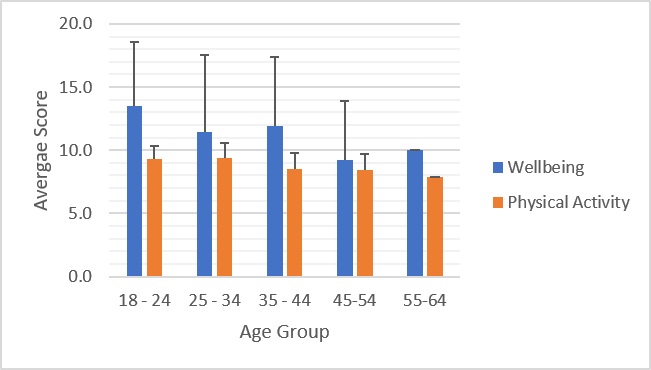
Figure 1. Participants’ average wellbeing and physical activity scores across age groups
Table 1
Demographic data of participants
Characteristic
N
%
Sex
Female
76
15.5
Male
414
84.5
Age
18–24
89
18.2
25–34
183
37.3
35–44
175
35.7
45–54
42
8.6
55–64
1
0.2
Branch
Air Guard
44
9.0
Coast Guard
133
27.1
Regiment
300
61.2
Reserves
13
2.7
Education
Secondary School level
234
47.8
Associate Degree /Diploma level
154
31.4
Tertiary level (Bachelor’s Degree)
77
15.7
Graduate or Professional Degree level (MA, MS, PhD, MD, etc.)
25
5.1
Rank
Commissioned Officer
37
7.6
Junior Officer
359
73.3
Senior Officer
94
19.2
Table 2
Participants’ average physical activity and wellbeing data (values expressed as mean ± SD)
Variable
Score (points)
Score (%)
Physical Activity (PA)
Work index
3.50 ± 0.606
70
Sport index
2.70 ± 0.570
54
Leisure index
2.78 ± 0.603
56
Total PA score
8.98 ± 1.26
60
Wellbeing
11.8 ± 5.68
47
Table 3
Multiple Regression Analyses—Predictors of wellbeing based on physical activity domains
Predictor
B
SE
β
t
p
Work index
1.448
0.444
0.155
3.26
0.001
Sport index
-0.993
0.463
-0.100
-2.15
0.032
Leisure index
-0.954
0.447
-0.101
-2.14
0.033
Intercept
12.041
1.840
6.554
<0.001
Discussion
This study aimed to examine the physical activity patterns of TTDF service members and explore their relationship with mental wellbeing. Key findings showed an average total physical activity level of 60%, and an average wellbeing level of 47%. More specifically, within the physical activity domains, participants reported average scores of 70% for work physical activity, but comparatively moderate scores for sport physical activity (54%) and leisure physical activity (56%), respectively. Moreover, the leisure, work and sport physical activity domains showed a significant but weak association with the subjective wellbeing of service members.
Physical activity comparative analysis
Findings on the physical activity behaviours of military service members in this study were consistent with those of other international military organisations. Using the BHPAQ instrument, Martins and Lopes,22 in a study of 506 active-duty Brazilian Military service personnel found, on average, lower engagement in work PA (63%) among TTDF personnel (70%). Conversely, the Brazilian Military reported higher levels of sport physical activity (73%) and slightly higher levels of leisure physical activity (58%) than TTDF members (54%) and (56%), respectively. Total physical activity scores averaged 65% in the Brazilian Military versus 60% among TTDF personnel. Additionally, a study on trends in physical activity and overweight in active-duty US military personnel over 3 years found that physical activity levels were high, with approximately 67% of the sample engaging in moderate to vigorous physical activity.23 A longitudinal study of 15 747 active-duty US military personnel investigating leisure exercise found that more than 57% of respondents met the Healthy People 2010 guidelines for moderate or vigorous leisure exercise.24 Younger participants (18–24 and 25–34 years) and junior/commissioned officers had the highest average physical activity scores, whereas older participants (45–54 and 55–64 years) and senior officers registered the lowest average physical activity scores in the current study. The findings in our study were consistent with previous research on physical activity and sedentary levels by age and type of work in the general population. For instance, white-collar/office workers in primarily sedentary jobs (which coincide with the more administrative tasks undertaken by senior-ranked officers in the TTDF) were found to be at greater risk of low work physical activity and high sedentary time.24
Wellbeing comparative analysis
In this TTDF study, younger participants (18–24 years) had the highest wellbeing scores, whereas older participants (45–54 years) had the lowest. This is in contrast with research on mental health and wellbeing by age in the general population, which revealed that persons in the older age category (40–58 years) had the lowest levels of stress and anxiety and higher levels of wellbeing compared to participants in the younger (25–29 years) category.25 This phenomena in the TTDF population may be explained by research on older military veterans who reported higher rates of trauma exposure, moral injury symptoms and may experience re-emergent post-traumatic stress disorder (PTSD) later in life due to past combat exposure & traumatic events (26). In the current study, on average, females reported higher mental wellbeing (51%) than their male counterparts (46%). These findings are not in alignment with some previous research that investigated stress and mental health in female military personnel. For instance, research on the Canadian Forces of 5155 regular force personnel and 3286 reservists between the ages 16 – 54, found that regular force women reported higher levels of work stress than men and were more likely to have posttraumatic stress disorder. Furthermore, reservist women were more likely than men to have depression, mood and anxiety disorders.27 Higher military-specific stressors in women military veterans have been linked to having endured more general harassment,28 lower levels of pre-deployment preparedness and deployment-related social support.29 In fact, social justice (e.g., gender equality treatment, hierarchy transparency, etc.) in the German Armed Forces was considered too strongly influence wellbeing, with psychosocial health & learning having an even stronger impact.16 Anecdotal reports from the TTDF leadership suggested that the robust enforcement of sexual harassment policies and procedures within the organisation may have resulted in reduced incidence of general harassment in women.
However, our current study did not investigate the prevalence and reasoning for specific mental health issues within the TTDF population, and as such, causal conclusions cannot be made. Additionally, this study did not investigate all work and life dimensions of wellbeing, e.g., positive work environment, leader and organisation support, job satisfaction, satisfaction with medical services, financial stability, family stability, etc. As such, these specific dimensions cannot be directly linked to wellbeing outcomes for this study. Furthermore, a key challenge in emotional and mental wellbeing research among military personnel is the difficulty of gathering accurate information. These challenges may be due to logistical issues of accessing service members in constant rotation, hesitation by members to acknowledge or report such problems while actively serving, or the delayed manifestation of mental health problems long after combat has ended.13,30 Consequently, accessing credible evidence-based research on the subjective wellbeing of military personnel remains a challenge.
Association between physical activity and wellbeing
A key finding of this study was significant but weak associations for the leisure, work and sport physical activity domains in relation to subjective wellbeing; however, no association was found between total physical activity and wellbeing levels. The direction of these associations is unclear because this study was cross-sectional. Additionally, the small effect sizes reported in our research study may have been influenced by other variables, e.g., participant characteristics (i.e., baseline health and initial fitness levels), reporting on physical activity levels by participants (i.e., variation in physical activity durations and intensities), as well as the impact of work-life factors, e.g., organisational leadership, financial stability, work-family conflicts, etc. Research in general populations investigating the relationship between physical activity and wellbeing in adults aged 18–65 years has shown strong evidence (predominantly from randomised controlled trials) that physical activity improves wellbeing and quality of life.31 Nevertheless, our findings of weak or no associations between the total physical activity and wellbeing variables are consistent with some earlier studies. A study investigating the association between physical activity, job stress and psychological stress in active-duty Brazilian Army service members found no association between overall physical activity and job stress or psychological distress. In contrast, the study found a significant association within the work and leisure physical activity domains.22 A similar weak association between both variables has been found in research on general populations.
Implications for military health promotion
The findings highlight the work, leisure and sport physical activity and wellbeing levels of TTDF personnel, which may influence their work performance and productivity within the organisation. As such, this study proposes a series of strategies to increase planned and structured sporting events and social support workshops/programs orchestrated by the TTDF organisation to facilitate increased sport and leisure physical activity levels and wellbeing outcomes for service members. However, post-research discussions with TTDF representatives revealed that during the pre-COVID period, TTDF implemented quarterly planned sporting events/activities for service members (e.g., basketball, cricket, football, etc.) that facilitated engagement in continuous leisure and sport physical activity. These planned activities may have been adversely affected during the COVID period due to nationwide shutdowns (2020–2021).
Suggested recommendations include: A) A return to pre-COVID sporting and leisure activities that would now include tailored activities for older and senior-ranked officers. B) Inclusion of mandatory annual fitness tests within the military policy to ensure adherence to acceptable fitness levels of service members by age group. Launch of a TTDF digital health initiative using wearable fitness step trackers to foster friendly fitness challenges among formations or units if feasible. C) Establishment of unit team-building support groups and mentorship programs by organisational leadership that foster psychological resilience and a strong sense of camaraderie among military personnel to enhance wellbeing.15 D) Provide workshops on healthy lifestyle behaviours and medical health awareness to reduce stress and promote wellbeing. E) The TTDF organisation should also serve as referral resources to behavioural health, fitness programs, military life counsellors, medical and spiritual support.15 While our study findings did not directly measure social support or stigma, the relatively low average wellbeing score (47%) underscores the need for broader psychosocial strategies beyond physical activity alone. In fact, 51% of soldiers in the German Armed Forces was reported to be ‘not in a state of wellbeing’.16 Social support has been consistently linked with improved mental health outcomes. Strong peer networks in military settings can reduce isolation and improve resilience.32 Reducing stigma around mental health and promoting social support are key to improving mental wellbeing. Building a culture where seeking mental health care is normalised and where peers are trained to provide support can make a significant difference in service members’ willingness to seek help.
Conclusion
In the present study, we examined, for the first time, work, leisure and sport physical activity levels among military personnel and their relationship with mental wellbeing in Caribbean military service members. The study builds on previous research by providing evidence-based findings on overall physical activity and wellbeing patterns among military personnel in the Caribbean region. The findings also provide contrasting evidence on wellbeing levels by age and gender compared to previous findings in military populations. The study also found a significant but substantially weak association between leisure, work and sport physical activity domains and subjective wellbeing, and no association between total physical activity and wellbeing levels, consistent with some previous research. Nevertheless, this research sheds new light on physical activity and wellbeing patterns within Caribbean military populations. It provides key insights into specific factors the military organisation can target to improve performance and productivity.
Please specify the URL of your file