
INTRODUCTION
Unconventional warfare is a strategic subset of the broader spectrum of irregular warfare, characterised by covert, irregular and indirect methods such as guerrilla warfare, subversion, sabotage and support to resistance movements.1 It ideally operates below the threshold of manoeuvre warfare, leveraging non-state volunteer forces, aka underground and auxiliary forces, to disrupt or subvert an illegitimate or occupying power.
The US Department of Defense defines unconventional warfare as activities conducted through or with underground, auxiliary and guerrilla forces to undermine enemy control, often blending political, military and psychological operations to achieve objectives without large-scale engagement.2
Unconventional warfare medicine operates in complex, austere environments, where medical care must be provided across the full scope and spectrum within non-permissive combat zones. Unconventional warfare demands flexibility in medical tactics and strategies, including integrating commanders’ intent, complex security systems and specialised planning to sustain the health of the resistance movement and effectiveness in denied and possibly resource-scarce environments.3
Thus, UWM differs from conventional warfare because the system’s primary patient is the covert resister, also known as the guerrilla or civilian, rather than a uniformed combatant of one’s own military. Medical support systems developed during the past 20 years of expeditionary military operations assume casualties can be backloaded internationally to return home and access advanced care. In UWM, however, the casualty is not expected to be evacuated from his location, leaving him operationally isolated from definitive medical care.
As unconventional warfare persists in global conflict zones, mapping and examining what is known about medicine in these contexts is critical to advancing knowledge, improving outcomes and preparing medical forces for future operational demands.
Despite its significance, UWM requires greater operational security and opacity, with practitioners sharing knowledge within closed networks. This lack of visibility has limited wider understanding of its principles and evolution, leaving critical gaps between policy, practice, research and innovation. By systematically clarifying known information, this scoping review seeks to responsibly bring existing evidence into the public domain, enhancing collective understanding without compromising operational security. In doing so, it aims to create a foundation for future collaboration and evidence-informed development in this vital but underexplored field of medicine.
Objective
This scoping review maps and examines the existing evidence to provide an overview of what is known about UWM in developed countries. This review is not intended to provide an in-depth analysis of medical support during individual unconventional warfare missions or conflicts. Rather, it explores UWM broadly to identify conceptual boundaries, key themes, practices, challenges and knowledge gaps within the existing literature. By systematically synthesising the available evidence, this review aimed to inform future research, doctrine and capability development in UWM.
A preliminary search for existing systematic and scoping reviews on the topic was conducted on 21 October 2025. Databases searched included the JBI Database of Systematic Reviews and Implementations Reports, the Cochrane Database of Systematic Reviews, CINAHL, PubMed, EPPI and Epistimonikos. One recently published systematic review was found;4 however, it focused on synthesising lessons learned from medical support in irregular warfare from 2000 to 2024, with an emphasis on identifying doctrinal gaps and strategic recommendations within the US military context.
Review question
The review question was: What is known about UWM practice in developed countries?
Definitions
The term developed country refers throughout to a country with a developed economy and advanced technological infrastructure relative to other less industrialised nations, as reported by the United Nations in the World Economic Situation and Prospects 2020 report.5
Colloquially, the distinctions of first-world, second-world and third-world are used in international relations literature, yet this is a Cold War-era misnomer: first-world referred to democratic nations; second-world to communist-controlled or influenced nations; and the third-world to contested nations. Despite this misnomer, alignment among what were known as first-world countries—the United States and Canada, Western Europe, Australia, Japan and New Zealand—and the developed world remains relatively strong. We mean those nations with mature healthcare systems, economies and military capabilities.
The term ‘unconventional warfare’ is defined above, but in simple terms, it means mobilising local populations against an occupying or oppressive government.6 Unconventional warfare thus relies on non-state volunteer forces from the local civilian population, blurring the distinction between militaries and non-combatants. Historical violence is generally intimate, involving small arms or close engagements, and the intensity of conflict is generally lower than in conventional warfare.
Inclusion criteria
The primary search commenced in March 2026. To guide the search strategy, a set of parameters was developed that encompassed inclusion and exclusion criteria, scientific databases, grey literature sources, search terms (Table 1), search limitations and experts to consult. Editorial articles were included owing to the valuable theoretical information that helped inform this review.
Table 1
Search strategy including system descriptors that were combined with index terms.
| System descriptors | Index terms |
| Unconventional warfare | Hybrid warfare, asymmetric warfare, non-traditional warfare, guerrilla warfare, low-intensity conflict, special operations, grey zone conflict, proxy war, resistance operations |
| Medicine and medical support | Unconventional warfare medicine, special operations medicine, combat medicine, battlefield medicine, austere medicine, tactical medicine, prolonged field care, remote medical support, forward medical care, medical logistics, medical evacuation |
| Boolean terms | The Boolean terms used will be AND and OR organised around differences in spelling and terminology, e.g. non-traditional OR non-traditional OR non-traditional AND UWM. |
Studies were included if they examined, reviewed or explored UWM in developed countries, or in contexts initiated by them. Studies were excluded if they only briefly mentioned UWM or related concepts without substantive exploration or analysis; focused on UWM between developing countries; or were not written in English. This review specifically explored unconventional warfare, not irregular warfare more broadly, recognising that UWM is a distinct subset within the wider irregular warfare framework. Accordingly, studies that focused on other forms of irregular warfare outside the scope of unconventional warfare, such as counterinsurgency or stability operations, were excluded to maintain conceptual clarity and relevance.
Participants
Individuals involved in providing or supporting medical care in unconventional warfare environments, including military medics, special operations medical personnel, and other healthcare providers (military or civilian) operating within irregular or hybrid conflict zones in developed countries.
Concept
The review focused on UWM as the systems, principles and practices that underpin medical support in non-permissive irregular warfare. It aimed to map how UWM is defined, organised and applied; identify key themes, practices and challenges; and delineate the conceptual boundaries that distinguished this field from conventional military and civilian medicine.
Context
Developed-world settings in which unconventional warfare or hybrid conflict operations occur or are planned for, including military, paramilitary and security domains. The review did not focus on specific missions or historical case analyses; instead, it examined how academic, military and policy literature on developed nations conceived, structured and discussed medical support.
Types of studies
This review included qualitative or quantitative study designs, including original peer-reviewed research, systematic, narrative and scoping reviews; policy statements; and government or industry reports. All literature used was open source and unclassified.
METHODS
This scoping review followed the Joanna Briggs Institute scoping review methodology.7,8 A scoping review was considered to be the most appropriate design to address the objectives of this study for several reasons. First, the review aimed to identify knowledge gaps, scope the body of literature, clarify key concepts and identify characteristics or factors related to the concept.9 Second, unlike a systematic review, the review did not attempt to answer a specific question, but rather examine the extent, range and nature of the literature surrounding the concept.10 The objectives, inclusion criteria and methods for this scoping review were specified in advance and documented in a previously published protocol.11
Search strategy
A search strategy using the terms listed in Table 1 was conducted in Embase, MEDLINE, Web of Science, EBSCOhost, CINAHL, Google Scholar and Epistemonikos to ensure that the optimal combination of databases for efficient searches in health, military and industry-based journals was obtained.12 A subject specialist librarian was consulted to guide the search strategy. Additionally, one of the authors applied a forward-backwards search technique for all relevant articles.
Given the topic of this scoping review, much information exists outside the scientific literature. Therefore, a thorough search of the grey literature to identify non-indexed relevant literature was conducted in Open Grey, Google and Bing using the same search terms listed in Table 1. The search focused on government and industry reports and policy statements. The search covered articles dating back to MEDLINE’s inception to capture all relevant literature.
Finally, UWM experts were consulted to ensure all relevant literature had been explored. The panel included 12 academics, physicians and medics employed in military special operations units in English-speaking developed countries. The experts were invited to review the literature list and to provide comments and feedback on findings. The experts recommended six previously unidentified articles, which were incorporated into the review.
One researcher conducted all searches and used reference management software, Covidence and EndNote X9 (Clarivate Analytics, PA, USA), to store and assess all relevant literature.13,14
Source of evidence screening and selection
The study selection process was conducted in two stages. First, two reviewers (TM & AC) evaluated the title, abstract or website content based on the defined inclusion and exclusion criteria. If the reviewer was uncertain at this stage, the article or website was included. In the second stage, full-text articles were obtained, and two reviewers (TM & AC) independently reviewed the articles and websites collected in the first stage. The reviewers grouped the articles and websites into three categories: included, excluded and uncertain. The reviewers then compared the categories to ensure interrater reliability and validity. A third reviewer reviewed any discrepancies (AD), and a consensus was reached by majority vote.
Data extraction
A custom data collection form was used to extract data that enabled charting of both general information contained within the article and information that best answered the research question.13
Ethics and dissemination
Because the methodology involves reviewing and collecting data from publicly available materials, this study does not require ethics approval.
RESULTS
Search results
The database and register search identified 12 367 records from CINAHL (n = 6659), JSTOR (n = 2763), Embase (n = 2100), Web of Science (n = 827), citation searching (n = 10) and unspecified grey literature sources (n = 8). Following removal of 2001 duplicates, 10 366 records were screened at the title and abstract stage. Of these, 10 345 were excluded, leaving 21 records for full-text assessment. One additional record was identified through backward and forward citation searching,15 and six through expert consultation,16-21 for a total of 28 articles for full-text assessment. Following this stage, 16 articles were excluded, giving a total of 12 studies included in the final review (Figure 1).
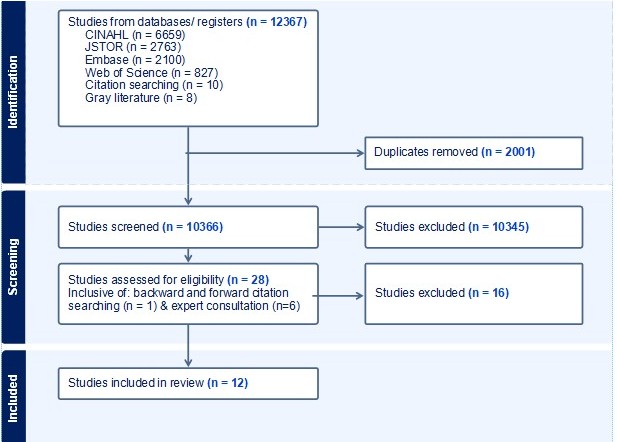
Figure 1. PRIMSA flow diagram
Characteristics of included sources
The 12 included sources spanned 58 years, from 1968 to 2026. Most originated in the United States,3,4,15-17,21-24 with contributions from the United Kingdom,18 Canada20 and New Zealand.19 Publication types included books,18-20 peer-reviewed journal articles,3,4,17,21 grey literature,15,22,23 a master’s thesis24 and a government concept paper.16 Study designs were heterogeneous; only one source constituted primary empirical research;17 the remainder comprised first-person operational accounts,18-20 narrative historical analysis,22 text and opinion,15,23 a field exercise report,21 evidence synthesis,3 systematic review4 and a government concept paper.16 No included source reported a prospective or controlled study design. A full summary of source characteristics is presented in Table 2.
Table 2
Summary of main findings from data extraction
| Author/s | Title | Year | Publication type | Origin | Operational context | Key themes |
| Parker G | The Black Scalpel | 1968 | Book | UK | World War II operational account | 1. Improvisation in medical equipment and techniques was important2. Three-tiered evacuation chain worked well, surgery delayed till in a safe country 3. Operational security drove medical decision making |
| Street B | The Parachute Ward | 1987 | Book | Canada | World War II operational account | 1. One surgeon can have a rapid, significant effect on reducing morbidity and mortality in resistance medical systems.2. Cleanliness of facility just as effective in reducing mortality as clinical interventions in austere settings. 3. Focus on continued backloading of all patients able to survive the journey. |
| Rogers L | Guerrilla Surgeon | 1957 | Book | New Zealand | World War II operational account | 1. Wounds should be managed as delayed primary closure where possible. 2. Medical infrastructure was concealed underground and in forests for operational security3. Sepsis, pressure ulcers and basic disease were larger mortality concerns than initial wounding. |
| Wade Jnr D, Erskine JF | The medical support of guerrilla forces | 1969 | Journal article | US | Field exercise review | 1. Focus on dispersing casualties using offset locations2. 20 bed hospital required 50 support personnel to function well3. Acknowledged there was a US doctrinal gap in UWM |
| Farr R | The death of the golden hour and the return of the future guerrilla hospital | 2017 | Journal article | US | Reviewing post-GWOT medical capability requirements | 1. Large, forward medical facilities with air dominance may not feature in the next conflict reducing focus on the ‘Golden Hour’2. Prolonged Field Care will rise in importance 3. SOF requires its own surgical asset |
| US Department of Defence | Non-standard medical support | 2023 | Departmental article | US | Doctrinal concept paper | 1. Argues US Special Operations Command should lead non-standard medical support efforts2. Identifies a gap in frameworks to support this capability and proposes a three pillar model |
| Hoffman L, et al. | High and tight to pack and press: Prioritisation of tourniquet conversion in unconventional warfare improves outcomes | 2026 | Journal article | US | Contemporary UW operational review | 1. Most tourniquets in this setting were able to be converted to pressure dressing2. Arterial ligation was required in 21% of cases3. Novel TQ conversion algorithm proposed |
| Hickman J | Survivability: Medical support to resistance | 2019 | Journal article | US | Review article | 1. Rapid evacuation will be a critical fail point in future operational environments.2. SOC Europe has developed a conceptual paradigm for medical support to UW3. A whole of society approach to medical resilience and resistance is required |
| Farr R | American guerrilla warfare medical doctrine – The first manual: Lessons learnt | 2006 | Journal article | US | World War II review | 1. A medical service is essential to guerrilla forces and theatre level medical control is required2. Medical supply is a chronic vulnerability3. Two contrasting hospital models in Yugoslavia and France were seen |
| Lyon R | When the ‘Golden Hour’ is dead: Preparing indigenous guerrilla medical networks for unconventional conflicts | 2021 | Thesis | US | Doctrinal concept paper | 1. Current NATO echelons of medical care not suitable for UW medical systems2. Trained personnel a significant rate limiting factor3. New structure for UW medical networks proposed |
| Jasinkas N, et al. | Unconventional warfare is the ultimate prolonged field care | 2022 | Journal article | Lithuania | Reviewing PFC exercise lessons learnt | 1. PFC will be a ‘forced necessity’ in future UW operations2. UWM lessons learnt from WWII remain relevant in contemporary practice3. Further NATO training and doctrinal work is required |
| Licina D, et al. | Medical support to irregular warfare: A systematic literature review, 2000-2024 | 2025 | Journal article | US | Literature review | 1. Most studies focused on counter-insurgency and haemorrhage control2. PFC will continue to grow in importance3. Global Health Engagement (GHE) and medical resiliency are important enablers. |
Table 3
Data extraction template
| Section | Field | Details / Options |
| 1. Study details | Author(s) | |
| Year of publication | ||
| Title | ||
| Country of origin | 1. United States 2. UK 3. Canada 4. Australia 5. Other | |
| Publication type | 1. Primary research 2. Evidence synthesis 3. Conference proceedings 4. Grey literature 5. Other | |
| Source | 1. Journal 2. Website 3. Organisation | |
| 2. Study characteristics | Study aim / purpose | |
| Study design | 1. Randomised controlled trial 2. Non-randomised experimental study 3. Cohort study 4. Cross-sectional study 5. Case-control study 6. Systematic review 7. Literature review 8. Scoping review 9. Qualitative research 10. Prevalence study 11. Case series 12. Case report 13. Diagnostic test accuracy study 14. Clinical prediction rule 15. Economic evaluation 16. Text and opinion 17. Military doctrine 18. Letter to the editor 19. Other | |
| Population / participants | ||
| 3. Context | Country classification | 1. Developed country (confirm eligibility) |
| Operational context | 1. Unconventional warfare 2. Hybrid warfare 3. Grey-zone operations 4. Guerrilla warfare 5. Low-intensity conflict operations 6. Asymmetric warfare 7. Counterinsurgency operations 8. Resistance operations 9. Irregular warfare | |
| Setting | 1. Military 2. Civilian 3. Integrated / Hybrid | |
| Environment characteristics | 1. Denied / contested 2. Austere / resource limited 3. Occupied territory 4. Covert / clandestine 5. Other 6. Multiple | |
| 4. Concept: How UWM is defined | Definition of UWM | (Verbatim if provided) |
| 5. Key findings | Summary of main findings | |
| Relevance to UWM | ||
| Emerging themes | ||
| Key quotes | ||
| 6. Limitations | Explicit gaps noted by authors |
Presentation of evidence
The included sources addressed four dimensions of UWM in relation to the review question: conceptual framing and attempted definition;3,15,16,22-24 historical operational accounts;18-21 contemporary doctrine and clinical practice;15-17,24 and evidence synthesis.3,4 None provided a formal consensus definition of UWM. Multiple contemporary sources identified the inadequacy of Global War on Terror (GWOT)-era doctrine for unconventional settings.3,4,15,23,24 Foundational knowledge was concentrated in post-World War II sources,18-22 with a significant publication gap before a cluster of contemporary work from 2017 onwards.3,4,15-17,23,24
DISCUSSION
UWM operates at the intersection of clinical practice, irregular conflict and operational security beyond conventional military medicine. The discussion that follows examines eight themes derived from the included evidence: the extreme clinical demands upon providers of all levels requiring an expanded scope of practice in a limiting environment; a call for crisis standards of care; the absence of a consensus definition; the constraining effect of GWOT-era doctrine; the fragmentation of the literature and probable underrepresentation of UWM knowledge in open sources; persistent force unpreparedness; the whole-of-society architecture UWM requires; and the strategic importance of proactive peacetime preparation.
UWM is a uniquely complex field
UWM represents the most operationally extreme expression of medical care. It imposes denied evacuation, resource scarcity, clandestine operations and indefinite care timelines that exceed those in any other form of combat medicine. Thus, the UWM is the most demanding form of operational medical care and a field in its own right. Jasinskas et al.3 articulate this position directly, characterising UWM environments as settings in which usual medical systems cannot be relied upon, where adversaries actively target medical infrastructure, where the full spectrum of medical care is a forced necessity rather than a contingency response, and subject to the impact of complex security measures. The force of this claim lies in what it excludes: conventional medicine assumes access; unconventional warfare medicine assumes denial. In this discipline, the full spectrum of care delivered without resupply, evacuation or higher echelons of support is not a contingency. It is the founding premise.
Lyon24 demonstrates that current US and NATO medical doctrine structures levels of care around available assets rather than treatment goals, a framework that fails in UWM environments where those assets cannot be assumed. The UWM practitioner must sustain life across timeframes that conventional care doctrine does not anticipate, without the expectation of eventual evacuation that shapes the clinical calculus in every other operational context. For many patients in UWM environments, evacuation is not merely delayed but is not planned at all; the model is definitive field care, in which the patient receives their full course of care in the operational environment. Farr22 makes this structural point explicit, noting that UWM is a long-dwell mission conducted without force superiority in the most immature of theatres, requiring practitioners to sustain life across timeframes and without evacuation expectations that no contemporary doctrine was designed to address.
The need for crisis standards of care
Crisis standards of care, and by extension crisis scope of practice, are rapidly developing fields adjacent to UWM but largely outside this paper’s scope. We note only that without a clear delineation of UWM, setting standards of care is arduous. The UW environment nonetheless compresses both: fewer providers; those providers carry genuine personal risk as members of the resistance movement; and the least trained are likely to deliver the greatest volume of care. This places task shifting and task sharing at the centre of UWM practice.
No uniform definition of UWM exists across literature
No consensus definition of unconventional warfare medicine exists across the 12 included sources, and no author provides a formal definition of UWM as a clinical or doctrinal construct. Operational descriptions vary in scope, framing, and how clearly they distinguish UWM from adjacent concepts, including special operations medicine, irregular warfare medicine and prolonged field care. As a result, the term carries different meanings for practitioners, planners, policymakers and researchers, preventing coherent knowledge accumulation, constraining the standardisation of training and doctrine, and limiting the comparability of future research. This is an important factor in UWM establishing its own unique body of knowledge.
Contemporary sources offer functional framings that vary considerably in scope. Farr22 characterises UWM as medical care in denied theatres relying on indigenous auxiliaries and clandestine hospitals; Hickman et al.15 operationalise it as a cyclical system of treatment and return to duty conducted entirely within occupied territory; Jasinskas et al.3 emphasise denied evacuation and reliance on auxiliary networks. Interestingly, the US Department of Defense government concept paper does not define UWM as a medical discipline; instead, it frames non-standard medical support as a broader operational category.16 Historical sources avoid the term entirely, constructing operational pictures through documented practice rather than definition.18-21
Lyon24 and Licina et al.4 both identify this absence as a primary gap, noting that roles, responsibilities and capabilities cannot be coherently assigned without a shared definition. The convergent elements across all included sources, including care in denied environments, clandestine infrastructure, improvised logistics and civilian network integration, provide the raw material for a consensus definition that does not yet exist.
UWM is outdated, limited, fragmented and underrepresented
The 12 included sources collectively constitute an extremely thin, dispersed and methodologically heterogeneous body of evidence, representing isolated contributions produced in response to operational challenges, personal initiative and institutional mandate rather than as part of a sustained and cumulative programme of inquiry into an emerging discipline. The gap in formal publication between the post-World War II operational accounts and the contemporary cluster of work beginning in 2017 represents decades in which knowledge that did exist was not translated into accessible, comparable or cumulative form and cannot be retrospectively closed by future research.
Several included sources explicitly acknowledge that a significant proportion of UWM knowledge is held in classified reports, operational debriefs, and closed professional networks rather than in accessible literature, and that this structural opacity reflects deliberate operational security requirements rather than a lack of practice. The authors of this study recognised this as part of an earlier published editorial calling for a wider, yet safe dissemination of information. The implication for this and any future review is that its findings describe what is visible in open sources and should not be read as a comprehensive account of what is known within the practitioner community. While this is a key limitation of this review, it is also a key finding worth discussing and analysing.
Farr23 most directly acknowledgement this gap, noting that the GWOT era of indigenous casualty care by 18D medics (US Special Forces medics) currently lacks documentation, identifying a significant evidence gap at the heart of the field from the author best positioned to survey it.
Licina et al.4 identify insufficient data and documentation as a structural weakness across the wider irregular warfare medicine literature. The Department of Defense concept paper directly acknowledges that a lack of comprehensive research on the effectiveness of non-standard medical support approaches in actual combat scenarios hinders drawing firm conclusions.16 Together, these acknowledgements point towards a field in which the visible evidence base is a surface expression of a substantially larger body of operational knowledge, and in which the gap between what is practised and what is documented may be more consequential for doctrine development than any specific finding the published literature can directly support.
Without a sustained research programme producing consistent, comparable and cumulative data from UWM environments, the field will continue to be practised and taught based on individual experience and historical analogy. This is not merely an academic limitation. It structurally constrains the development of evidence-informed doctrine, training standards and clinical guidelines. It will persist until the field secures the institutional investment in academic and research infrastructure that its operational significance warrants.
Global War on Terror era medical doctrine impedes preparedness for UWM
Two decades of expeditionary conflict in Afghanistan and Iraq produced the most significant advances in combat casualty care of the modern era and, simultaneously, a set of doctrinal assumptions that are directly counterproductive to preparedness for UWM.25 More specifically, the conditioning effect of GWOT-era assumptions, including air superiority, rapid medical evacuation, forward surgical access, and the expectation of an accessible and reasonably unobstructed evacuation chain, has shaped training systems, equipment programmes and institutional expectations in ways that do not transfer to unconventional settings.3,4,15,23,24 Farr23 traces this problem historically, documenting the structural shift from a GWOT model built on large forward medical facilities and air dominance to the operational realities of UWM, in which the golden hour is neither achievable nor conceptually applicable. The argument is not that the GWOT model is clinically wrong but that it is environment-specific, and that its institutionalisation has produced a medical workforce with sophisticated skills calibrated to conditions that UWM does not provide. The Department of Defense concept paper reinforces this by referencing the Ukraine conflict, noting that contested airspace, pervasive surveillance and reconnaissance, loitering drones, and indirect fires increase risk and restrict the logistics and evacuation conditions that GWOT-era doctrine presupposes.16
Lyon24 operationalises the problem at the system-design level, showing that medical treatment and evacuation networks built around battlefield dominance and asset capability function adequately in GWOT conditions where assets are predictably available and fail in UWM conditions where they are not. The proposed remedy reconceptualises levels of care around treatment goals, representing a fundamental structural departure from current doctrine not a modification. Hickman et al.15 reach the same conclusion from an exercise-based perspective, finding that conventional military health service support constructs would be wholly inadequate to support resistance movements in a peer conflict in Europe, being overstaffed and undertrained for the relevant operational environment.
US and allied forces have recognised their unpreparedness for UWM
The persistence of documented unpreparedness for UWM across more than five decades of sources is among this review’s most analytically significant findings. Wade and Erskine21 note that the US Army Special Forces medical organisation is not primarily designed to support unconventional warfare and that the US Army Medical Service has little well-documented experience establishing a clandestine medical service. Nearly six decades later, Hickman et al.15 document that US SOF surgical teams as currently configured will have low, if any, chance of survival in occupied territory, and Jasinskas et al.3 report that US medical forces cannot provide unilateral, unsupported care for severely injured SOF in a UWM environment. The language of discovery and recommendation has not materially changed over 57 years.
The 1967 field exercise reported by Wade and Erskine21 represents the first documented US attempt to operationally test establishing a clandestine hospital in a UWM setting. The exercise produced findings on indigenous personnel requirements, physical security challenges and logistics constraints that structurally match those reported in exercises conducted more than five decades later. The authors conclude that commanders and medical teams must be prepared to establish a clandestine medical service. This recommendation reappears, without material elaboration, in Jasinskas et al., Hickman et al. and the Department of Defense.3,15,16
Farr adds a further dimension to this argument. Post-World War II US Army field manuals established before Special Forces units existed contained comprehensive guerrilla medical doctrine addressing clandestine hospital establishment, indigenous medic training, non-standard evacuation and theatre-level SOF medical representation.22 That doctrine was not maintained or developed, and the institutional knowledge it represented was not transferred across generations. The Department of Defense states that no framework currently exists for medical support to operations in contested or non-permissive environments,16 a position Farr shows is historically inaccurate,22 such a framework existed and was subsequently lost.
Licina et al.4 confirm at the systematic-review level that gaps in medical doctrine remain a persistent theme across the broader irregular warfare medicine literature, and that efforts to advance medical support in these environments have progressed without a fundamental direction or universally shared foundation of knowledge. The cumulative picture across the included sources is one of recurring identification, partial institutional response, and incomplete retention of knowledge about a capability gap that has been clearly articulated for more than half a century and has yet to be resolved.
UWM requires a whole-of-society medical architecture
Military medical capability, however advanced, cannot sustain a resistance movement on its own in a denied UWM environment. Historical operational accounts and contemporary doctrine support the notion that civilian reliance is built into how UWM medical systems work, not a stopgap forced by limited resources. Hickman et al.15 state this requirement directly, noting that civilian medical infrastructure is the centre of gravity for medical support to resistance, and a workable system must draw on SOF medicine, partner military health service support and civilian capabilities at once, as interdependent layers, since none stands alone. The US Department of Defense concept paper proposes a similar three-pillar model in which shaping the operating environment, building ally and partner medical capability, and enhancing US operational flexibility work together as parts of a single system.16
Jasinskas et al.3 describe auxiliary civilian network integration as a distinct competency that requires training and validation before conflict begins, noting that if the assessment of an auxiliary asset’s motivation and reliability is incorrect, casualties become the most vulnerable point in the system. Licina et al.4 likewise confirm in their systematic review that host-nation capabilities are vital and that global health engagement is a key enabler across the irregular warfare medicine literature. Although dated, Wade and Erskine21 quantified civilian dependency in operational terms, noting that a 20-bed clandestine hospital requires at least 50 indigenous support personnel to achieve adequate security and staffing. These anecdotes underscore the importance of strong planning and preparation prior to conflict.
Proactive peacetime preparation is the decisive unrealised advantage for contemporary UWM practitioners
The contemporary UWM literature differs from its historical antecedents by a single structural argument. For the first time, UWM practitioners have time and space to prepare before conflict begins. This observation appears across multiple included sources and functions simultaneously as a strategic rationale and an implicit critique of current institutional progress. Hickman et al.15 state this directly, arguing that one great advantage over historical precedent is that preparation can now occur before a violation of national sovereignty rather than in response to one. The World War II practitioners who provide the foundational operational evidence for this field built medical systems under fire, without precedent and without access to the limited doctrinal knowledge that now exists. Contemporary practitioners have all three structural advantages but have not fully exploited any.
Jasinskas et al.3 operationalise the argument clinically, noting that building medical support for guerrilla movements is extremely challenging after conflict starts, and that relatively low-cost pre-conflict investments produce dividends in reduced battlefield mortality that reactive preparation cannot replicate. The Lithuanian Guerrilla Medicine course described by Jasinskas et al.3 represents exactly this class of proactive investment in that it’s a structured pre-conflict training programme preparing SOF medical personnel for the specific demands of UWM, subsequently tested through the annual Flaming Sword exercise (a multinational special operations field training exercise conducted in the Baltic region simulating resistance operations in a denied environment) in a simulated denied environment.
Hickman et al.15 document specific peacetime investments under way through Special Operations Command Europe (SOCEUR), including UWM training for surgical teams, partner-nation trauma centre rotations and the development of SOF interoperability standards. The Department of Defense16 applies the same logic at the policy level, arguing that it must develop a non-standard medical support construct before conflict and ground it in operational planning to set favourable conditions for US forces and partners before any specific contingency arises. Lyon24 translates this into a planning framework, proposing a systems dynamics model and decision-support algorithm that UWM medical planners can apply in advance of any specific conflict scenario.
The evidence also identifies structural limits on realising this advantage. Hickman et al.15 note that reverse-engineering resistance constructs prior to conflict is difficult because it is impossible to forecast who and what will survive an initial invasion, limiting the ability to pre-plan specific medical structures. The US Department of Defense concept paper acknowledges that peacetime capability development requires sustained political and institutional commitment, along with a level of trust and honesty with constituents, that has historically not been maintained.16 Licina et al.4 identify strategic planning as a prerequisite for medical resiliency, noting that the absence of a shared doctrinal direction has allowed efforts to progress without a common foundation of knowledge. The advantage of time and space is real and consistently identified across the contemporary literature; however, its institutional realisation is partial, inconsistent and structurally dependent on developing the consensus definition and doctrine the field does not yet possess.
LIMITATIONS
The geographic and linguistic scope of the search introduced constraints, as restricting the search to English-language sources from developed countries excluded relevant perspectives from nations where English is not the primary language and from settings outside the developed world. Furthermore, the absence of a consensus definition of UWM introduced definitional uncertainty throughout screening. Conceptual overlap with adjacent constructs, including irregular warfare, hybrid warfare and counterinsurgency, required ongoing judgements that the protocol could not fully anticipate and that reflect the definitional gap this review identifies as a primary finding.
RECOMMENDATIONS
The following recommendations emerge directly from the themes identified in this review. Each is an actionable statement directed at the research, policy and institutional communities responsible for developing unconventional warfare medicine as a field.
- A structured multinational process involving clinicians, doctrinal experts and operational practitioners must develop a consensus definition of UWM.
- Military medical doctrine must formally recognise UWM as a distinct category of care with its own training standards and clinical guidelines, separate from those developed for conventional SOF medicine.
- Military medical training programmes must be redesigned to address the conditioning effect of GWOT-era doctrine, incorporating scenarios in which air superiority, medical evacuation and conventional surgical timelines cannot be assumed.
- Systems of care (similar to TCCC and PFC) need to be developed, modelled around treatment goals, representing a fundamental structural departure from current doctrine rather than a modification.
- Establish pre-conflict whole-of-society medical planning frameworks that integrate civilian medical institutions, auxiliary networks and partner-nation military health service support and exercise them in nations at elevated risk of unconventional conflict.
- Relevant agencies and commands should be engaged to explore opportunities to responsibly translate operationally non-sensitive UWM knowledge into accessible open-source publications, where security considerations permit.
- Substantial further research into UWM is required across clinical practice, system design, logistics and outcomes in defence medical establishments in developed countries, beginning with establishing an expert consensus on research priorities in this emerging field of medicine.
CONCLUSION
This review provides the first scoping synthesis of open-source evidence on UWM in developed countries. The answer to the review question is constrained by both the volume and nature of available evidence and by the lack of a consensus definition of UWM. Furthermore, the literature is outdated and methodologically heterogeneous, and only one primary empirical study was identified across 58 years of publication.
The evidence does establish something consequential. Unconventional warfare medicine is a distinct and highly demanding form of nonpermissive, full-spectrum medical care that remains conceptually and doctrinally underdeveloped. Military medical capability alone is structurally insufficient, and effective UWM requires whole-of-society medical architectures built before conflict begins. The same capability gaps have persisted and gone unaddressed for more than five decades of doctrinal and operational development. Operational knowledge held within closed professional environments and classified systems almost certainly exceeds what this review could access.
This review is a foundation, not a conclusion. The field requires definitional consensus, substantial research investment and institutional mechanisms that prevent the recurring loss of hard-won operational knowledge.
Funding
No funding has been sought for this scoping review protocol.