

Note: Content within this review and book regarding mental health challenges may be distressing for some people. Support is available through your Chain of Command, Chaplaincy, Health Centre, Lifeline 13 1144 or Open Arms 1800 011 046.
An Australian soldier sits in an underground advanced dressing station near Ypres, Belgium, in September 1917. Oblivious to the activity around him, he has a crooked smile and a distant stare on his face. Is he mugging for the camera, relieved he has a Red Badge of Courage under his left arm bandages, happy that he is likely on his way to a general hospital in England and out of the combat zone, or just so emotionally disconnected from the horror of trench warfare that he feels nothing at all? We can never know what this anonymous witness to World War I was thinking, but his lasting image (AWM E00715) haunts those of us who have to manage and hopefully repair the invisible mental wounds of armed conflict.
Dr Ian Howie-Willis’ book From Shell Shock to PTSD: the hidden cost of war for Australian soldiers is the history of mental health disorders in Australian soldiers from the time of the Boer War to the Royal Commission into Defence and Veterans Suicide.
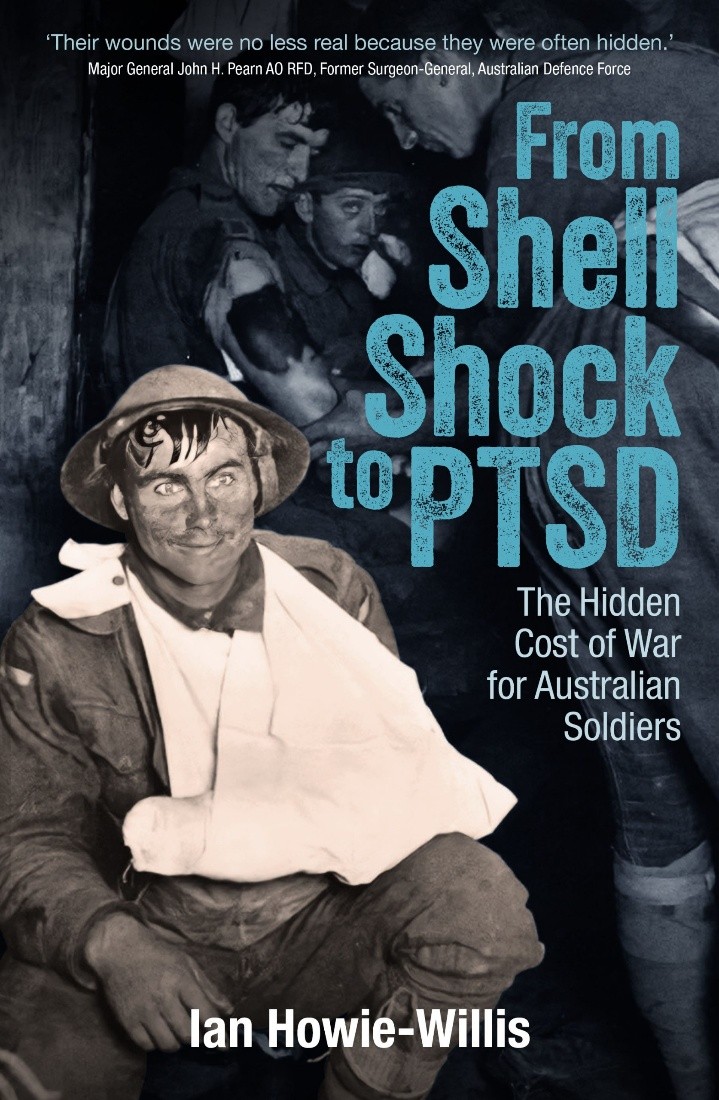
Figure caption: Cover From Shell Shock to PTSD; the hidden cost of war for Australian soldiers by Ian Howie-Willis, Big Sky Publishing; 2026. Available from: https://www.bigskypublishing.com.au/from-shell-shock-to-ptsd
The title hints at the shifting nomenclature, which has given each major conflict a separate and, at times, confusing designation for soldiers who become casualties due to mental health reasons. This is a military historian’s view of the landscape, not a clinician’s, and it provides a broad selection of the limited existing data from over a century of Australia’s wars and peacekeeping efforts. It is hard to compare across the generations, and Howie-Willis’s biggest accomplishment is allowing the reader to see the commonalities across the various conflicts despite the differing diagnoses and, at times, the official obfuscation to hide the fact that many Australian soldiers fell out due to mental illness. There are many witnesses but few heroes in this struggle to keep soldiers fit to fight in an environment that no human can endure indefinitely. Combat psychiatry teaches us that eventually everyone breaks down under unremitting stress and clinicians’ ability to predict who and when is extremely limited.
The author faithfully records much of the original data from Australia’s very large collection of official war histories. It is revealing how little was said about mental illness in those dense volumes, as it was a topic that the military and indeed society generally wanted to avoid. The reader longs for a better description of how soldiers managed to stick it out while serving in the trenches of the Western Front for months on end, not unlike the current conflict in Ukraine. The existing data reported in this book are at best fragmentary observations by a few enlightened observers. The reality was you were in the infantry until you were killed or wounded, and the most remarkable observation was that the vast majority of soldiers managed to mentally endure somehow and return from the war to be functional citizens of Australia. As building resilient soldiers is our modern mental health goal, it would have been great to better understand how their great-grandfathers did it in the original ANZACs. The mythology still exists, but there is not much data.
This is a book of history. The author does a great service to general readers with detailed summaries of war events that place mental health issues in their historical context. One cannot properly understand the psychology without understanding what was happening in the military sphere at the same time. Those readers with a pre-existing background in military history may find themselves skipping over some sections to get to the all-too-limited parts specific to mental illness. Personally, I found the author’s collection of standardised casualty statistics from previous conflicts in a single cover very useful. This assists serving medical and nursing professionals in translating the historical impact of mental health disorders into our current era.
Perhaps the hardest question posed by the history of mental health in the military is whether the current generation of soldiers is simply less resilient to stress than their forefathers. What would the medical officers of World War II have thought about having to place a mental health disclaimer in front of a book review? Clearly, much of the early experience of Anzac mental illness was understated, often for very practical reasons. Early 20th-century governments were terribly worried about the pension costs of World War I, especially during the Great Depression, the only time membership in the Australian Imperial Force was included in a national census in 1933. We discover in Howie-Willis’s book that one-third of Australian soldiers who served in East Timor are receiving compensation for mental health conditions. Nearly half of all ADF personnel who participated in Operation Tamar to Rwanda are receiving compensation from the Department of Veterans Affairs for mental health conditions. Mental health diagnoses and treatment have vastly evolved over the years, but there is now a popular perception that military service, even during peacetime, invariably breaks soldiers’ mental health. A volunteer force cannot exist in a society that refuses to send its sons and daughters into the military, yet expects them to be broken and untrained to endure great difficulties. The reason to read From Shell Shock to PTSD is to gain historical perspective on the evolving relationship of Australian society to its military forces and how we are now better able to address the inevitable mental cost to some who choose to serve in our nation’s armed forces.
Author affiliations: Australian Defence Force Infectious Disease and Malaria Institute, Gallipoli Barracks, Enoggera, Queensland, Australia
University of Queensland, School of Public Health, Brisbane, Herston, Queensland, Australia
Funding: No specific funding was provided for this work. The author is an employee of the Australian Defence Force, a retired US Army officer and claims no conflicts of interest.
Disclaimer: The opinions expressed are those of the author and do not necessarily reflect those of the Australian Defence Force or the US Department of Defense.