


Abstract
Background: Military personnel operate under high-stress conditions that challenge mental wellbeing. In Malaysia, particularly East Malaysia, research on psychological distress among military members remains limited.
Purpose: This study examines the relationship between work–life balance (WLB), job demands and resources (JD–R), and sociodemographic factors with psychological distress among military personnel in Southern Sarawak.
Material and methods: A cross-sectional study was conducted among 471 male army personnel from three major camps in Southern Sarawak using stratified random sampling. Data were collected using validated Malay versions of the WLB Scale and the Depression, Anxiety and Stress Scale (DASS-21).
Results: While 95.3% of respondents reported Good WLB, 34.6% experienced psychological distress, with anxiety being the most prevalent (31.2%), followed by depression (24.6%) and stress (12.7%). Multivariate logistic regression identified poor WLB, high workload and substance use as significant predictors of distress. Marital status emerged as a protective factor.
Conclusion: Psychological distress remains a concern even among personnel reporting Good WLB. Interventions should focus on managing workload and substance use while strengthening family support systems.
Keywords: Work–life balance, psychological distress, military personnel, JD–R model, anxiety.
Introduction
Military personnel operate in environments characterised by high operational demands, psychological strain and limited personal autonomy. These conditions necessitate sustained physical, emotional and cognitive resilience. In Malaysia, particularly in East Malaysia, the mental health of military personnel remains underexplored, despite increasing national and global attention to occupational mental health.1 The introduction of the Army Strategic Capability Development Plan 2021–2050 (Army4NextG) envisions a future-ready force with advanced capabilities.2 This transformation emphasises advanced cognitive readiness and the acquisition of technical skills. However, the psychosocial implications of the changes might be significant. The increased demand for professional skills and the adoption of more complex operational roles may inadvertently place a heavier cognitive load on service members. Burnout and psychological distress are more likely to occur when these changing organisational needs are not matched with a proportional rise in psychological resources, which could jeopardise the modernisation that the plan is attempting to accomplish. To understand how these occupational factors influence psychological outcomes, this study utilises the Job demands–resources (JD–R) model as a comprehensive theoretical framework. Originally developed by Demerouti et al.3 and refined by Schaufeli and Bakker,4 the JD–R model posits that every occupation has unique demands and resources that interact to influence employee wellbeing. In this study, job demands refer to aspects that require sustained effort, such as high workload and deployment history. In contrast, job resources are structural assets, such as rank and service duration.5 The JD–R model is particularly relevant here because it aligns with the structured culture of military roles and explains how the imbalance between demands and resources can lead to burnout and psychological distress.6
Another critical construct influencing mental health in this setting is work–life balance (WLB). WLB refers to the ability to harmonise professional responsibilities with personal life, thereby mitigating stress.7 In military contexts, achieving WLB is particularly challenging due to rigid hierarchies, unpredictable schedules and prolonged separation from family.8 Exploring WLB is significant because effective management of work and personal life has been shown to reduce tension and improve mental health within the military in general and the Malaysian Army in particular.9 Furthermore, WLB is treated as an independent factor in this study, offering novel insights into its direct impact on psychological outcomes.10 The conceptual framework is illustrated in Figure 1.
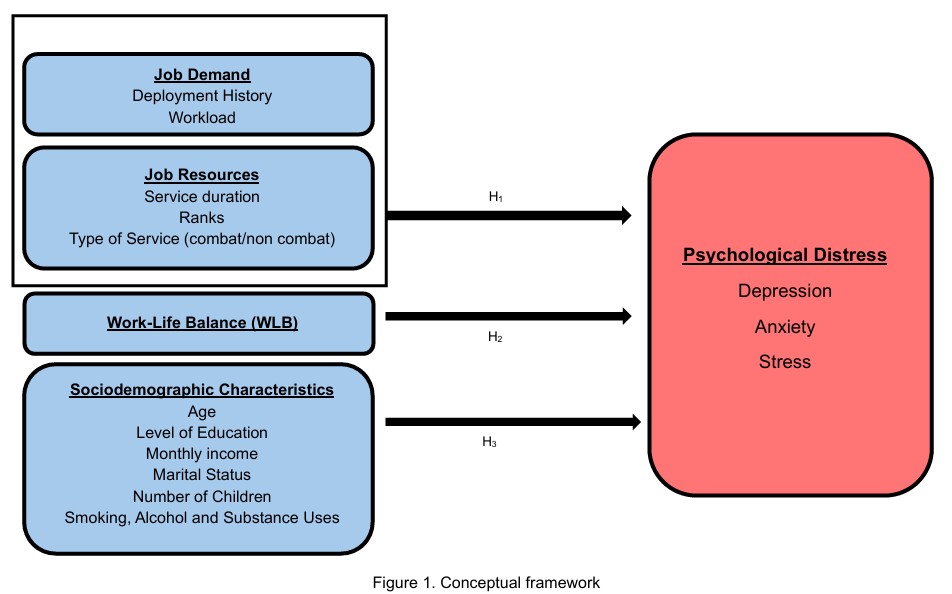
This framework illustrates the hypothesized direct relationships between three independent construct groups (JD-R, WLB and Sociodemographic Characteristic) and the multidimensional outcome of Psychological Distress.
Despite the rising prevalence of mental health disorders in Malaysia,11 empirical data regarding the psychological wellbeing of military personnel in East Malaysia remains sparse. This study addresses this critical gap by evaluating the prevalence of depression, anxiety and stress among personnel in Southern Sarawak to establish a foundational baseline for future inquiry. By analysing the interplay among the JD-R model, sociodemographic variables and WLB, this research aims to inform targeted interventions and policy frameworks to bolster mental health resilience within the Malaysian Armed Forces.
Methods
Study design and population
A quantitative cross-sectional study was conducted between October 2024 and August 2025. The population consisted of male military personnel from three major camps in Southern Sarawak of the Malaysian Army. Inclusion criteria were personnel who had served in combat or infantry battalions for more than three months. Personnel with less than three months of service were excluded to avoid confounding from transitional stress. Stratified random sampling was employed. The population was divided into three strata based on unit location: Penrissen Unit, Semenggo Unit and Muara Tuang Unit. Using a calculated sample size of 392 (adjusted to 471 for 20% attrition), participants were randomly selected proportional to unit size. The response rate was 100% (n=471).
Instrumentation
The survey consisted of four sections:
- Sociodemographics: Age, income and substance use (smoking, alcohol, illicit substances).
- JD–R factors: Job demands (workload, deployment history) and resources (rank, service duration, combat/non-combat role). Workload was assessed by frequency of extra hours; deployment was defined as operations of more than three months in the last year. Although combat and non-combat roles were initially collected as potential job resources, this variable was ultimately excluded from inferential models due to a high concentration of respondents in combat roles, preventing meaningful subgroup comparisons.
- Work–life balance (WLB): Measured using a 7-item WLB Scale adapted from Hayman (12), validated in Malay (Cronbach’s alpha 0.89). A mean score above 2.5 indicated ‘Good WLB’, as suggested by a previous study using the same questionnaire.13
- Psychological distress: Measured using the DASS-21 (Malay version), validated for the local population. It assesses depression, anxiety and stress. Scores were calculated using the standard scoring system and first categorised as Normal, Mild, Moderate, Severe or Extremely severe. For analysis purposes, ‘Normal’ was coded as absence, while ‘Mild’ to ‘Extremely severe’ indicated the presence of distress.
Data were analysed using SPSS version 29. Descriptive statistics summarised sociodemographics and prevalence. Chi-square tests assessed associations between independent variables and distress. Simple and multivariate logistic regression identified independent predictors, with statistical significance set at p <0.05.
Results
Sociodemographic and job characteristics
The 471 respondents were all male, with a mean age of 29.6 years (SD=5.68). The majority were aged 26–39 (70.5%), married (60.5%), and Junior Non-Commissioned Officers (JNCOs) (75.4%). Regarding job demands, 76.2% had been deployed in the last year, and 29.7% reported a high workload. Substance use (illicit) was reported by 5.9%, while 20.8% consumed alcohol (see Table 1).
Table 1
Sociodemographic and JD–R characteristics (N=471)
| Characteristic | Category | n | % |
| Age* | <25 years | 118 | 25.1 |
| 26–39 years | 332 | 70.5 | |
| ≥40 years | 21 | 4.5 | |
| Marital status | Single | 176 | 37.4 |
| Married | 285 | 60.5 | |
| Widower | 10 | 2.1 | |
| Rank† | JNCO (Pvt-Cpl) | 355 | 75.4 |
| SNCO (Sgt-WO1) | 105 | 22.3 | |
| Officer (2nd Lt and above) | 11 | 2.3 | |
| Service duration | ≤10 years | 271 | 57.5 |
| >10 years | 200 | 42.5 | |
| Deployment history‡ | Yes (Last 1 year) | 359 | 76.2 |
| No | 112 | 23.8 | |
| Workload | High | 140 | 29.7 |
| Normal | 331 | 70.3 | |
| Substance use | Yes | 28 | 5.9 |
| No | 443 | 94.1 | |
| Alcohol consumption | Yes | 98 | 20.8 |
| No | 373 | 79.2 |
* Age at time of data collection.
†Rank categories: JNCO = Junior Non-Commissioned Officer (Private to Corporal); SNCO = Senior Non-Commissioned Officer (Sergeant to Warrant Officer 1).
Analysis of DASS-21
DASS-21 scores showed that while most personnel scored within normal limits, clinical symptoms were notably present. Anxiety was the most frequent concern (31.2%), with 6.8% of the cohort falling into the severe or extremely severe categories. Depression was observed in 24.6% of respondents, with 4.4% reporting severe to extremely severe symptoms. Although stress was the least prevalent domain (12.7%), nearly 2% of personnel still experienced severe levels. These data highlight a significant minority of the force experiencing high-intensity psychological distress (see Table 2).
Table 2
Severity levels of depression, anxiety and stress among military personnel (N=471)
| Severity Level | Depression, n (%) | Anxiety, n (%) | Stress, n (%) |
| Normal | 355 (75.4) | 324 (68.8) | 411 (87.3) |
| Mild | 44 (9.3) | 29 (6.2) | 23 (4.9) |
| Moderate | 51 (10.8) | 86 (18.3) | 27 (5.7) |
| Severe | 12 (2.5) | 22 (4.7) | 9 (1.9) |
| Extremely Severe | 9 (1.9) | 10 (2.1) | 1 (0.2) |
* Severity categories based on DASS-21 standardised cut-off scores.
† DASS-21: Depression, Anxiety and Stress Scale – 21 Items.
‡ Percentages rounded to one decimal place.
- n: frequency.
Prevalence of WLB and psychological distress
A large majority (95.3%) reported Good WLB. However, the overall prevalence of psychological distress was 34.6%. Anxiety was the most prevalent condition (31.2%), followed by depression (24.6%) and stress (12.7%) (see Table 3).
Table 3
Reasons for exclusion of full-text articles (n=42)
| Domain | Category | n | % | Mean (SD) |
| Work–life balance | Poor WLB | 22 | 4.7 | 3.72 (0.72) |
| Good WLB | 449 | 95.3 | ||
| Depression | Normal | 355 | 75.4 | 5.55 (7.30) |
| Depression | 116 | 24.6 | ||
| Anxiety | Normal | 324 | 68.8 | 5.83 (7.16) |
| Anxiety | 147 | 31.2 | ||
| Stress | Normal | 411 | 87.3 | 6.88 (7.71) |
| Stress | 60 | 12.7 |
* Measured using the Work-Life Balance Scale (lower scores indicate poorer balance).
†Psychological distress measured via the Depression, Anxiety and Stress Scale – 21 Items (DASS-21).
‡SD = Standard Deviation.
- Prevalence based on standardised DASS-21 cut-off scores for symptomatic categories.
Factors associated with psychological distress
Chi-square analysis revealed significant associations. Poor WLB was strongly associated with all three domains of distress (p <0.001). Substance use was significantly associated with depression, anxiety and stress. High workload was associated with depression (p=0.007) and stress (p=0.030). Marital status was significantly associated with all three domains, with married personnel generally showing lower distress (see Table 4).
Table 4
Association of key factors with psychological distress (chi-square)
| Variable |
Depression (p-value) |
Anxiety (p-value) |
Stress (p-value) |
| Sociodemographic factors | |||
| Age | 0.006* | 0.034* | 0.017* |
| Marital status | <0.001* | <0.001* | 0.024* |
| Substance use | 0.001* | 0.008* | <0.001* |
| Alcohol consumption | 0.200 | 0.021* | 0.392 |
| JD–R factors | |||
| Rank | 0.607 | 0.502 | 0.010* |
| Deployment history | 0.034* | 0.477 | 0.063 |
| Workload | 0.007* | 0.112 | 0.030* |
| Work–life balance | <0.001* | <0.001* | <0.001* |
*Statistical significance at p <0.05.
†Bivariate analysis performed using chi-square test.
‡JD–R = Job demands–resources.
- Work–life balance (WLB) categorised into ‘Good’ or ‘Poor’ based on mean split.
Predictors of psychological distress
Multivariate logistic regression identified independent predictors (see Table 5).
- Depression: poor WLB increased odds by 4.6 times (aOR 4.66). Substance use (aOR 2.56) and high workload (aOR 2.17) were also risk factors. Being married was protective (aOR 0.47).
- Anxiety: poor WLB (aOR 3.29) and alcohol consumption (aOR 1.76) increased risk. Being married was protective (aOR 0.47).
- Stress: substance use was the strongest predictor (aOR 4.23), followed by Poor WLB (aOR 3.77) and high workload (aOR 2.08).
Table 5
Multivariate logistic regression: independent predictors
| Outcome | Predictor |
Adjusted odds ratio (aOR) [95% CI] |
p-value* |
| Depression | Poor WLB (vs Good) | 4.66 [1.82 – 11.91] | 0.001 |
| Substance use (Yes vs No) | 2.56 [1.12 – 5.86] | 0.026 | |
| Workload§ | 2.17 [1.33 – 3.57] | 0.002 | |
| Marital status‡ | 0.47 [0.23 – 0.96] | 0.039 | |
| Anxiety | Poor WLB (vs Good) | 3.29 [1.30 – 8.32] | 0.012 |
| Alcohol consumption (Yes vs No) | 1.76 [1.07 – 2.88] | 0.025 | |
| Marital status ‡ | 0.47 [0.24 – 0.90] | 0.022 | |
| Stress | Poor WLB (vs Good) | 3.77 [1.38 – 10.28] | 0.010 |
| Substance use (Yes vs No) | 4.23 [1.71 – 10.45] | 0.002 | |
| Workload§ | 2.08 [1.10 – 3.91] | 0.024 |
* Significant at p <0.05 in the final model.
†aOR = Adjusted odds ratio; CI = Confidence interval.
‡Reference group (Ref) for Marital status is ‘Single’.
- Reference group (Ref) for workload is ‘Normal workload’.
||Adjusted for age, service duration and rank.
¶Model fitness checked using Hosmer-Lemeshow test.
Only significant predictors (p <0.05) from the final model are shown. The model demonstrates the relationship between job demands, personal factors and psychological outcomes within the JD–R framework.
Discussion
This study examines the complex relationship between work–life balance, job demands and mental health in a military population. A striking finding is the paradox that 95.3% of respondents claimed ‘Good WLB’, while 34.6% had psychological distress. This shows that, while personnel may regard their balance as adequate, either due to military culture normalising high expectations or strong leadership cushioning perceptions, underlying distress remains. Anxiety (31.2%) was the most prevalent across the domains, aligning with evidence from the United States and Malaysian militaries that identified anxiety as a significant result of operational readiness stress.
Work–life balance (WLB) as the critical predictor
The most significant finding is that WLB is the strongest independent predictor of psychological distress across all three domains. Multivariate analysis revealed that personnel with ‘Poor WLB’ faced drastically higher odds of mental health issues compared to those with ‘Good WLB’. Specifically, poor WLB was associated with a 4.66 times higher risk of depression (aOR 4.66; 95% CI: 1.82–11.91), a 3.29 times higher risk of anxiety (aOR 3.29; 95% CI: 1.30–8.32), and a 3.77 times higher risk of stress (aOR 3.77; 95% CI: 1.38–10.28). This positioning of WLB as an independent predictor offers novel insights into its direct impact on psychological outcomes.10
This finding is significant because it positions WLB not merely as a personal preference, but as a vital ‘super-resource’ essential for psychological resilience in high-demand organisations. Within the JD–R framework, WLB functions as a critical buffer that mitigates the strain of operational demands; however, when this balance is upset, often due to the inherent rigidity of military service, rapid psychological deterioration follows.
Achieving this balance is especially difficult in military environments, where ‘greedy’ institutional demands, strict hierarchies and uncertain schedules compel unconditional commitment.7,8 Given that nearly one-third of respondents (29.7%) reported a ‘High’ workload, these findings suggest that managing the interface between professional duties and personal life is not a luxury. Rather, it is a fundamental requirement for reducing systemic tension and sustaining the force’s mental health.9
JD-R factors: demands vs resources
High workload significantly increased the odds of depression (aOR 2.17) and stress (aOR 2.08), supporting the JD-R model’s assertion that chronic physical and cognitive demands exhaust personnel’s mental resources.14 While deployment history was significant in bivariate analysis, it was not significant in the multivariate model. This suggests that the daily, sustained operational workload, often characterised by limited personal autonomy, may harm long-term mental health more than deployment itself.6 This suggests that, within this cross-sectional framework, the observed ‘health impairment process’ showed a stronger association with the chronic pressure of daily military roles than with isolated operational events.
Interestingly, job resources (rank, service duration) showed limited protective effects in the multivariate model. This may reflect shared exposure to baseline environmental and operational stressors within the ‘combat unit,’ though alternative explanations must be considered. The absence of rank and role differences may be artifactual, driven by reduced statistical power from substantial rank imbalance and sample constraints that limited direct comparisons between combat and non-combat personnel.
Sociodemographic risk factors
Social support, operationalised through marital status, served as a protective factor for depression and anxiety, highlighting the “buffering” role of personal resources, where a stable home life acts as a structural asset that helps personnel manage professional strain.15 However, this contradicts some studies suggesting military life strains marriages.16,17 Conversely, the strong association between substance use and severe stress (aOR 4.23) indicates a dangerous maladaptive coping cycle. When institutional or personal resources are perceived as inadequate to meet job demands, personnel may turn to substances to manage psychological strain, which ultimately exacerbates their distress levels. This corroborates findings on maladaptive coping in military populations.18,19
Limitations
This study has several methodological limitations that warrant acknowledgment. Primarily, the cross-sectional design prevents establishing causality between poor WLB, occupational demands and psychological distress. Additionally, reliance on self-reported questionnaires may introduce social desirability bias, particularly concerning sensitive topics like mental health and substance misuse. The reliance on dichotomous (yes/no) measures for substance and alcohol use further restricts the evaluation of consumption severity and usage patterns. Finally, the study population was limited to male army personnel in Southern Sarawak, with a substantial rank imbalance (2.3% officers) and a heavy concentration of combat personnel (compared with non-combat personnel). Consequently, these sampling constraints limit the generalisability of findings to female personnel, broader rank structures and non-combat support roles across the Malaysian Armed Forces.
Conclusion and recommendations
Future research should utilise longitudinal study designs to track changes in personnel’s mental health from initial recruitment into the armed forces through deployment. Additionally, future studies should deliberately sample across diverse operational specialties and functional roles (e.g., combat vs non-combat support) to evaluate whether specific occupational demands or resources buffer against distress. Furthermore, alcohol and substance usage should also utilise validated severity tools to ensure precision. Qualitative research might also help understand soldiers’ perceptions of specific stressors in the modern military era.
In conclusion, psychological distress affects over one-third of military personnel in Southern Sarawak, with anxiety being predominant, despite high levels of reported WLB. Poor WLB, high workload and substance use are critical risk factors. The Malaysian Armed Forces should prioritise workload management strategies, such as structured decompression periods, and enforce policies that genuinely support WLB. Furthermore, interventions targeting substance misuse and strengthening family support systems are vital for maintaining operational readiness.
Declarations
- Funding: The authors received no support from any organisation for this work.
- Conflict of interest: The authors have no conflicts of interest to declare that are relevant to the content of this article.
- Ethics approval: Ethical approval was obtained from the UNIMAS Medical Research Ethics Committee (Ref: FME/25/31) and the Malaysian Armed Forces Health Services Ethics Committee (Ref: PKAT/EK/75-43). The First Malaysian Infantry Division Commander granted permission to conduct the study within the military camps in Southern Sarawak. To ensure ethical oversight and participant safety during psychological screening, participants identified with severe or extremely severe distress on the DASS-21 scale were provided with confidential referral pathways to military health facilities for professional evaluation and support.
- Informed consent: We obtained informed consent from all participants.
- Data availability: Data are available upon request with permission from the Malaysian Armed Forces Medical Ethics Committee.