
An Immersive Mixed Reality Approach to Tactical Medical Training in Military Medicine
Dr. Dale Linegar1, Mr. Sven de Vries2, Mr. Michael Schinkel2, Mr. Benjamin Krynski1
1Blueroom Simulations, Clayton South, Australia, 2Defence Healthcare Education and Training Centre (Netherlands Ministry of Defence), Hilversum, Netherlands
Biography
Dr. Dale Linegar is Chief Technology Officer at BlueRoom Simulations, leading the development of mixed reality solutions for defence, healthcare, and emergency services. He holds a PhD from RMIT University and specialises in serious games, simulation, and immersive learning. Ben Krynski, co-founder and CEO of BlueRoom Simulations, is an experienced pre-hospital clinician and business leader driving the development of practical mixed reality training systems that enhance preparedness and performance across defence, emergency services, and healthcare. Together, the authors combine expertise in defence medicine, simulation, immersive technologies, human performance, and digital transformation to improve military medical training. Sven de Vries leads technology and digital transformation at the Defence Healthcare Education and Training Centre of the Netherlands Ministry of Defence, advancing military medical education and readiness through technology-enabled learning. Mike Schinkel brings extensive military and healthcare operational experience, focusing on human performance, education, and readiness in complex environments.
Mixed reality (MR) integrates real and virtual environments, enabling users to interact simultaneously with physical and digital elements in real time. Within military medical education, MR has emerged as a promising approach for bridging the gap between technical skills training and performance under operational stress. The BlueRoom Mixed Reality Medical Simulator (BlueRoom) was developed as an immersive extended reality training environment designed to enhance contextual realism, situational awareness, and decision-making during medical and tactical combat casualty care training.
An anonymous post-training evaluation was conducted following BlueRoom sessions delivered as an adjunct to military medical education for the Royal Netherlands Army. Participants (n=84–86 responses per item) completed a five-point likert-scale survey assessing engagement, immersion, realism, perceived stress exposure, educational value, and usability. Open-ended responses were analysed thematically to identify strengths and areas for improvement.
Learners rated BlueRoom highly as an engaging learning method (mean 4.2/5) and a valuable addition to the training programme (4.1/5). Scenario immersion and empathy were positively perceived (4.0/5), while participants reported that the environment enabled practice of medical actions under increased tension (3.7/5). Perceived realism was moderate to high (3.5/5). Adverse effects such as nausea or dizziness were limited (2.0/5). Qualitative feedback highlighted opportunities to improve visual fidelity, ergonomics, movement freedom, equipment realism, and multisensory environmental cues. Participants also advocated stronger integration with physical casualty care models and progressively complex scenarios.
Consistent with emerging evidence supporting immersive technologies in medical training, BlueRoom demonstrates potential as a blended MR training platform that enhances engagement, contextual stress exposure, and operational relevance. These findings support continued development of MR-enabled military medical simulation and further investigation of its effects on skill transfer, decision-making under pressure, team performance, and operational readiness.
Augmenting Expeditionary Medical Capability: IQARUS Forward Surgical Teams in Multinational Operations
Professor Mansoor Khan1, Mr Jonathan Kendrew
1Iqarus Gulf Fz Llc, United Arab Emirates
Biography
Professor Mansoor Khan is a trauma and humanitarian conflict surgeon whose career spans frontline medicine, executive leadership, entrepreneurship, and investment. His work uniquely bridges the high-stakes precision of the operating theatre with the strategic demands of global organisations, reflecting a rare ability to lead across both clinical and corporate arenas.
Internationally recognised in the surgical field, Professor Khan has extensive experience in trauma care, complex surgical environments, and austere humanitarian settings. He currently serves as Regional Medical Director at Iqarus, where he provides clinical leadership and operational oversight across diverse regions. In this role, he is responsible for ensuring the delivery of high-quality medical services in challenging environments, guiding multidisciplinary teams, shaping clinical governance frameworks, and aligning medical operations with broader organisational strategy.
His career is defined by adaptability, disciplined execution, and a deep commitment to impact. Whether advancing surgical care in high-risk settings, leading regional medical operations, advising ventures, or investing in innovative projects, he brings a consistent philosophy: innovation grounded in experience, empathy informed by service, and an uncompromising pursuit of excellence.
His work is marked by measurable outcomes and transformative influence, establishing him as a trusted leader and multidisciplinary professional with a truly global perspective.
In modern military operations, the delivery of timely, high-quality surgical care in austere and forward environments remains a critical determinant of survivability and mission success. Iqarus has emerged as a key enabler in this domain, providing rapidly deployable, highly trained Forward Surgical Teams (FSTs) in support of NATO and European Union Training Mission (EUTM) operations.
Over the past several years, Iqarus has consistently delivered scalable medical support across challenging operational theaters characterized by limited infrastructure, resource constraints, and evolving security dynamics. By integrating experienced surgeons, anesthetists, nurses, and pre-hospital providers with expeditionary capability, Iqarus augments existing medical frameworks and enhances operational resilience.
This model emphasizes clinical excellence, interoperability with multinational forces, and adherence to established military medical standards. Outcomes from multiple deployments demonstrate high levels of procedural success, effective damage control resuscitation, and improved casualty stabilization and evacuation readiness. Importantly, the deployment of professionally trained clinical personnel ensures continuity of care and reinforces host-nation and coalition medical capabilities.
Iqarus represents a flexible, mission-adaptable solution that bridges capability gaps in forward environments, contributing to both immediate life-saving interventions and the broader strategic objective of strengthening deployed medical systems. Its continued evolution offers a replicable framework for future multinational medical support operations.
Barriers and enablers to WHO-classified Emergency Medical Team deployment in armed conflict: a narrative literature review
SBLT Sandon Allen1
1Royal Australian Navy, Ararat, Australia
Biography
Sub-Lieutenant Sandon Allen is a third-year medical student at Deakin University with a background in paramedicine and pre-hospital care. Prior to medical school, he worked as a paramedic with Ambulance Victoria and as a Medical Sailor with the Royal Australian Navy. He holds a Bachelor of Health Science (Paramedics) from Victoria University, a Bachelor of Paramedicine with Clinical Honours and a Graduate Diploma of Advanced Paramedicine (Critical and Primary Care) from the University of Tasmania. He is completing his medical degree through the Deakin University MD Rural Training Scheme, based in Ararat, Victoria. This review, examining barriers and enablers to WHO-classified EMT deployment in armed conflict, is his first research project and was produced as part of the Deakin MD program.
Background
Armed conflict places extreme pressure on local health systems, overwhelming national capacity and requiring international support. This support is frequently provided through WHO-classified Emergency Medical Teams (EMTs), self-sufficient groups of health professionals deployed to augment local services during sudden-onset disasters and armed conflict. Since 2010, the WHO has sought to standardise and improve EMT practice through a classification system and minimum standards, codified in the Blue Book for disasters and the Red Book for armed conflict. Despite deployments in Syria, Yemen, Gaza and Ukraine, existing evidence remains fragmented across WHO reports, case studies and commentaries, with no formal review of barriers and enablers in armed conflict.
Methods
This narrative literature review searched 6,646 records, with 20 studies selected based on direct relevance to EMT deployment barriers or enablers in armed conflict settings, comprising peer-reviewed papers, WHO operational reports and policy analyses published 2010–2026. Barriers and enablers were categorised against the WHO Health System Building Blocks framework, with primary focus on service delivery, health workforce, essential medical products and technologies, and leadership and governance, the domains for which the literature was richest.
Results
Violence against healthcare workers and health infrastructure was the most consistently reported service delivery barrier. WHO documented 2,209 verified attacks on health facilities in Ukraine between 2022 and 2024, while field reports from Sudan documented facility closure rates of 70–80% among facilities serving conflict-affected populations. Restricted patient access and logistical and supply chain failure compounded these barriers, with 60–80% of trauma deaths in conflict-affected Eastern Mediterranean states occurring before hospital arrival, reflecting the collapse of ambulance and evacuation systems in environments where EMTs were operating.
Effective coordination emerged as the most significant leadership and governance enabler. The WHO EMTCC, national EMT structures and locally grounded partnerships reduced fragmentation across multiagency responses in Gaza, Mosul and Ethiopia. However, coordination was undermined when non-WHO-verified teams operated alongside classified EMTs, as in Ukraine, and when host-country leadership was absent or withdrawn.
A persistent health workforce barrier was the mismatch between WHO EMT training and the operational realities of conflict deployment. The literature identified inadequate preparedness in International Humanitarian Law (IHL), Chemical, Biological, Radiological and Nuclear (CBRN) threat response, and non-communicable disease (NCD) management as the most significant gaps. The Red Book (2021) and EMT 2030 Strategy (2023) represent important steps forward, but conflict-specific verification mechanisms and standardised deployment evaluation frameworks remain underdeveloped despite these goals.
Conclusion
This review shows that violence, access restriction and supply chain collapse are the primary barriers to conflict EMT deployment, while coordination cells, national EMT structures and local partnerships are the principal enablers. Critical gaps persist in conflict-specific training and standards verification, particularly in IHL, CBRN and NCD competencies. These findings are directly relevant to the Asia-Pacific, where EMT capability has been built for natural-hazard responses rather than armed conflict, and where Australia’s 2023 Defence Strategic Review identifies increasing strategic competition. Strengthening conflict-ready EMT capacity in this region is an emerging research and policy priority.
Barriers and facilitators to support for Australian Defence Force families during military-to-civilian transition: Recommendations for practice and service delivery
Ms Amber B. Cohen1,2, Ms Angeli Tabinga1,2, Dr Mark Westby1, Dr Emina Prguda1,2, Dr Laura G. Carrascosa1, Emeritus Professor Justin Kenardy1,2, Prof Nicola T. Fear1,3, Dr Camila Guindalini1, A/Prof Miranda Van Hooff1
1Gallipoli Medical Research, Brisbane, Australia, 2The University of Queensland, Brisbane, Australia, 3King’s College London, London, United Kingdom
Biography
A/Prof Miranda Van Hooff is Manager of Research Engagement and Development at Gallipoli Medical Research and Adjunct Associate Professor at the University of Adelaide. With over 25 years’ experience in trauma and military population health, she is a leading epidemiologist whose research has significantly advanced Australia’s understanding of veteran mental health. She led the $4.9 million Transition and Wellbeing Research Programme, which provided foundational evidence underpinning current Australian Defence Force (ADF) and Department of Veterans’ Affairs (DVA) mental health strategies.
Her expertise spans military mental health, wellbeing, family functioning, and the long-term impacts of military service. She has published extensively on veteran and first responder families, including intergenerational impacts and risk and protective factors for mental health and suicide. She also leads strategic research engagement with Invictus Australia including authorship of a national report examining the role of sport, exercise, and physical activity in military-to-civilian transition and veteran wellbeing.
As Chair of the South Australian Veterans Advisory Council and former member of the Royal Commission into Defence and Veteran Suicide advisory group, she ensures strong policy relevance. Having secured over $16.5 million in research funding and supervised 21 HDR completions, she brings outstanding expertise in research design, psychometrics, and translation.
Background
Emerging evidence suggests that military-to-civilian transition is a complex period of practical and psychosocial adaptation for the entire family unit, not solely the veteran. However, holistic and meaningful inclusion of families in transition support remains limited, and it is unclear how supports should be designed and delivered to maximise sustained engagement for both veterans and family members. This research aims to identify key recommendations to improve support for transitioning Australian Defence Force (ADF) families, by exploring barriers and facilitators to veteran and family member engagement.
Method
A series of semi-structured qualitative workshops were conducted with five ex-serving ADF veterans (Mdn age = 48 years, IQR = 6), 13 family members of serving and ex-serving ADF veterans (four parents [Mdn age = 56 years, IQR = 5], nine partners or ex-partners [Mdn age = 51 years, IQR = 9]), and 17 professionals working with ADF families in the community (Mdn age = 42 years, IQR = 8). Veteran participants had transitioned a median of 4 years ago (IQR = 2), most commonly for medical reasons (60%), and had a median service length of 26.5 years (IQR = 6.5) across the Navy (n=3) and/or Air Force (n=3). 15% of family members had a serving veteran approaching transition, while 85% had an ex-serving veteran who transitioned within the last 10 years. Participants engaged in gamified activities and group discussions, which were analysed using abductive thematic analysis.
Results
Veteran and family member engagement with support during military-to-civilian transition was shaped by five core elements: inclusivity, attitudinal change, trust, agency, and relevance. Inclusivity of support was a key barrier, influenced by veteran-centric service models that systemically exclude family members; lack of service availability and accessibility; and inequitable, fragmented service pathways resulting in inconsistent support. Participants described how stoicism and stigmatising narratives of becoming a civilian could undermine engagement with support for the entire family unit, and advocated for strengths-based support that promotes a positive outlook towards civilian life and help-seeking. Trust was described as imperative for initial and sustained engagement with support, undermined by hidden institutional agendas and enhanced by positive reputation, credibility of information, protection of privacy, and integration of peer lived experience. The bureaucratic processes involved in military-to-civilian transition and accessing associated supports was perceived to undermine families’ sense of agency, leaving them overwhelmed and disengaged despite a clear desire for support that empowers autonomy over their own transition journey. Given the overwhelming nature of military-to-civilian transition for many families, supports were seen as inherently more engaging when the relevance was clear, through culturally appropriate language, emphasis on the unique value offered to families, and support tailored to both the individual and their family circumstances.
Conclusion
Findings suggest that military-to-civilian transition is experienced by families too and offer rich insight into factors potentially undermining or facilitating veteran and family member engagement with support. This research highlights key opportunities for improving the design and delivery of transition support. Family members should be actively and meaningfully included in service eligibility, resource content and advertising efforts alongside veterans, where appropriate. Supports should be delivered flexibly and transparently to enhance accessibility, trust and tailored care, while ensuring veterans and family members retain control over if, how, and when they engage with such support. Shifting towards a strengths-based approach while addressing transition-related stressors was a key facilitator to family engagement. To promote resilience and long-term wellbeing, it is essential for practitioners, industry, and governments to shift from reactive, rigid service provision to proactive, strengths-based, and family-centred models of care.
Civilian Contractors in Air Medical Evacuation: Sustained Exposure to High-Acuity Trauma in Conflict Environments
Professor Mansoor Khan1, Mr Jonathan Kendrew
1Iqarus Gulf Fz Llc, , United Arab Emirates
Biography
Professor Mansoor Khan is a trauma and humanitarian conflict surgeon whose career spans frontline medicine, executive leadership, entrepreneurship, and investment. His work uniquely bridges the high-stakes precision of the operating theatre with the strategic demands of global organisations, reflecting a rare ability to lead across both clinical and corporate arenas.
Internationally recognised in the surgical field, Professor Khan has extensive experience in trauma care, complex surgical environments, and austere humanitarian settings. He currently serves as Regional Medical Director at Iqarus, where he provides clinical leadership and operational oversight across diverse regions. In this role, he is responsible for ensuring the delivery of high-quality medical services in challenging environments, guiding multidisciplinary teams, shaping clinical governance frameworks, and aligning medical operations with broader organisational strategy.
His career is defined by adaptability, disciplined execution, and a deep commitment to impact. Whether advancing surgical care in high-risk settings, leading regional medical operations, advising ventures, or investing in innovative projects, he brings a consistent philosophy: innovation grounded in experience, empathy informed by service, and an uncompromising pursuit of excellence.
His work is marked by measurable outcomes and transformative influence, establishing him as a trusted leader and multidisciplinary professional with a truly global perspective.
Civilian medical contractors are increasingly embedded within Air Medical Evacuation Teams (AMETs) operating in conflict-affected environments, yet their clinical exposure and contribution to operational medicine remain underrepresented in the literature. This study describes the case mix, operational tempo and clinical burden experienced by a civilian contractor over a 31-month deployment.
A prospective operational registry was analysed from July 2023 to February 2026, capturing patient encounters, mission characteristics, injury patterns and outcomes. Over 860 aeromedical callouts, 3,255 patients were managed, equating to a sustained tempo of approximately one mission per day and a mean of 3.8 patients per sortie.
Trauma accounted for 84% of cases, with gunshot wounds (n=1,276) and improvised explosive device-related injuries (n=489) representing the predominant mechanisms. Medical presentations comprised 16% of the caseload. The majority of patients (69%) were classified as wounded in action. Despite the high-acuity environment and frequent multi-casualty missions, in-flight mortality remained low at <1% (n=5).
These findings demonstrate that civilian contractors within AMET systems operate in a high-intensity clinical environment characterised by sustained exposure to penetrating and blast trauma comparable to military aeromedical evacuation platforms. This exposure provides a unique opportunity for maintaining trauma proficiency and operational readiness, potentially mitigating skill degradation during periods of low operational tempo.
Recognition of civilian contractor roles is essential for informing clinical governance, training frameworks and workforce planning within modern conflict medicine. Structured integration between military and contractor systems may offer a viable mechanism to preserve trauma competence in an evolving operational landscape.
Closing the Forward Oxygen Gap: Rugged Oxygen Generation for Contested and Austere Care
Mr Alexander Charlesworth1
1Owen International Pty Ltd, Artarmon, Australia
Biography
Alex Charlesworth is the Program Director at Owen International Pty Ltd with over 20 years of experience supporting Defence and maritime capability programs. He holds a Bachelor of Science (Honours) in Chemistry with Pharmaceutical Chemistry and has built a career spanning program management, engineering support, sustainment, business development and contract management across the Australian Defence sector.
Alex specialises in delivering complex Defence projects involving naval communications, control systems, diving and life-support equipment, and through-life support solutions. He works closely with Defence stakeholders, prime contractors and international OEMs to develop sovereign Australian capability, manage strategic partnerships and deliver critical operational outcomes.
Known for his practical leadership style, technical understanding and strong stakeholder relationships, Alex is passionate about developing teams, supporting Defence capability and strengthening Australia’s industrial and sustainment base.
Background
Oxygen has long been treated as a platform and facility resource, positioned in evacuation assets, Role 1 and higher. Large-scale combat operations, contested airspace and evacuation timelines, now measured in hours rather than minutes – and the shift to prolonged field car doctrine – means this stance is no longer practical.
Evolving clinical guidance now reinforces the shift. Updated Tactical Combat Casualty Care direction now treats oxygen saturation below 92% as a trigger for respiratory intervention at the point of injury, with supplemental oxygen directed for traumatic brain injury wherever available. The requirement to oxygenate has moved forward, but the means to do so safely has not followed.
The capability gap
The need to oxygenate early is shared across each operating environment, but what differs is how each makes traditional compressed oxygen unworkable.
At sea, compressed-gas fragmentation and fire risks are unacceptable in a submarine’s enclosed compartments. And logistics chains for refill are absent or difficult on extended deployments.
In the air, aeromedical platforms face weight, pressurisation and stowage constraints while contested airspace delays the evacuation that oxygen logistics assume.
On land, cylinders are not deployed for dismounted and point of injury care because of blast hazards. And portable oxygen concentrators fail without continuous power under heat, dust and altitude demand.
In first response, firefighters, search and rescue teams and remote ambulance services encounter oxygen depleted, power denied or hazmat conditions, where the same constraints apply.
Across all four, hypoxia – shown to triple mortality in traumatic brain injury during the prehospital phase – advances during the window when intervention matters most.
A single solution for all environments
The Rugged Oxygen Generator (ROG) addresses this shared gap through solid state chemical oxygen generation. Producing >96% medical grade oxygen at >6 L/min for 15 minutes. It requires no power, is non-pressurised and non-explosive. The chemistry is not novel to deployment, it derives from Molecular Products’ in-service heritage, including the MilSpec MPOG oxygen generator deployed today on Australia’s submarines.
Areas of use
ROG supports oxygenation at the point of injury and during transfer of ventilated patients. Validated with the Zoll Impact 731, the ROG enables oxygen to move with the patient, back from the front. Because it is non-pressurised, ROG is deliverable by uncrewed aircraft; a recent proof flight delivered a ROG payload beyond 1,000 m using a seven-inch FPV drone, restoring last mile access across contested ground. Offering a demand driven resupply method where conventional movement is interdicted.
Evidence and readiness
ROG has completed MIL-STD-810G/H qualification including vibration, thermal extremes, humidity, altitude, drop and shock. It is FDA 510 (k) cleared and UN3356 certified. For Indo-Pacific and allied forces defined by maritime separation and constrained lift, this presentation will look at how one capability closes the forward oxygen gap across Defence and civilian settings.
Combat Tourniquets and the Prevention of Iatrogenic Limb Ischaemia in Modern Warfare
Dr Patrick Weinrauch1
1Australian Army, Brisbane, Australia, 2Central Queensland University, Rockhampton, Australia
Biography
Orthopaedic Surgeon
Medical support for anticipated Australian Defence Force operations requires the capability to deliver extended duration austere healthcare in response to the constraints of contested mobility, long evacuation distances, resource limitations and tactical requirement. Combat torniquet application in Prolonged Casualty Care represents a challenge at all levels of healthcare provision and tactical command. Contemporary evidence based guidance for clinical decision making and organisational preparedness in the management of combat tourniquets in modern warfare is presented.
AI-native Physiological Guided Microwearable Sensors for Hydration, Health & Defence Force Readiness
Mr Jeff Bryant1, Mr Sean Ryan
1Wearoptimo Pty Ltd, Australia, 2Aspen Medical, Australia
Biography
Jeff has 30 years of technology focussed commercial experience working directly for and as a consultant with local and international health and medical tech, life science and clinical diagnostics companies, including senior roles at Microbio Australia, Devyser AB, Agena Bioscience, Sequenom, BD, and Bio-Rad Laboratories. He specialises in bringing new innovative technologies to market, strategic market development, commercial strategy planning and execution, strategic market entry and penetration, and sustained sales growth. Over his career Jeff has built and led high-performing commercial teams, including commercial technology sales and support operations internationally and developed robust strategic channel distribution partnerships and key account strategies across global markets.
Jeff is currently the Head of Commercialisation at WearOptimo and leads the commercial go-to-market planning and execution including commercial engagement with channel partners such as Aspen Medical and engaging with early-stage customers across the Defence, Resources and Elite Sporting sectors.
Climate change is materially intensifying the operational health challenge posed by heat, with hotter, more humid and less predictable conditions placing growing pressure on personnel operating across equatorial regions, hot temperate environments, and northern Australian training areas. These are the environments in which military forces must continue to train, deploy, and sustain readiness, and where heat stress and mis hydration can quickly degrade cognition, reaction time, decision quality, physical output and overall deployability. Current controls such as work/rest tables, wet bulb monitoring, awareness training, urine colour checks and self-reporting remain important, but they are blunt instruments: they assess environmental conditions or broad population assumptions rather than the real time physiological state of the individual soldier under load, in protective equipment, and under operational stress.
Micro wearable continuous hydration monitoring devices offer a materially different capability for the military. Worn as a small adhesive patch on the arm or shoulder, using minimally invasive microelectrodes to access relevant bio signals just beneath the skin’s surface and provide continuous hydration risk monitoring in a practical, unobtrusive form factor suited to field conditions. This creates the opportunity to identify evolving dehydration risk earlier, before it contributes to training stoppage, avoidable loss of deployable force, fatigue and degraded performance, heat exhaustion, heat stroke, evacuation, or death.
Its operational value lies in supporting both the individual and the operational commander. Timely alerts can enable hydration, cooling, pacing, rest, task adjustment, or medical escalation, while aggregated visibility can better inform commanders and medical professionals on force readiness in hot and humid conditions. This shifts the current approach to heat stress and mis hydration from not simply monitoring exercise, but to a military human performance and force enhancement capability.
Combination Topical Anaesthesia, Antisepsis, and Haemostasis for Battle Wounds—Initial Human Trial of an Established Australian Veterinary Formulation, Used on Major Wounds to Deliver Rapid and Prolonged Pain Relief.
Dr Meredith Sheil1, LT COL Professor Steven Jeffery1
1Medi-Solfen Pty Ltd, Melbourne, Australia
Biography
Dr Sheil MBBS FRACP PHD, is bringing expertise in innovative wound anaesthesia to patients with wounds in high-stress environments such as military and emergency care settings. Dr Sheil has background expertise in paediatric cardiology and managing children undergoing open heart surgery, holding a PhD from Sydney University. She is also a sheep farmer, ARC linkage grant recipient, and former honorary lecturer in veterinary medicine at Sydney University. In 2008, as a founding director of Animal Ethics Pty Ltd, Dr. Sheil developed a pioneering topical anaesthetic formulation for direct, in-field use on major open wounds in livestock. The formulation, now used globally on ~10 million animals each year, combines topical anaesthetic, antiseptic and haemostatic agents in a viscous fluid base, able to be sprayed or instilled onto wounds and persist, to provide rapid onset numbing (sufficient to enable cleaning and debriding) as well as long-acting pain relief. This was to meet an urgent need for pain mitigation in infant livestock with major open wounds, such as seen following husbandry procedures including tail amputation, skin degloving (Mules procedure), castration, burn and amputation dehorning. Using this experience, she is now advancing topical anaesthetic pain management solutions for humans with analogous serious wounds.
Introduction
Topical anaesthetic products suitable for application in war zones, disaster situations, retrieval, or emergency care, are critically needed, to treat wounds, including traumatic, blast and / or burn, and deliver prompt and sustained pain relief. In military contexts, this is needed to reduce reliance on opioids which may impair combat performance, self-preservation, and extraction capabilities. Ideally, products should also promote haemostasis, provide antisepsis, and enable pain-free wound care such as cleaning, debriding, or suturing. A topical wound anaesthetic formulation of this type (Tri-Solfen®) is well established in veterinary medicine, but has not previously been evaluated for human application. An Australian innovation, designed for use on complex livestock wounds, it combines lignocaine 5%, bupivacaine 0.5%, adrenaline (1:40,000), and cetrimide 0.5% in a biocompatible viscous fluid base that can be sprayed or instilled directly onto wounds and persist in-situ for prolonged effect. First approved in 2008, it is now extensively used for pain management in up to 10 million animals annually, with open wounds from procedures such as tail or horn amputation, castration, skin degloving (Mules procedure), or on diffuse infective ulcerative lesions. Ease of application enables rapid treatment of multiple animals, even in remote field conditions. Robust animal data confirm safety (including in doses exceeding 1ml/kg), and efficacy, with local anaesthesia onset within a minute and sensory analgesia persisting from 4 to over 24 hours, depending on wound type and species. To assess its suitability for battlefield applications, Medi-Solfen®, a GMP-compliant human formulation, has been prepared to progress to phase II clinical trials in Ukraine.
Objectives
A 2-part phase Ib/IIa ICH clinical trial to examine safety, efficacy and optimal dwell time of Medi-Solfen®, when applied to traumatic lacerations requiring suture repair.
Methods
Part 1 open label trial, including 24 adults presenting with lacerations (up to 16cm2) needing suture repair, sequentially assigned to 4 cohorts (6 patients each). Product was applied without occlusive cover allowing 15 minutes dwell-time prior to suture (Cohort 1) or with occlusive cover and allowing 5-, 10-, or 15- minutes dwell-time prior to suture in Cohorts 2 – 4 respectively. Safety parameters included systemic and local tolerability, wound healing and pharmacokinetics. Efficacy was evaluated by NRS response to needlestick (wound anaesthesia), VAS pain scores (pain relief), and rescue analgesia use. Wound bioburden was measured with quantitative swabbing.
Results
Patients with wound size range 1-6cm length, and 0.5-0.9cm width, received mean±SD Medi-Solfen® dose of 0.9±0.6ml (range 0.2-2.6ml). No clinically significant product-related adverse effects were observed in monitored safety parameters. Maximum plasma concentrations of bupivacaine and lidocaine (<0.004±.001 ug/ml), remained well below toxic thresholds. Baseline NRS scores (≥5/12) decreased significantly to ≤1/12 in all cohorts following treatment dwell time, p<0.012. Only one patient (Cohort 1), needed rescue analgesia during suturing. Baseline VAS scores (31.2±9.2 on a 100mm scale) dropped significantly to 5.0±6.7, 1.7±3.9, and 0.8±2.9 at 5, 10, and 15 minutes post-application (p≤0.007). During suture repair, mean VAS scores ranged from 0.0 in Cohort 4 (p<0.007) to 16.7± 26.6 in Cohort 1 (p<0.04). Post-operatively, mean VAS scores remained below 1.7± 8.2 from 1 to 24 hours. No participants required postoperative rescue analgesia. Bacterial growth was found in 6 of 24 patients before- but in none after- treatment.
Conclusions
Innovative use of topical anaesthesia may enable improved wound pain management on the battlefield, helping to prevent complications linked to opioid use. When applied to traumatic lacerations, Medi-Solfen® proved safe and effective, to provide rapid wound anaesthesia (sufficient for suture repair), extended pain relief, and lowered bioburden. These results align closely with preclinical animal studies involving significant open wounds and underscore the importance of further trials and development for battlefield use.
Connecting Data, Improving Care: Harnessing Organisational Intelligence Through Quality Management Systems
Ms Kayla Vella1, Mrs Kimberly Steed1
1Serco Aspac, Australia
Biography
Kayla Vella is a Quality & Governance Coordinator with Serco AsPac, supporting the Australian Defence Force Health Services Contract. She works across clinical governance, quality management and organisational reporting, helping transform data into meaningful insights that support patient safety and continuous improvement. With experience across both government and healthcare sectors, Kayla has developed expertise in quality management systems, clinical governance, risk management, data analysis and stakeholder engagement. She is passionate about using organisational intelligence to move beyond compliance reporting, enabling informed decision-making and system-wide quality improvement. Kayla is an ISO 9001:2015 Lead Auditor and has contributed to the development of governance reporting, quality management processes and continuous improvement initiatives that strengthen organisational resilience and improve health outcomes.
Health organisations can oversee multiple health sites, with each site contributing data that forms a central organisational view of quality and safety. Individually each health site collects large amounts of information every day through incidents, complaints, risks, audits and quality improvement activities, this information provides valuable insight into the performance of a single service. When data is then combined across an organisation with multiple services, it provides a much broader understanding of the organisation’s performance, trends, risks and opportunities for improvement. Actively using this health data can drive meaningful change and improve overall patient outcomes.
When data is considered in isolation, opportunities to identify broader patterns and trends, emerging risks, and system gaps can be missed. This can result in repeated incidents, delayed recognition of safety issues, inconsistent responses across services, ongoing reactive management and missed opportunities for organisational learning. In contrast, using organisational data in a connected, central way enables overarching oversight, allowing organisations to identify trends earlier, prioritise improvement efforts, and implement system wide changes that strengthen patient safety, improve care quality, and enhance patient outcomes.
Quality Management Systems provide a centralised hub for collecting, analysing, and acting on quality and safety data, supporting evidence-based decision making and system wide improvement. It assists in connecting the data between multiple health sites and displays the overarching view of the organisation. However, these systems are often underutilised and can be viewed primarily as a compliance requirement or used as a data repository, rather than a strategic tool for decision making and improvement. Health organisations often already have the data needed to identify opportunities for improvement. The challenge is turning this data into organisational intelligence that drives action.
This poster explores how organisational data can be better used to support informed decision making and drive continuous improvement. It will demonstrate how connecting data allows individual events to be seen in context, reveals patterns, recurring issues and system wide risks that provide us with intelligence to inform decision making and drive continuous improvement. A Quality Management System supports this by bringing these data sources together and enabling them to be analysed and interpreted as a whole.
Having an organisational view of data enables leaders to determine if issues are isolated or occurring broadly across health sites, understand contributing factors, and implement coordinated improvements across sites, reducing variability in care. It also supports organisational learning by sharing improvement activities that could be utilised across sites, rather than each health site addressing similar issues in isolation. It enables improvement efforts to be prioritised where they will have the greatest organisational impact, leading to more consistent care and improved patient safety.
The information required to improve patient safety often already exists within health care organisations. The opportunity lies in bringing that information together and using it to inform decisions, rather than managing trends in isolation at individual health sites. By connecting information across multiple health sites, a Quality Management System transforms individual data points into meaningful organisational intelligence. This enables organisations to identify emerging risks and trends, implement targeted quality improvement initiatives, and take a proactive rather than reactive approach to quality and safety. Ultimately, using data in this way enables a consistent approach to care across services, strengthens organisational learning, supports continuous improvement, and contributes to safer care and better patient outcomes.
Drivers, Challenges, and Maturity: The Evolution of Quality Management in the ADF Health System – A Qualitative Systematic Review
Dr Monica Ding1, Dr Andrik Lohman, Mr Grant Vickery
1Adf, Brisbane, Australia
Biography
Dr Ding has been a registered clinician since 2009, with extensive experience in research methodology, academic education, and health systems analysis. Within the Australian Defence Force (ADF), her work focuses on quality improvement and clinical governance, with a particular emphasis on psychological safety, data quality, and system‑level learning. She adopts a collaborative, multidisciplinary approach, integrating clinical, administrative, and command perspectives to support efficient, safe, and evidence‑based care for ADF members.
Dr Lohman is a practising senior clinical consultant within Joint Health Unit South Queensland (JHU SQ EHC) and has over 20 years’ experience working within the Australian Defence Force. He brings substantial expertise in longitudinal and continuous care within military health settings and has contributed to the development and implementation of clinical governance and quality‑improvement initiatives. His experience spans operational, primary care, and organisational contexts, supporting consistent, accountable, and clinically safe care delivery.
Mr Grant Vickery is a Pathology Manager and Medical Laboratory Scientist focuses on ensuring the accuracy, safety, and reliability of pathology services within the healthcare system, with particular emphasis on quality assurance, regulatory compliance, and risk management. He contributes specialist expertise to supporting clinically informed decision‑making.
Quality management is not a novel concept in healthcare. Its philosophical roots can be traced to the Tao Te Ching in the sixth century BCE, where Lao Tzu observed that quality, when narrowly defined, risks losing its enduring essence. Across history, healthcare quality has evolved through pivotal transitions driven by individuals, crises, scientific discovery, and organisational reform. From Florence Nightingale’s systematic analysis of wartime outcomes to public health leadership during global pandemics, these tipping points laid the foundations for modern quality improvement and governance.
Technological and organisational innovations further transformed healthcare quality, including sterilisation, diagnostic imaging, cardiopulmonary resuscitation, and simulation based education. System level reforms—such as the Flexner Report, vaccine development, and national healthcare financing models—created the structural conditions necessary for formal quality management systems. By the mid twentieth century, these developments converged into recognisable quality frameworks, often described through “tipping point” theory, where alignment of leadership, culture, and evidence accelerates system change.
In Australia, structured quality management gained momentum from the 1970s through accreditation initiatives and national safety reforms, culminating in contemporary clinical governance frameworks. In contrast, the Australian Defence Force (ADF) health system adopted formalised quality management later and within a unique operational and command driven environment. While professional standards existed earlier, structured quality and safety systems emerged in the mid 1990s and were consolidated through the ADF Clinical Governance Framework in the early 2000s, aligning Defence health services with national expectations while maintaining readiness and deployability.
This qualitative systematic review examined how quality management has evolved within the ADF health system and assessed the extent to which existing literature supports contemporary, evidence based quality governance. A total of 57 records were identified through database searching. After removal of duplicates and exclusion of two studies due to unavailable full text access, 55 records proceeded to screening. Title, abstract, and full text review resulted in the exclusion of 54 publications, leaving only one study eligible for inclusion.
The predominant reason for exclusion was lack of relevance to the ADF context. The overwhelming majority of publications focused on the United States Military Health System or other non Australian military organisations, including the UK Defence Medical Services, the French military health system, the Nigerian Armed Forces, or mixed civilian–military health systems in China. Although these studies provided valuable international insights, substantial differences in governance structures, funding models, population characteristics, and operational environments limited their applicability to the ADF.
A large proportion of excluded studies examined clinical or specialty specific issues rather than system level quality governance. These included analyses of trauma care, maternal morbidity, immunisation programs, mental health screening, surgical quality improvement, and other intervention focused initiatives. While demonstrating effective localised improvements, these studies lacked organisational governance perspectives necessary to inform ADF wide quality management. Notably, no identified publications examined system level quality governance within the Australian Navy or Air Force, highlighting an additional tri service evidence gap.
Ultimately, only one publication—Reade’s assessment of trauma system quality priorities—was retained. Importantly, this work is itself a secondary synthesis undertaken because of insufficient primary studies, reinforcing the central finding of this review.
This study demonstrates a profound and persistent gap in published research examining ADF health system quality governance. Its primary contribution lies in clearly identifying this absence of evidence and the need for targeted, ADF specific research to inform governance, performance measurement, and strategic quality improvement reform. Strengthening this evidence base is essential for the ADF health system to mature as a modern, high reliability organisation delivering safe, effective, and operationally ready care.
Establishing a Shore Based Psychological Resilience Training Program for Australia’s Future Nuclear Submarine Crew: A Three Phase Study
Dr Monica Ding1, SBLT Jiugao Wang
1ADF, Australia
Biography
Dr. Ding and SBLT Wang are deeply committed to enhancing members’ wellbeing through consistent, high‑quality, and ongoing support. Guided by a shared passion for research and innovation, they work collaboratively to design and implement structured, evidence‑based interventions. Their approach integrates research, practice, and continuous evaluation to promote sustainable wellbeing, informed decision‑making, and positive outcomes for individuals and the broader community.
Background
The submarine environment presents unique and sustained psychological stressors, including prolonged confinement, lack of sunlight, chronic sleep disruption, high operational demands, social isolation, and separation from family and support systems. Within the Australian submarine force, approximately 33% of submariners are discharged for psychological reasons before completing their first enlistment, equating to more than 350 personnel annually. As Australia transitions toward nuclear powered submarines with longer and more demanding patrols, proactive, evidence based psychological resilience training is required to improve mental health, retention, and operational readiness.
Aim
This study aims to establish the feasibility, design, and preliminary effectiveness of a shore based psychological resilience training program tailored to Australian Navy submariners, using Acceptance and Commitment Therapy (ACT) principles to enhance psychological flexibility and resilience prior to first operational deployment.
Study Design
A three phase translational study was conducted.
Phase I: Feasibility and Evidence Review
Design: Systematic literature review and feasibility assessment
Objectives:
- Examine psychological risks associated with extended submarine missions, including mental health outcomes, retention, and occupational functioning.
- Review existing interventions used in military, submarine, spaceflight, and high reliability isolated environments.
- Assess feasibility of shore based psychological resilience training within Australian Navy operational constraints.
Key Findings:
- Psychological distress, depression, anxiety, and sleep disruption are prevalent in submarine populations.
- Psychological flexibility based interventions (e.g., ACT) demonstrate effectiveness in military and high stress occupations.
- Shore based delivery prior to first deployment is logistically feasible and acceptable.
Phase II: Program Development and Adaptation
Design: Intervention design and manualisation
Intervention
A 4 hour, shore based ACT informed psychological resilience training program developed specifically for Australian submariners preparing for their first submarine tour.
Core Components:
- Understanding stress and performance under confinement
- Psychological flexibility skills (acceptance, cognitive defusion, values based action)
- Managing isolation, sleep deprivation, and interpersonal strain
- Brief experiential exercises tailored to submarine operational realities
Delivery:
Group based sessions delivered during pre deployment training, facilitated by Defence mental health professionals.
Phase III: Pilot Effectiveness Evaluation
Design: Pre post single group evaluation
Participants:
Submariners scheduled for their first operational deployment
Outcome Measures:
Collected immediately pre training and post training:
- Psychological flexibility (e.g., AAQ II)
- Psychological resilience (e.g., Brief Resilience Scale)
- Psychological distress (e.g., DASS 21)
- Training acceptability and perceived usefulness
Expected Outcomes:
It is hypothesised that participants will demonstrate:
- Increased psychological flexibility
- Improved resilience scores
- Reduced psychological distress
- High acceptability and relevance ratings
Timeline
Phase Duration
Phase I – Review & Feasibility 3 monthsz
Phase II – Program Design 2 months
Phase III – Pilot Delivery & Evaluation 3 months
Total Duration 8 months
Conclusion
This three phase study supports the feasibility and preliminary effectiveness of a brief, shore based ACT resilience training program for Australian submariners. Early intervention prior to first deployment may mitigate psychological risk, enhance resilience, and potentially reduce attrition. Findings will inform larger controlled trials and integration into future nuclear submarine workforce preparation.
Evolving Regulatory Expectations in General Practice: A National Environmental Scan and Governance Impact Assessment
Ms Liz Dalla Santa1,2, Dr Jen Coleman1, Dr Ayesha Floyd-Smith1
1Bupa, Australia, 2Monash University, Monas Medicine, Nursing and Health Sciences, Melbourne, Australia
Biography
Dr Jen Coleman, BAppChem(Hons), MBBS, FRACGP, MSportsMed, is the Senior Medical Advisor with Bupa ADF Health Services, working within the Clinical Governance Team supporting healthcare delivery to the Australian Defence Force. With over 15 years’ clinical experience spanning rural and remote generalism, emergency medicine, sports medicine and occupational health, she has held senior roles including Director of Medical Services across six HNELHD hospital sites and Chair of the Medical Staff Council at Maitland Hospital. She is Deputy Chief Medical Officer for the Australian Formula 1 Grand Prix.
Background
Australia’s general practice workforce is undergoing significant regulatory and structural transformation, driven by workforce shortages, evolving models of care, and diversification of entry pathways. The contracted Defence health system maintains strong clinical governance requirements, with standards above that of civilian run sectors. Contracted clinicians must hold full and unconditional registration status to meet credentialing requirement and safeguard member experience and high-quality care. Since 2020, general practitioners have been required to hold Specialist Registration with Ahpra, creating a cohort of practitioners practising with specialist registration only as transitional arrangements evolved. This shift is accelerating with the introduction of the Expedited Specialist Pathway (October 2024), enabling eligible international medical graduates (IMGs) to obtain specialist registration in general practice independently of specialty colleges.
Concurrently, increasing regulatory focus on professional conduct, including heightened visibility of sexual misconduct tribunal findings, is reinforcing expectations regarding professional boundaries, cultural safety, and early intervention.
Aim
To undertake a national environmental scan of emerging regulatory requirements impacting the general practice workforce, and to assess their implications for clinical governance across the contracted Defence national health workforce.
Methods
An environmental scan involved structured analysis of Ahpra and Medical Board requirements, including reforms to registration pathways, supervision requirements, and eligibility criteria for IMGs. Differences between pathways leading to general registration and specialist-only registration were examined, including the implications of conditional registration without explicit scope-of-practice limitation. Processes for publication of tribunal decisions relating to sexual misconduct were reviewed.
The impact assessment mapped regulatory developments against governance systems for on-base Contracted Health Professionals and off-base Service Providers. Impacts were assessed across credentialing, and professional conduct systems, with consideration of compliance risk, operational implications, workforce sustainability, and access to care.
Results
The environmental scan identified increasing complexity and heterogeneity in general practice entry pathways, including the emergence of specialist-only registration routes that may not require traditional college-led assessment. These pathways introduce variability in training, supervision, and standardisation of capability across the workforce. Regulatory expectations are also strengthening in relation to professional conduct, with tribunal findings reinforcing expectations for early identification and escalation of boundary violations.
The impact assessment demonstrated key governance risks, including: Ahpra regulatory changes will have ongoing downstream impacts for the Defence contracted workforce including increased administrative burden and risks to continuity of care for members.
Daily Ahpra PIE monitoring identified an increasing frequency of conditions applied to practitioners, particularly relating to supervision requirements and mandated education. These conditions create important safeguards, yet have a material operational impact, such as constrained workforce flexibility, and downstream effects on access to and continuity of care, particularly in high-demand general practice settings.
Discussion
The convergence of workforce reform and increasing regulatory scrutiny highlights the limitations of static compliance models. Specialist-only pathways, evolving entry requirements, and increased use of regulatory conditions challenge traditional pathways to practice. Health systems must transition to dynamic, intelligence-driven governance models capable of integrating real-time regulatory signals and responding consistently at scale.
Conclusion
A structured environmental scan combined and impact assessment, suggests that a dynamic governance system is required to maintain alignment with an evolving regulatory landscape. Current systems such as robust credentialing and daily regulatory surveillance such as Ahpra PIE monitoring, provide strong controls and protecting quality of care. Building a continuously improving governance capability is critical to ensuring safe integration of a diversifying general practice workforce, mitigating organisational risk, and preserving access to care within the national contracted Defence health system.
From NAMRU-2 to Future Regional Laboratories: Military Medicine, Health Diplomacy, and Pandemic Preparedness in the Asia-Pacific
Mrs Alfiah Noor1
1Aspen Medical, Indonesia
Biography
Alfiah Noor is a biomedical scientist and healthcare operations professional from Indonesia with more than 20 years of combined experience in medical research, healthcare management, and digital health innovation. She earned her Bachelor of Science in Biology from Institut Teknologi Bandung and her Master of Science in Biomedical Science, with a focus on Cell and Gene Therapy, from Vrije Universiteit Brussel, Belgium.
Her early career included work at U.S. NAMRU-2 Jakarta, where she contributed to influenza surveillance and virology research, and at the Stem Cell and Cancer Institute, Kalbe Farma, where she played a key role in establishing ReGenic Lab for autologous stem cell therapy. She later joined Vrije Universiteit Brussel as a researcher in oncology and molecular medicine, contributing to peer-reviewed publications on cancer biology, nanobody technology, and targeted therapies.
She is currently Operations Manager at Aspen Medical Indonesia, a subsidiary of Aspen Medical Pty Ltd Australia, where she manages hospital commissioning, feasibility studies, and strategic healthcare projects.
Her professional focus lies in bridging scientific research and healthcare delivery, with special interests in oncology, stem cell therapy, virology, precision medicine, and delivering equitable healthcare in Indonesia.
Military medicine is often associated with battlefield care, but its role extends far beyond the treatment of soldiers during conflict. It also can contribute to health diplomacy, infectious disease surveillance, international research collaboration, and pandemic preparedness. A significant example is the U.S. Naval Medical Research Unit Two (NAMRU-2), which operated in Jakarta from 1970 to 2009. During its presence in Indonesia, NAMRU-2 conducted research on malaria, dengue, influenza, HIV/AIDS, and other infectious diseases, while supporting surveillance networks across Southeast Asia (Brachman, 2001). The Jakarta laboratory included bacteriology, virology, parasitology, entomology, and emerging infectious disease components, with capacity ranging from classical microbiology to molecular biology approaches, including BSL-2 and near-complete BSL-3 capability (Brachman, 2001). However, its eventual closure following political concerns and questions of trust illustrates both the potential and the challenges of international military medical research (Smith, 2014).
This abstract examines NAMRU-2 as a case study through three dimensions: geopolitics, interoperability, and resilience. First, NAMRU-2 functioned as a form of health diplomacy between the United States and Indonesia, demonstrating how military medicine can support international cooperation. Second, it contributed to interoperability by training local scientists, standardizing research protocols, and enabling data-sharing with civilian and regional partners. Third, its surveillance networks strengthened resilience by improving early detection and response capacity for infectious disease threats.
At the same time, the NAMRU-2 experience demonstrates that technical capability alone is not sufficient. International military medical laboratories require transparency, shared ownership, clear legal frameworks, civilian participation, and regional compatibility of standards and protocols. Without these elements, research partnerships may face distrust, political resistance, and questions about sovereignty, data ownership, and biosecurity.
These lessons are especially relevant for future pandemic preparedness in the Asia-Pacific. Transparent and balanced international laboratories can support early pathogen detection, rapid data-sharing, and coordinated cross-border responses. When integrated with civilian health systems, military medicine adds value through logistics, rapid deployment capacity, laboratory expertise, and operational discipline (Thomas et al., 2023).
Indonesia–Australia cooperation offers a promising contemporary model. Existing collaboration through health security partnerships, infectious disease research, and defense cooperation provides a more balanced framework that emphasizes shared ownership, civilian involvement, and bilateral trust (Australian Government Department of Foreign Affairs and Trade, 2020). By applying lessons from NAMRU-2 to current Indonesia–Australia cooperation, future regional laboratories can be designed to support both military medical readiness and global health security.
In conclusion, NAMRU-2 provides an important case study for understanding the opportunities and risks of international military medical research. Its history shows that such laboratories can strengthen geopolitics, interoperability, and resilience, particularly in pandemic preparedness. However, future initiatives must prioritize transparency, equitable governance, civilian participation, and regional trust. These principles are essential for building international research laboratories that are scientifically effective, politically sustainable, and responsive to future health security threats.
References
Australian Government Department of Foreign Affairs and Trade. (2020). Australia Indonesia Health Security Partnership Design Document.
Smith, F. L., III (2014). Advancing science diplomacy: Indonesia and the U.S. Naval Medical Research Unit. Science & Diplomacy.
Brachman, P. S., O’Maonaigh, H. C., & Miller, R. N. (Eds.). (2001). Perspectives on the Department of Defense Global Emerging Infections Surveillance and Response System: A Program Review. National Academies Press.
Thomas, R. J., Krahl, P. L., Mallon, T. M., & Gaydos, J. C. (2023). Preparedness of military public health for epidemic and pandemic recognition and response. Military Medicine.
Hindrance or Health? Exploring Mental Health Outcomes in Health Veterans: A Narrative Review
Dr. Ayesha Floyd-Smith1
1Bupa, Brisbane, Australia
Biography
Dr Ayesha Floyd Smith is the Principal Clinical Lead for ADF and DVA Health Services, Bupa. She brings to the role 24 years of recent service as a Wing Commander in the Royal Australian Air Force and extensive clinical, operational and leadership experience. A specialist General Practitioner with a Master of Public Health, she has worked in diverse and dynamic environments across Australia and overseas; spanning high tempo deployments, senior clinical and military Command roles. Some career highlights have been her involvement as a flight commander in the massive aeromedical evacuation of Cairns health facilities in the face of Cyclone Yasi and subunit command during activation of RAAF Base Learmonth for OP Resolute. She was also deployed as Senior Medical Officer and Senior Health advisor to ADF Command in the Middle East during the rapidly evolving COVID 19 pandemic. Her Defence career has included senior medical, capability, operations and clinical governance roles, culminating in Command of Joint Health Unit South Queensland. Dr Floyd Smith brings both professional and lived ADF health experience to the delivery of safe, high quality and continuously improving care for serving members and veterans.
Background
Australian Defence Force (ADF) veterans experience substantial and disproportionate mental health burden following transition from service; including depression, anxiety disorders, PTSD, alcohol use disorders, comorbidity, psychological distress and suicidality. The recent Royal Commission into Defence and Veteran Suicide (RCDVS) has brought this issue into sharp focus.
Clinicians constitute another subgroup of the Australian population experiencing greater mental health morbidity in comparison to other occupational groups. Studies similarly demonstrate elevated rates of psychological distress, depression, anxiety and burnout. Suicide risk is also increased in specific health professions. This is observed in the context of assumed high health literacy (HL) among health care workers.
These discrete elevated-risk statuses for veterans and for clinicians converge in ADF Health veterans i.e. those who have served in clinical roles. This gives rise to the possibility of cumulative risk potentially disguised in broader group averages. Multiple risk and protective factors are potentially interacting within this subgroup, complicating extrapolation of net effects.
Further study is required to resolve this. If health veterans are identified as a distinctly vulnerable population, this warrants recognition and targeted interventions. Equally, any protective factors associated with improved outcomes should be understood and leveraged to enhance health and wellbeing across the broader veteran population.
Objectives
To undertake narrative review of current literature relevant to mental health outcomes in ADF Health veterans.
To consider potential impacts in this cohort relative to the broader veteran population.
To define existing knowledge gaps and propose future research opportunities.
Methods
A narrative review approach was selected following initial literature search, as no publicly accessible studies specifically examined mental health outcomes in the ADF Health veteran subgroup. ‘SANRA’ criteria were applied in development of the subsequent review.
Systematic searches of relevant clinical databases and authoritative health publications followed multiple lines of enquiry. These considered mental health outcomes in clinicians, ADF and other militaries’ veteran and health veteran populations. Also reviewed were HL in the same populations, HL impact on mental health outcomes and health behaviours in each clinical population.
Results / Discussion
A consistent finding across international military research was that veterans experience higher rates of mental health morbidity than the general population, although this varies by country, deployment history, combat exposure, transition experiences and access to veteran-specific healthcare services. Poorer clinician mental health outcomes were equally consistent across the literature.
Transition and Wellbeing Research Programme findings support comparatively poor mental health outcomes in ex-serving ADF veterans but published analyses to date do not stratify these by service occupation. Outcomes for ADF veterans who served in Health roles are likely to be represented but indistinguishable from more generalised veteran impacts.
Health literacy is dynamic and multidomain, offering protective pathways via improved condition recognition, treatment knowledge, information appraisal, provider engagement and system navigation. Understanding may not translate into help seeking behaviours or mitigate mental health vulnerability where clinical trauma exposure, workload, burnout, moral injury, stigma, stoicism, self-treatment, career-driven avoidance behaviours and role conflict pose barriers to care. Relative low health literacy was reported by the RCDVS as a contributor to observed veteran mental health outcomes post separation. Validated, increased HL in clinicians does not appear sufficient to mitigate increased mental health burden in this population.
Conclusion
There is currently insufficient evidence to determine whether ADF Health veterans have improved, worsened or unchanged mental health outcomes when compared with the general veteran population. Where both clinicians and post-transition veterans experience increased mental health burden, the theoretical risk of cumulative or compounding effects drives a pressing requirement to address the question directly through further research, including longitudinal cohort studies.
LEAP into Leadership: A unified framework and toolkit for Australia’s Integrated Defence Health System
Ms Liz Dalla Santa1,2, Ms Toni Arndell1
1Bupa, Australia, 2Monash University, Medicine, Nursing and Health Sciences, Melbourne, Australia
Biography
Adj. A/Prof Liz Dalla Santa B.Phys, MHM, MBA, is the General Manager of Clinical Operations for Bupa’s ADF Health Services, with accountability for the contracted aspects of the ADF health services clinical governance, quality and safety, and continuous improvement systems.
She is a registered physiotherapist, with 19 years of clinical and senior leadership experience across the continuum of acute to community health services in Australia. She is passionate about life long learning, delivering values-based health care and excellent member outcomes.
Background
The Australian Defence healthcare system operates within a uniquely dynamic environment, where clinical services must rapidly adapt to fluctuating operational demands, workforce mobility, and the requirement to sustain force readiness. Unlike traditional healthcare settings, Defence health services must balance routine care delivery with the ability to rapidly scale, reconfigure, and deploy services in response to operational and humanitarian demands.
This occurs within a complex, integrated workforce comprising contracted clinicians, uniformed personnel, and Australian Public Service (APS) staff, working across multiple organisations, locations, and governance structures. While this model enables flexibility and scale, it also introduces variability in leadership capability, fragmented governance, and inconsistent accountability, which can impact patient outcomes, workforce performance, and the system’s ability to respond cohesively under pressure.
Clinical leadership is a foundational enabler of safe, high-quality, and continuous improvement.
Objective
To design a nationally consistent Clinical Leadership Framework and Toolkit for the to support clinical governance and patient outcomes within an integrated Defence health system.
Methods
A structured, evidence-informed approach was undertaken, including:
- Review of contemporary clinical leadership frameworks (Adaptive Leadership, NHS Healthcare Leadership Model, Collective Leadership, Clinical Microsystems)
- Consultation with Senior Contracted Clinicians and operational leaders across the integrated workforce
- Gap analysis of leadership expectations across position descriptions and credentialing processes
- Integration of the National Model for Clinical Governance 2026, systems thinking, quality improvement, and governance best practice
This ensured alignment between evidence-based leadership approaches and the operational realities of Defence healthcare.
Results
The LEAP Clinical Leadership Framework (LEAP) was developed as a clear and actionable solution to strengthening leadership capability across clinical teams. By integrating Learning, Engagement, Accountability, and Partnering with purpose, the framework aligns professional development with organisational goals and patient outcomes. LEAP fosters a culture of continuous improvement, supports high-performing and resilient teams, and enables clinicians to lead with clarity, accountability, and collaboration. As a structured yet adaptable model, it provides a unifying approach to transforming care delivery and advancing system-wide excellence.
The LEAP Framework is structured around three pillars, and supported by a targeted toolkit of evidence-based tools and methods:
- Leadership of Self
- Leadership of People
- Leadership of Systems
The model is explicitly designed to support clinical governance across an integrated workforce, translating principles into observable leadership behaviours that drive safety, quality, and accountability.
By linking leadership behaviours directly to governance functions, the model strengthens clinicians’ ability to coordinate across organisational boundaries, identify and escalate risk, and maintain safe, high-quality care in dynamic environments. It supports a shift from reactive, siloed decision-making to proactive, integrated leadership across the system.
Discussion
In the Defence context, clinical leadership is a critical system capability that underpins both clinical governance and force readiness. The ability to lead effectively across a diverse, integrated workforce directly impacts patient outcomes, workforce performance, and operational capability. This framework operationalises the principles of the 2026 National Clinical Governance Framework by embedding them into everyday leadership practice, ensuring governance is not only defined at a policy level but enacted consistently across all parts of the workforce.
Conclusion
A nationally consistent Clinical Leadership Framework and Toolkit provides a scalable, practical mechanism to strengthen clinical governance, improve patient outcomes, and enhance operational effectiveness within an integrated Defence healthcare system.
Lessons from Ukraine: An International Preventive Psychological Recovery Model for Active-Duty Military Medics During Prolonged Armed Conflict
Ms Kateryna Serdiuk1, Chase Hui2, A/Prof Derrick Tin3
1Repower, Ukraine, 2Canadian International School, Hong Kong, 3Serrco ASPAC
Biography
Dr Derrick Tin is an Associate Professor of Critical Care Medicine and a US fellowed Disaster Medicine Specialist. He is the Chief Medical Officer at SERCO. His interests focuses on the healthcare impacts of intentional mass casualty events such as terrorism, conflict and war.
Background
Military medics operate under sustained exposure to death, severe injury, repeated traumatic events, and morally challenging circumstances. Unlike traditional rehabilitation services that primarily focus on veterans after military service, there remains limited discussion regarding structured preventive psychological recovery for healthcare personnel who continue to serve in active combat environments. Maintaining the psychological health of military medical personnel is essential not only for individual wellbeing but also for preserving operational capability and healthcare system resilience during prolonged conflict. Repower, a Ukrainian non-government organisation, has developed an innovative model designed specifically to address this capability gap by providing structured psychological recovery to active-duty military medics before psychological injury becomes chronic.
Program
Repower delivers intensive 10–12 day multidisciplinary recovery programs for 25–100 active-duty military medics in international locations including Sweden, Denmark and Spain. Participants remain in active service throughout the program and are nominated through official Ukrainian defence and government agencies. The intervention integrates multiple evidence-informed components including psychological education, trauma-informed recovery practices, individual psychological consultations, peer-support and facilitated reflection groups, neuroplasticity and stress-regulation exercises, mindfulness, cultural and nature-based recovery experiences, professional exchange with international healthcare colleagues, and engagement with governmental and civil society partners to reinforce professional identity, purpose and recognition. Rather than relying on a single therapeutic intervention, the program aims to regulate the nervous system, restore resilience, strengthen peer relationships, and facilitate sustainable return to operational duties.
Results
Since December 2022, Repower has delivered 25 international recovery programs involving more than 2,000 military medics and healthcare professionals while also supporting frontline medical capability through humanitarian assistance. Independent psychological assessments have demonstrated encouraging improvements following participation, including a greater than 54% reduction in PTSD symptom severity, a 35.7% reduction in anxiety symptoms, and a 32.9% reduction in depressive symptoms. Significant improvements were also observed across core trauma domains including intrusive memories, hyperarousal, avoidance behaviours, and negative alterations in mood and cognition, suggesting meaningful stabilisation of participants’ trauma responses and psychological readiness to continue operational service.
Discussion
The Repower model represents a shift from reactive treatment towards preventive psychological sustainment for military healthcare personnel. By embedding recovery before functional deterioration occurs, the program reframes psychological health as a component of force readiness rather than solely a clinical outcome. The multidisciplinary design acknowledges that recovery extends beyond symptom reduction to include restoration of identity, professional purpose, social connectedness and operational confidence. Importantly, participation is recognised by Ukrainian defence authorities as an official work assignment rather than leave, reflecting an evolving understanding that psychological resilience constitutes an essential element of military capability. This approach aligns with emerging concepts of human performance optimisation and force preservation that may have broader relevance across allied military health systems.
Conclusion
Preventive psychological recovery programs for active-duty military medics offer a promising approach to sustaining operational readiness during prolonged conflict. The Repower experience provides an innovative and scalable model that integrates evidence-informed psychological support, peer connection, professional identity, and international collaboration. As military organisations increasingly recognise psychological resilience as a core capability, similar preventive recovery frameworks may provide valuable lessons for defence health services internationally.
Mental Health Screening in Australian Defence Force Ab Initio Pilot. Part 1: Implementing a Screening-Plus Model: Protocol and Early Learnings from the RCDVS Pilot Study
Ms Peta Fry1, Dr Jack Roberts2
1Department of Defence, Australia, 2Queensland University of Technology, Australia
Biography
Peta Fry is a registered psychologist and Board‑approved supervisor with over 20 years’ experience across clinical, organisational, and counselling domains. She is currently Assistant Director, Mental Health Surveillance within the Australian Department of Defence, where she leads a team delivering operational mental health data analysis and insights.
Ms Fry contributes to mental health reform and projects, including implementation of recommendations from the Royal Commission into Defence and Veteran Suicide. Her qualifications include psychology, suicide prevention and management, and is currently undertaking postgraduate training in clinical epidemiology.
Dr Jack Roberts is a health economist and Research Fellow at the Centre for Healthcare Transformation, Queensland University of Technology. He completed his PhD in Health Economics in 2026, building on a multidisciplinary background that includes biomedical science and communication. Dr Roberts specialises in economic evaluation, preference-based measurement, and advanced analysis of clinical, registry, and epidemiological data, with a strong focus on respiratory and paediatric health.
He has extensive experience in clinical research operations and contributed to translational research that informs healthcare decision-making. Dr Roberts has authored multiple peer-reviewed publications in leading journals. His contributions have been recognised through competitive scholarships and awards, including a Rising Star Award at the 2025 World Bronchiectasis Conference.
Background
The Royal Commission into Defence and Veteran Suicide (RCDVS) identified limitations in existing mental health care pathways, including reliance on self-referral and variability between Services. In response to Recommendation 65, the Australian Defence Force will implement a pilot of a Screening-Plus model during ab initio training. The Screening-Plus model consists of a brief mental health questionnaire and semi-structured interview with a mental health clinician, and includes response review, mental state assessment, and psychoeducation. Participants are referred for care as clinically indicated. This pilot will evaluate the implementation of the Screening-Plus model to understand its performance as a pathway to mental health care, focussing on feasibility, acceptability, and screening yield of the intervention.
Methods (Protocol)
DDVA HREC approval: 710-26. In this quasi-experimental-, pragmatic cluster-designed evaluation of the Screening-plus model, four cohorts across three ADF recruit training establishments commencing training in 2026 (approx. 390 trainees) received a Screening-Plus intervention. Intervention cohorts are compared to several cohorts receiving usual care before, during and after the intervention phase (approx. 1900 trainees). In addition to screening responses from intervention participants, demographic, administrative, and health service utilisation data was collected for both groups.
Primary outcomes include feasibility, acceptability and screening yield. Secondary outcomes include associations with clinical and occupational outcomes, with early training outcomes (e.g., attrition, medical episodes) and with resource use and implications.
A mixed-methods approach will be used to evaluate Screening-Plus. Quantitative analyses will focus on descriptive and modelled comparisons of time-to-care, referral patterns, resource utilisation and cost-consequences. Qualitative data is collected through semi-structured interviews and regular feedback from clinicians and organisational stakeholders. Evaluation of program implementation will be guided by the PRISM framework, to explore determinants across trainee, clinician, and organisational contexts.
Preliminary Results
Initial implementation has shown that integrating structured mental health screening into ab initio training schedules is inherently complex. Delivery must be carefully balanced against fixed training requirements, limited time, available training resources, and clinical resources.
Several key lessons have emerged:
- Workflow integration: Embedding screening within existing administrative processes reduces disruption and improves compliance.
- User experience: Clearly framing the purpose as performance optimisation, rather than exclusion, increases acceptability and improves the quality of responses.
- Data governance: Establishing secure, auditable data pipelines early is essential for scalability and building stakeholder confidence.
- Threshold calibration: Achieving the right balance between operational usefulness and false-positive risk requires ongoing refinement, particularly in a low-base-rate population.
- Stakeholder engagement: Continuous collaboration with recruiting, clinical, and command stakeholders ensures alignment and supports practical implementation.
Discussion
This pilot represents a pragmatic evaluation of a multi-component mental health screening model within a complex, highly structured training environment. The Screening Plus approach extends beyond traditional screening by integrating clinician engagement with screening tools and psychoeducation.
The study design supports assessment of changes in mental health care pathways, including time to care, referral patterns, and service utilisation, while also identifying implementation factors relevant to scalability. Findings will inform ongoing reform by supporting evidence-based decision-making regarding integration, resourcing, and sustainability of routine screening activities for early career Defence personnel.
Keywords: mental health screening, recruitment, military medicine, early intervention, feasibility, predictive modelling.
Please note: The opinions expressed in the presentation are that of the authors/presenters, and not of the Department of Defence.
Military Triage: Concepts Old and New
Dr Duncan McAuley
1HQ94WG, RAAF, Amberley, Australia
Biography
After medical school at Cambridge and London, I started training in General Medicine before switching to Emergency Medicine and becoming a consultant in 2005. I moved to Queensland in 2010 and joined RAAF Reserves in 2016, before transitioning to the Medical Specialists Program in 2025. I work clinically at the Royal Brisbane & Women’s Hospital and Royal Flying Doctors Service, Qld. I am currently attending Australian Command and Staff Course (Military Art) in 2026.
My professional interests are military, austere and retrieval medicine, especially trauma care and use of austere POCUS. I enjoy mountaineering and trekking and have been a expedition doctor.
Military Triage: Concepts Old and New
References
A. ADF-I-1 PERSONNEL AND HEALTH CONSIDERATIONS, 2023
B. NATO AJP-4.10 ALLIED JOINT DOCTRINE FOR MEDICAL SUPPORT, 2019
C. NATO AMedP-1.10 MEDICAL ASPECTS IN THE MANAGEMENT OF A MAJOR INCIDENT/ MASS CASUALTY SITUATION, 2021
D. ADF-I-0 LAW OF ARMED CONFLICT
E. Fandre, Matthew. Medical Changes Needed for Large-Scale Combat Operations: Observations from Mission Command Training Program Warfighter Exercises. Military Review, 2020.
F. Vassallo, J., Moran, C.G., Cowburn, P. and Smith, J., 2022. New NHS prehospital major incident triage tool: from MIMMS to MITT. Emergency medicine journal, 39(11), pp.800-802.
G. Hurst, D.J. and Ray, T.L., 2025. Reassessing reverse triage in future conflict. BMJ Mil Health, 171(e1), pp.e1-e3.
- History and Types of Triage
a. Napoleonic triage: 1806 Battle of Jena Baron Larrey ambulance volante; 1846 British Naval Surgeon John Wilson: treated first those with severe injuries but likely to survive
b. WW1 first use of word Triage by French Army: greatest good for the greatest number, severely injured should wait unless can be sorted quickly
c. Triage in Emergency Departments
d. Triage for evacuation
e. Reverse triage - Current Triage Tools
a. From ATLS:
Multiple Casualty Incident: Patient care resources are overextended but not overwhelmed. Use the ‘P’ system of triage.
Mass Casualty Event: Patient care resources are overwhelmed and cannot be immediately supplemented. Use the ‘T’ system of triage.
b. From ADF Doctrine:
A mass casualty event overwhelms the healthcare capability, with the number of casualties vastly exceeding the health resources in a short period of time. It can occur as a result of the tactical situation, combat activity or resourcing issues
Large Scale Combat Operations provide many challenges eg need for simple, accurate field triage in MASCAL need for triage given limited surgical capability, limited resources especially blood or oxygen.
c. Triage Sieve and Sort
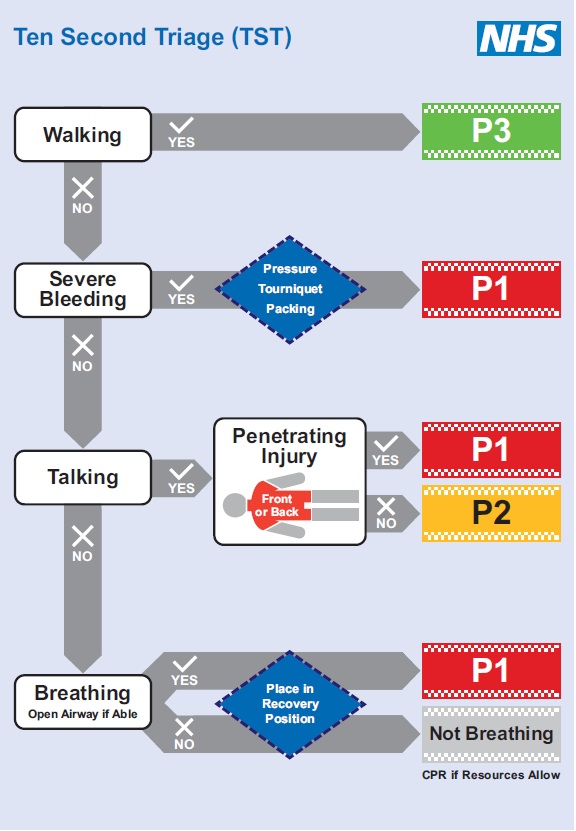
But…..identifies <50% patients requiring urgent interventions. Never been validated in military trauma population, Sort requires knowledge of GCS and ability to take Blood Pressure.
Other triage tools include: START, SALT, Berlin Triage Algorithm, Australasian Triage Scale (not for MCIs), SMART Triage, Modified Physiological Triage Tool.
d. NATO Doctrine: Triage should be directed by the best qualified medical personnel available, preferably a medical officer experienced in emergency medicine. (This is for R2/3, not field triage).
- New Triage Tools
Sieve and Sort only 50% accurate in identifying casualties who need emergent interventions.
Ideal Field Triage: rapid, can treat while triaging, doesn’t require expertise or cognitive load (not physiological), doesn’t require equipment, avoids decision on death, appropriate for military injuries.
Ten Second Triage
(image)
From MIMMS to MITT: introduced NHS in 2023, developed from MPTT-24 (RR <12 or >23, HR >100). Outperforms Triage Sort (Vassallo et al, 2023)
4. Reverse Triage
Method to optimise allocation of limited resources during high demand situations, eg mass casualty incidents”
In Military setting this could be: treat less injured first for return to duty (examples from French Army WW1, German Army WW2 but NOT in doctrine (ADF or US) and explicitly mentioned in IHL as not appropriate, Article 12 of the 1949 Geneva Convention (I) for the Amelioration of the Condition of the Wounded and Sick in Armed Forces in the Field states: “Only urgent medical reasons will authorize priority in the order of treatment to be administered”.
Reverse triage is referred to in literature as applied to Hospitals: discharging patients early to make room.
As well as legal there are psychological implications on: military medical personnel (potential for moral injury), unit morale.
Preliminary evaluation of the RSL Be:Well digital program for Australian Defence personnel
Dr Stephanie Howarth1, Kelly Brown1, Dr Sarah Hampton1, Dr Camila Guindalini1,3, Dr Pilar Rioseco1,2
1Gallipoli Medical Research, Greenslopes Private Hospital, Brisbane Australia, 2School of Public Health, The University of Queensland, Brisbane, Australia, 3School of Public Health, The University of Queensland, Brisbane, Australia, 4Centre for Health Services Research, The University of Queensland, Brisbane, Australia, 5Faculty of Medicine, Health and Human Sciences, Macquarie University, New South Wales
Biography
Mrs Kelly Brown is a Psychologist and Research Officer at Gallipoli Medical Research (GMR). She holds a Master of Clinical Psychology from Queensland University of Technology and has been involved in clinical and applied research since 2017. Her work focuses on the health and wellbeing of Australian Defence Force veterans and their families, spanning clinical trials, program evaluation, qualitative methods, and the co-design of digital wellbeing resources. She has contributed to research examining sleep, mental health, chronic pain, transition and reintegration, and digital health interventions. Her work is centred on translating research into meaningful real-world outcomes and accessible, evidence-based resources.
Background
The Royal Commission into Defence and Veteran suicide showed that many current and ex-serving Australian Defence Force (ADF) personnel experience challenges related to their physical and mental health, particularly during/after separation from the military. Despite the recognised need for support, help-seeking may be limited by stigma and cultural barriers. Digital health interventions may offer an alternative by providing private, accessible and self-directed support.
RSL Be:Well is an online psychoeducation program with free, self-directed, 20-minute modules providing health information, tips and resources on health issues common to veterans. The modules are evidence-informed and aim to improve knowledge and self-awareness, increase confidence to make changes, and connect veterans with relevant support resources.
Commissioned by RSL Queensland Branch, the present pilot study aimed to evaluate the feasibility, acceptability, user experience and preliminary impact of the RSL Be:Well program focusing on three modules targeting sleep, physical activity and nutrition (Be:Sleep Savvy, Be:Exercise Inspired and Be:Food Positive).
Methodology
A pre-post evaluation design was used with baseline, post-program and follow-up surveys, 4-6 weeks apart. Program evaluation included questions about acceptability, appropriateness, feasibility, user satisfaction, and module-specific feedback. Standardised measures of health literacy, behaviour change, health and wellbeing were also collected.
Eligible participants included Australian veterans (current/ex-serving ADF members) who had not completed RSL Be:Well modules. Recruitment occurred in February-May 2026 via online and print media. Registered RSL Be:Well users who had not completed modules were also invited to participate. Data was collected online via Qualtrics. A data integrity protocol was developed to assess the validity of responses. The project was deemed an evaluation activity (protocol 670-25).
Results
A total of 134 baseline (S1), 70 post-program (S2) and 63 follow up (S3) surveys were completed. Sixty-six percent of participants were aged 45 years or older, 79% were male, 71% were ex-serving, 58% reported long-term health condition, and 44% had deployed to a combat zone.
Acceptability, appropriateness and feasibility were rated highly with mean scores of over 4.3 (out of 5). Across the 12 items, 84%–96% of participants agreed or completely agreed with the positive statements. User-experience ratings were also high: 93% agreed that RSL Be:Well was easy to move through, 91% trusted the information and advice provided, and 90% agreed that it was worth the time and effort. Nearly all participants (96%) would recommend RSL Be:Well to the veteran community.
Module specific findings were similarly positive. Ninety-four percent of participants reported that Be:Sleep Savvy improved their sleep knowledge and self-awareness, 94% reported that Be:Food Positive improved their knowledge of the relationship between diet, pain, gut health and fitness, and 91% reported that Be:Exercise Inspired improved their knowledge about having a healthy relationship with physical activity.
Most participants (83%) reported having implemented something they learnt from the modules. Among those who implemented something, 66% rated the positive impact of these changes on their health and wellbeing as ‘a lot’ or ‘significantly’, and 74% were very or extremely confident that they could continue applying what they had learnt.
Longitudinal analyses also identified favourable changes in psychological distress from baseline to post-program, and in ability to find good health information, sleep health and fruit intake from baseline to follow-up
Conclusion
Preliminary findings indicated high acceptability, appropriateness and feasibility of RSL Be:Well, alongside positive user experience, strong reported application of learning and favourable changes in several health and wellbeing outcomes. Together, these findings provide encouraging preliminary evidence of the program’s potential.
Ready to Prescribe? Insights from a National Survey of the ADF Contracted RN Workforce.
Ms Liz Dalla Santa1,2, Ms Toni Arndell1, Ms Amanda Woods1, Ms Narelle Basham3, Ms Terri Antonio3
1Bupa, Melbourne, Australia, 2Monash University, School of Primary and Allied Health Care, Faculty of Medicine Nursing and Health Sciences, Melbourne, Australia, 3Serco, Sydney, Australia
Biography
Toni brings a diverse background across healthcare delivery, government, and consulting, grounded in a strong commitment to quality, safety, and person-centred care. Clinically trained as a Speech Pathologist, she has delivered care across Australia, the UK, and the Middle East, including establishing services for vulnerable populations and enabling patients to be active partners in their care.
Toni holds a Global MBA and has worked with EY’s Global and MENA Performance Improvement and Transformation practices. She also served as the EY Global Advisory Resident, contributing to strategy and solution development, knowledge and change management, whilst also helping clients reimagine all aspects of the care experience. Most recently, Toni was the National Engagement Lead for a multi-institutional Government-funded aged care research program focused on optimising service delivery and cross-sector collaboration.
Having had family serve with both Army and the RAAF Toni has a deep appreciation of the life-changing impact that a great care experience can have on the lives of ADF members.
Background
Registered Nurse Prescribing (RNP) represents a significant advancement in nursing scope of practice within Australia, aligned to ongoing national health workforce reform and evolving legislative frameworks supporting non-medical prescribing. Recent policy directions emphasise improving timely access to medicines, optimising multidisciplinary care, and strengthening workforce sustainability. Within the Australian Defence context, healthcare delivery is largely supported by a contracted civilian nursing workforce, creating unique opportunities to enhance capability and access through expanded nursing roles. RNP is enabled through completion of accredited postgraduate education and endorsement pathways, positioning nurses to contribute safely and effectively to prescribing within defined clinical governance frameworks.
Aim
To assess workforce readiness, interest, and perceived barriers among a contracted Defence health nursing workforce for participation in RNP training and pilot programs.
Methods
A cross-sectional Expression of Interest survey was conducted from 4–13 May 2026 targeting Senior Nurses (NCs) and Registered Nurses (RNs and MHRNs) delivering contracted health services to Defence. The survey captured workforce demographics, eligibility for prescribing pathways, likelihood of participation, and key enablers and barriers. Quantitative data were analysed descriptively, and qualitative responses were thematically analysed to identify key insights relevant to implementation.
Results
A total of 250/697 Registered Nurses (36%) participated in the expression of interest survey. Among respondents, 76% indicated interest in undertaking a Registered Nurse prescribing course, of whom 96% reported willingness to participate in a pilot program. Interest in participation was consistent across organisations, with key enabling factors identified as financial incentives (~76%), paid study time (~74%), and financial support (~70%).
Respondents were predominantly clinically focused, with 93% of Registered Nurses (196/212) reporting that they spent 51–100% of their time on clinical work, while 65% (138/212) reported spending ≤25% of their time on clinical management or supervision. In contrast, 53% of Nursing Coordinators (20/38) reported spending 1–50% of their time on clinical work, and 26% (10/38) reported dedicating 100% of their time to clinical management or supervision.
Regional participation varied, with the highest engagement observed in New South Wales (43%; 22/51) and the lowest in South Australia (26%; 14/54).
Qualitative analysis identified three key themes: improved patient access through reduced wait times and faster medication access; expansion of nursing scope, enhancing autonomy and clinical capability; and the need for robust governance, structured implementation, and mentoring to support safe and effective prescribing practice.
Qualitative findings highlighted three key themes:
Improved patient access and outcomes – anticipated reductions in wait times and more timely, safe access to medications in Defence health centres.
Expanded nursing scope and autonomy – strengthening advanced practice capability through postgraduate education and endorsement.
Need for structured implementation – importance of governance, supervision, and organisational support to ensure safe integration into prescribing practice.
Respondents also identified operational efficiencies, including reduced reliance on medical officers for routine prescribing and enhanced service delivery across primary care, sexual health, and pre-deployment screening.
Conclusion
This study demonstrates a highly engaged and workforce-ready contracted Defence nursing cohort with strong interest in RNP as an advanced practice pathway within the evolving Australian regulatory environment. Successful implementation will require investment in postgraduate education, protected training time, and robust clinical governance frameworks tailored to the Defence setting. RNP has the potential to enhance patient access, support safe and timely care, and contribute to a more resilient, responsive, and mission-ready healthcare workforce, positioning nurses as key leaders in contemporary models of care.
Implications
By time of presentation we will have additional Medical Officer workforce survey data to integrate the perspective of potential Authorised Prescribers, enabling a fuller picture of barriers and enablers in the Defence context.
Real-world evaluation of the online Military-Civilian Adjustment and Reintegration Measure (M-CARM)
Miss Angeli Tabinga1,2, Dr Karolina Alichniewicz1,2, Miss Gina Fisher1, Dr Camila Guindalini1,2, Dr Laura G. Carrascosa1,2
1Gallipoli Medical Research, Greenslopes, Australia, 2The University of Queensland, St Lucia, Australia
Biography
Angeli Tabinga is a Research Coordinator at Gallipoli Medical Research (GMR) and an Honorary Research Fellow at the University of Queensland. At GMR, Angeli is involved in translational research for veteran families, including investigating emerging and adjunct treatments for common mental health conditions affecting veterans, and the spillover effects of military service on family quality of life. Angeli has worked in improving the health and wellbeing of various populations (Australian Aboriginal and Torres Strait Islander people, culturally and linguistically diverse communities, children and adolescents, and military families) and continues to engage in projects that promote health equity.
Background
The military-to-civilian transition is recognised as a diverse experience shaped by several factors. Preparing members for social and psychological dimensions of transition, is key for supporting veterans through this period. The availability of measures that assess these areas is therefore critical for understanding individual needs and informing the provision of transition supports. Acknowledged by the Royal Commission into Defence and Veteran Suicide as an assessment tool that enables a more holistic approach to understanding the needs of veterans, the Military-Civilian Adjustment and Reintegration Measure (M-CARM) is a validated, 21-item, five-factor self-report questionnaire designed to assess adjustment and reintegration to civilian life following military service. Since its launch in 2020, M-CARM has been freely available on the M-CARM website (https://m-carm.org/) for use by veterans and clinicians supporting transitioning members. Despite more than five years of implementation, the platform’s utilisation and user characteristics of those who choose to engage with it have not been examined. Therefore, this study aimed to evaluate the real-world use of the online M-CARM platform, including user characteristics, usage patterns, and psychometric performance.
Method
Reach, uptake and engagement were assessed using data collected through routine quality assurance processes. Website analytics were retrieved through Google Analytics from the start of data collection in February 2022 to February 2025. Descriptive statistics were computed to summarise the sources of website traffic and the geographic location of visitors to the M-CARM website. Survey data from 1,098 completed questionnaires were retrieved from the M-CARM website between December 2020 and February 2025. Statistical analyses were conducted to explore whether M-CARM total scores and domain-specific areas of need differed according to three demographic variables: age, gender, and service background. Confirmatory factor analysis (CFA) was also performed to evaluate the fit of the hypothesised five-factor structure.
Results
Website analytics showed strong real-world engagement, with 10,155 sessions on the M-CARM website, since February 2022. Most site visitors (83%) came through direct or organic searches. Visitors were mostly from Australia (58%), followed by the U.S. (28.2%), and U.K. (2.7%). During this period, 533 users completed the M-CARM, representing completion rates of approximately 6%.
Among survey respondents, the mean M-CARM score was 64.42 (SD = 17.31; range = 21-105), with over half meeting criteria for three to five areas of need (55.6%), indicating substantial reintegration challenges. The most commonly identified areas of need were Regimentation (68.3%), Beliefs about Civilians (67.8%), and Resentment and Regret (59.9%). Navy veterans had almost twice the odds of meeting criteria for Resentment and Regret compared with Army veterans (OR = 1.99, 95% CI [1.38, 2.90], p = .0003), while veterans aged 56–75 had significantly lower odds than those aged 18–25 (OR = 0.42, 95% CI [0.24, 0.73], p = .002), indicating that tailored support may be beneficial for particular groups.
The CFA demonstrated that the original five-factor structure was maintained in this independent sample, with total and domain scores comparable to the original validation cohort and acceptable model fit (χ²(179) = 936.83, RMSEA = 0.062, CFI = 0.925, TLI = 0.912), supporting the M-CARM’s reliability and validity as a self-reported online questionnaire outside of a research setting.
Conclusion
The findings indicate that M-CARM can successfully engage veterans in a real-world online environment and provide further evidence of its psychometric properties. The high prevalence of identified reintegration needs suggests the tool is reaching veterans who may benefit from further support, while substantial international uptake highlights an opportunity for cross-cultural validation and adaptation of the tool. These findings support M-CARM as a scalable digital screening tool with potential to facilitate earlier identification of reintegration needs and guide referral pathways in clinical and community settings.
The Worm Has Turned: A New Era in Soil-Transmitted Helminth Management
Dr Rebecca Suhr1, Dr James Smith1,2
1Australian Defence Force Malaria and Infectious Disease Institute, Brisbane, Australia, 2Queensland Health, Brisbane, Australia
Biography
Dr Rebecca Suhr is the current Research Medical Officer at the ADF Malaria and Infectious Disease Institute. Coming from a background in Close and General Health within the Army, she is focused on translating current research findings and disease surveillance information into policy changes and actionable steps for clinicians and health planners.
The new Soil-transmitted Helminth DHM chapter, published this year, is the first ADF policy to inform testing, treatment, and eradication of soil-transmitted helminths (STH) within the ADF population. We present a summary of the key points of the new chapter, most importantly, the recommended force health protection countermeasures, including eradication.
We will also review the information that informed the development of the chapter: the helminths of concern, their life cycles, and the threats they pose to our soldiers’ health; how soldiers could be exposed during exercise, deployment, or posting and subsequently require eradication treatment; testing and treatment options should concerns or symptoms arise; and historical examples of helminth infections in military forces.
War-Related Abuses and Health Outcomes Among Adults in Ukraine 2014-2025: Results from a Cross-Sectional, Population-based Study in 20 Oblasts.
Professor Lynn Lieberman Lawry1,2, Ms Vivitha Mani2,3, Dr Olena Nesterova4, Dr Olga Gvozdetska4, Dr Jana Asher5
1Usuhs, Bethesda, United States, 2Center for Health Services Research, Bethesda, United States, 3The Henry M. Jackson Foundation for the Advancement of Military Medicine, Inc, Bethesda, United States, 4Center for Public Health of the Ministry of Health of Ukraine, Kyiv, Ukraine, 5Statistical Consultant, Pittsburgh, United States
Biography
Dr Lieberman Lawry is a physician, epidemiologist, and biostatistician more than three decades of experience in humanitarian aid, disaster response, development, and research. She spent 20 years as faculty at Brigham and Women’s Hospital, Harvard Medical School, with concurrent appointments with the Department of International Health, Bloomberg School of Public Health, Johns Hopkins and Uniformed Services where she is currently a Professor of Preventive Medicine and Biostatistics. She has extensive experience in dozens of countries coordinating aid, facilitating development, and conducting population-based studies in conflict and post-conflict settings. Her studies elucidate the needs of populations regarding human rights, healthcare access, mental health, and conflict-related sexual violence among many other public health topics – utilizing these data to improve policy to address global health needs in conflict. Her current focus is trauma system assessments in large-scale combat for understanding needs and gaps for preparedness. She is currently finishing a nationally-representative study of war-related abuses and mental health consequences in Ukraine. In addition to teaching at USUHS, she developed interactive courses for international militaries who serve as Peacekeepers in 48 countries on preventing sexual exploitation and abuse and CRSV and as global health engagements for security cooperation in the human security space.
Background
Throughout recent invasions of 2014 and 2022 in Ukraine, it appears there are violations of international humanitarian law, and a wide range of war-related abuses that may be consistent with war crimes and crimes against humanity. This study aimed to comprehensively assess the characteristics and prevalence of war-related abuses during and between to the 2014 and 2022 Russian invasions and the health consequences of these abuses.
Methods
We conducted a household-based, population-level, cross-sectional quantitative study in 20 of 24 oblasts in Ukraine of Ukrainian females and males aged ≥18 years, residing in accessible oblasts. Four oblasts (Sumy, Donetsk, Luhansk, Crimea) were excluded due to ongoing conflict and limited access for data collectors. Using Computer-Assisted Personal Interviews (CAPI) conducted by Ukrainian interviewers with oversight. We asked a series of questions regarding conflict-related sexual violence (CRSV) and war-related abuses such as beatings, gunshot wounds, capture, torture, abduction, amputation, property theft and/or destruction that occurred personally or among household members. We also assessed the details of the abuse, perpetrators, where and when the abuse happened, the health consequences of the abuse, if they sought medical care and who they told about the abuse. Complex random sample design allows extrapolation to that population.
Results
Of 4,425 households sampled, respondents from 4,228 households completed the study (nonresponse rate 4.5%). Participants included 2,632 (62%) females and 1,596 (38%) males aged ≥18 years, residing in accessible oblasts, and willing to provide informed consent. An estimated 5.5% (4.6%-6.6%) of the population or 1.8 million households has experienced abuses since 2014. Of those abuses, the majority (55.4%, 47.8%-63.1%) are physical assaults and 31.5% (24.7%-38.4%) are property theft or destruction. Approximately 7.9% (0.0%-24.4%) of former military males and 13.6% (6.8%-20.4%) of civilian females have experienced conflict related sexual violence (CRSV). On average, four (3-5) perpetrators are involved per abuse, and the majority of abuses are attributed to Russian soldiers (53.8%, 45.4%-62.1%), although a large number of abuses have unknown perpetrators (35.4%, 27.7%-43.0%) with both male and female perpetrators. Anxiety (26.3%, 19.5%-33.1%) and physical injury (29.3%, 22.8%-35.8%) are the most common consequences of abuses. IDP households are significantly more likely to have experienced abuses for which the perpetrator is a Russian soldier, significantly less likely to experience physical violations, and significantly more likely to experience property violations and forced displacement. Abuses, especially CRSV are associated with significantly higher likelihood of mental health symptoms, as are abuses and IDP status together and abuses and military status together. Those who have experienced CSRV have a rate of 89.6% (76.7%-100.0%) for depression symptoms and 82.5% (67.0%-98.0%) for anxiety symptoms; former military who report abuses within their household have a 77.9% (63.7%-92.2%) rate for depression symptoms.
Conclusions
Approximately 1.8 million households have experienced war-related abuses. All abuses have health consequences, and war-related abuses produce profound and enduring harm for survivors which suggests “great suffering” or clinical evidence to support legal findings under the Rome Statute article 8. The rapid escalation of mental health disorders, disability, and morbidity represents a growing public health crisis in Ukraine that is likely to affect multiple generations. Understanding this war, how it is conducted, and the health consequences is important as Russia threatens other European countries.