


Abstract
Health support for anticipated Australian Defence Force (ADF) operations necessitates the capability to deliver prolonged austere field care in response to the constraints of contested mobility, extended evacuation distances, resource limitations and tactical requirements. Combat tourniquet application in the context of Prolonged Casualty Care (PCC) represents an emerging challenge at all levels of healthcare provision and tactical command. This manuscript provides contemporary evidence-based guidance for clinical decision making and organisational preparedness in the management of combat tourniquets where delayed evacuation to higher-level healthcare is anticipated.
Article overview
- Limb tourniquets are both safe and highly effective in reducing battlefield deaths.
- ADF tourniquet doctrine is proven within counterinsurgency operations.
- Current ADF tourniquet protocols require modification for projected future warfare.
- Preventable tourniquet injury represents a high-consequence healthcare vulnerability.
- Coordinated tourniquet de-escalation capabilities should be developed at scale within the ADF.
- Low-complexity tourniquet de-escalation techniques deliver the greatest organisational impact.
- Multiple operational environments support forward all-corps tourniquet conversion.
Tourniquet doctrine beyond counterinsurgency
Combat tourniquets arguably represent the single most important medical innovation in recent history for reducing avoidable battlefield deaths. Within counterinsurgency operations, as part of an overarching framework of Tactical Combat Casualty Care (TCCC), combat tourniquet application has been proven as both highly effective and safe.1-10 Modern TCCC training thus justifiably promotes aggressive pre-hospital tourniquet application as the cornerstone of effective haemorrhage control in severe open limb trauma. Furthermore, the favourable results demonstrated for tourniquet use in military trauma have driven the universal acceptance and implementation of pre-hospital tourniquets across multiple organisations, in both tactical and civilian trauma care.11-15 It is important to recognise, however, that the favourable results associated with combat tourniquets, and the organisational protocols that have subsequently developed surrounding their use, remain predicated on universal rapid casualty evacuation to higher-level healthcare.
Observations from the current Russo–Ukrainian War have exposed significant limitations in current TCCC tourniquet protocols when applied to operational environments other than counterinsurgency. The adverse outcomes associated with combat tourniquet use within Ukraine have been extensively documented. Limb tourniquet application with rigid adherence to TCCC protocols, in the absence of coordinated organisational de-escalation frameworks, has resulted in significant iatrogenic harm, including casualty limb loss and death.8-10,16-20 Although the exact incidence of tourniquet-associated complications remains uncertain, multiple sources from the Ukrainian military and external medical advisers within Ukraine have reached consensus that the magnitude of tourniquet-associated injury is substantial.9,21 Combat tourniquets in Ukraine may now be costing more lives and limbs than what they save, to the extent that in some hospitals, many more limb amputations are conducted to manage the direct complications of tourniquet misadventure as opposed to the primary traumatic injuries for which they were applied.18,22 While high, tight, horizontal, fast and ubiquitous tourniquet application is tactically appropriate during Care Under Fire (CUF), these practices also need to be mitigated by safety guards, particularly when extended duration evacuation times are encountered. The Australian Defence Force (ADF) may encounter similar challenges in a variety of future warfare environments.
ADF tourniquet management protocols, while proven suitable for counterinsurgency and civilian trauma care, remain challenging within a variety of alternate operational environments.9,23 High-intensity large scale combat operations, littoral warfare, contested near-peer conflict, airspace denial, extended range operations and grey zone asymmetric warfare may all result in protracted evacuation times, austerity of medical support and the non-doctrinal reliance on PCC for severely injured casualties. Further compounding the challenges of casualty evacuation is the evolving landscape of point-of-injury care within a modern battlespace, increasingly dominated by mobility denial. Changing threat and countermeasure requirements, combined with the vulnerability of healthcare assets, significantly constrain the time-sensitive delivery of specialised trauma care to soldiers isolated within the forward battlespace. Current ADF tourniquet de-escalation training, techniques and procedures, when applied to these operational environments, represent a potential healthcare vulnerability.10 The challenge is how to reconcile PCC tourniquet application with the minimisation of iatrogenic harm. Useful evolution of policy and procedures to direct tourniquet management outside of 2-30-1 (2 minutes to immediate care – 30 minutes to advanced resuscitation – 1 hour to surgical intervention) treatment and evacuation doctrine would be beneficial. Coalition partners are also considering the challenges surrounding prolonged tourniquet ischaemia and forward tourniquet de-escalation.9,20,23
While the ADF acknowledges tourniquet conversion and tourniquet replacement within CoTCCC frameworks, tourniquet de-escalation capabilities remain deficient in both scope and penetration throughout the organisation. Tourniquet conversion is often a less considered task compared to tourniquet application, and the procedures are typically less well defined.24 Soldiers are trained in the aggressive application of combat tourniquets without universal training or authorisation to perform de-escalation procedures. An opportunity exists to enhance tourniquet de-escalation capabilities within the ADF suitable for use in combat environments other than counterinsurgency.24-35
Overwhelming data supports combat tourniquets as a critical foundation for the prevention of battlefield death, with demonstrated safety and effectiveness. Within PCC, however, there is an imperative to revisit historic tourniquet management doctrine. Risk mitigation in the prevention of tourniquet injury thus requires flexible organisational change in response to an evolving defence landscape. Development of enhanced tourniquet de-escalation practice within the ADF will not only deliver best-practice combat healthcare by minimising avoidable harm due to tourniquet misadventure but also operational benefits.36
Guidance principles for tourniquet management in modern warfare
Evolution of organisational protocols for the prevention of iatrogenic tourniquet injury requires a platform of evidence-based principles. High-quality studies, directly informing the clinical management of combat casualties with extended durations of tourniquet application, are however, limited. Evidence-based best practice is therefore best guided by the evaluation of indirect models that demonstrate similar pathophysiologic and clinical manifestations to tourniquet induced limb ischemia. Of primary interest are the clinical end points of local tissue injury, limb viability and systemic reperfusion syndromes. While it is acknowledged that models, when considered independently, have limitations and may incompletely describe the unique complexity of circumstances surrounding limb ischaemia in a combat environment, practical guidance may still be gained by their appraisal. Models relevant to understanding time-dependent tourniquet ischaemia may include:
a. tourniquet application within contemporary military and civilian trauma1,3,6,7,9,20-23,27,33,34,37-44
b. pneumatic tourniquet application within elective surgical practice45-48
c. case reports and case series45,49-52
d. animal models53-57
e. crush syndrome26,50,51,58-61
f. limb compartment syndrome39,59,60,62
g. post traumatic limb and digital amputation and reimplantation52,63-66
h. acute arterial limb ischaemia due to vascular trauma and primary vascular disease67,68
i. Resuscitative Endovascular Balloon Occlusion of Aorta (REBOA) in trauma69,70
j. suspension syndrome71-73
k. multiple aetiology rhabdomyolysis and hyperkalamia.74-77
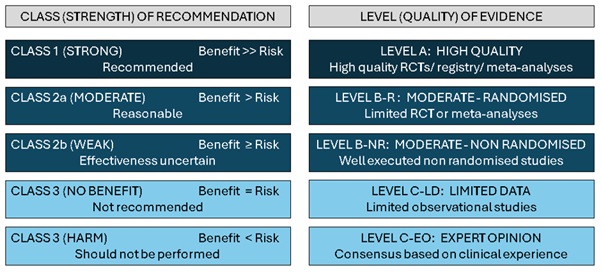
The guidance principles thus developed and presented below are classified according to the American College of Cardiology (ACC) / American Heart Association (AHA) framework (Figure 1).78 Where available, contemporary review articles and existing clinical management guidelines have been included for consideration. These principles remain generic in nature and require reasoned clinical judgement in their application. Although primarily developed to provide clinicians with an evidence-based framework for best-practice combat tourniquet management, the principles also have practical application for commanders, policy makers and logisticians (Table 1).
Figure 1
|
PRINCIPLES OF COMBAT TOURNIQUET MANAGEMENT
|
PRINCIPLE 1: Tourniquet application, reassessment, conversion and replacement are to be conducted in accordance with institutional guidelines (Recommendation strength: 1; Level of evidence: B-NR).
Combat tourniquets, when utilised correctly, represent a highly effective lifesaving measure in the management of catastrophic haemorrhage due to open limb trauma. Tourniquet application is recommended even if delayed evacuation to higher-level healthcare is anticipated.
PRINCIPLE 2: Tourniquet application for less than 2 hours duration represents optimal care (Recommendation strength: 1; Level of evidence: B-NR).
With appropriate application techniques, combat tourniquets applied for less than 2 hours duration are safe. Tourniquet ischaemia less than 2 hours duration does not adversely impact limb survival and is associated with minimal systemic metabolic consequences on removal. Arterial tourniquet application for less than 2 hours represents the optimal standard of clinical management.
PRINCIPLE 3: Tourniquet application for greater than 2 hours duration is associated with increased risk of permanent ischaemic injury (Recommendation strength: 1; Level of evidence: C-LD).
Variability exists in tissue vulnerability to ischaemia, with nerve tissue and fast-twitch muscle fibres being the most sensitive. Tourniquet application represents an ischaemic insult to the limb, which is further compounded by local vascular injury and systemic hypotension in trauma. Tourniquet application time therefore represents a grey scale of progressive ischaemic risk, influenced by the pattern of wounding, tissue type and associated injuries. Sublethal organelle damage is associated with tissue ischaemia times greater than 3 hours. Partially reversible advanced myofibrillar damage is observed in muscle tissue after 4 hours of ischaemia. Warm ischaemia time of greater than 4 hours is associated with progressively higher risk of significant permanent functional injury and failure of limb salvage procedures.
PRINCIPLE 4: Limb ischaemia commences at time of wounding and continues until effective reperfusion is obtained (Recommendation strength: 1; Level of evidence: C-EO).
In evaluating the risk of tourniquet-associated limb ischaemia, the total duration of perfusion compromise must be considered, from the time of wounding until the time of restoring effective distal reperfusion. Consistent with contemporary military TCCC management protocols, tourniquet application time will often closely approximate the time of wounding. Reperfusion time needs to consider not only evacuation time but also delays that routinely occur at the destination facility, such as land transport from the airhead, receiving facility triage, emergency resuscitation and delays in conducting surgical revascularisation, including the management of higher-priority injuries presenting within the casualty. Regardless of the circumstances associated with cumulative time delays, the limb remains ischaemic until restoration of distal circulation has been obtained.
PRINCIPLE 5: Limb cryotherapy is protective of ischaemic injury (Recommendation strength: 2A; Level of evidence: C-LD).
The metabolic activity and oxygen consumption of the injured tissues influence limb salvage rates and viability. Tissues with higher metabolic activity (muscle) are at higher risk of early ischaemic injury when compared to tissues with lower metabolic demands (digits). Cryotherapy reduces the metabolic activity of injured tissues. It may be employed to extend the ischaemic survival time of amputated or ischaemic body parts in both trauma reconstruction and elective surgical practice. The simplest cryotherapy method after tourniquet application is to exclude the limb from the casualty hypothermia wrap to achieve passive environmental cooling. Where resources and the tactical environment permit, applying more advanced cryotherapy techniques such as a water–ice slurry to the limb may further reduce the metabolic burden during ischaemia and improve tissue survival. Avoid packing the limb directly within ice or snow for risk of creating cryothermic injury (frostbite). Cryotherapy application should be clearly documented to alert future health care providers of an elevated potential for thermal core after-drop post limb reperfusion.
PRINCIPLE 6: Tourniquet conversion is an elective procedure to be conducted within controlled conditions (Recommendation strength: 1; Level of evidence: C-LD).
While early tourniquet conversion may re-establish distal circulation, situational awareness of the casualty, healthcare setting and tactical environment is required to mitigate potentially life-threatening metabolic reperfusion syndromes. Appropriate environmental considerations may include the availability of monitoring equipment, resuscitative capability, surgical capacity and the capability of the attending healthcare providers. Where suboptimal conditions exist for tourniquet release, the risk of conversion must be weighed against the consequences of extending tourniquet application times to achieve optimised environmental conditions.
Tourniquet conversion after extended application time risks undermining resuscitative measures in an already traumatised and hemodynamically compromised casualty. Where other immediately reversible injuries exist, appropriate sequencing of damage control resuscitation will dictate that tourniquet conversion be conducted only after thoracoabdominal haemorrhage control has been achieved and suitable haemodynamic reserve is appropriately secured.
PRINCIPLE 7: Limb reperfusion after prolonged ischaemia requires proactive resuscitation (Recommendation strength: 1; Level of evidence: C-LD).
Initial reperfusion after tourniquet conversion of a blood-depleted ischaemic limb with altered sympathetic tone typically results in transient hypotension due to volume sequestration and decreased cardiac afterload. Immediate hypotension should be anticipated upon limb tourniquet conversion, even in the absence of further blood loss. Venous blood returning from a reperfused ischaemic limb is typically cold and acidaemic, with cellular injury resulting in high concentrations of potassium and myoglobin. Proactive resuscitation measures to manage the predictable volumetric and cardiac aspects of tourniquet conversion after prolonged application are recommended. Proactive resuscitation efforts directed at minimising the systemic and metabolic impacts of tourniquet release should be undertaken prior to tourniquet conversion.
PRINCIPLE 8: Staged tourniquet conversion techniques minimise the adverse haemodynamic and metabolic consequences of reperfusion (Recommendation strength: 1; Level of evidence: C-EO).
Where multiple limb tourniquets have been applied, staged conversion should be conducted even if resources enable simultaneous conversion.
PRINCIPLE 9: Operative limb salvage interventions are to be conducted with situational awareness of the operational environment (Recommendation strength: 2A; Level of evidence: C-EO).
Limb preservation, including vascular repair or shunting techniques, represents resource- and time-intensive interventions. In the context of trauma and multicausality management with limited resources, the decision to undertake limb preservation as opposed to primary amputation requires careful consideration of the individual casualty, the capability of the treating surgical facility and the broader operational environment.
PRINCIPLE 10: Primary limb amputation is to be conducted after warm ischaemia time of greater than 6 hours (Recommendation strength: 2A; Level of evidence: C-LD).
While successful limb salvage in rare instances has been documented after extended duration ischaemic injury, complete occlusion warm ischaemia of greater than 6 hours duration remains a strong predictor of unsuccessful functional limb preservation. The decision to undertake primary limb amputation must consider the functional end outcomes of limb salvage related to the extent of limb wounding and the global management of other injuries in a traumatised casualty.
PRINCIPLE 11: Fasciotomy is to be conducted in limbs sustaining extended duration ischaemic injury (Recommendation strength: 1; Level of evidence: C-LD).
Early fasciotomy of ischaemic myofascial compartments is associated with improved clinical outcomes including limb salvage and infection rates. Prophylactic fasciotomy should be considered in traumatised limbs after 2 hours total ischaemic time and conducted in all traumatised limbs after 4 hours ischaemic time.
In the assessment of limbs where tourniquets have been applied for an extended time duration, limited fasciotomy may enable evaluation of compartment viability and guide clinical decision making and resource utilisation in relation to undertaking primary amputation.
PRINCIPLE 12: Suitable tissues from amputated limbs may be considered for subsequent reconstructive surgery (Recommendation strength: 2B; Level of evidence: C-EO).
Where large surface area burns or severe hand trauma with digital amputations have been sustained, tissue autografting procedures may be considered for subsequent reconstructive management. Depending on logistic constraints and the condition of the tissues of the amputated limb, salvage of suitable tissue parts for future reconstruction may be considered. Retrieved tissues are to be cooled using an ice slurry and transported with the patient.
PRINCIPLE 13: Renal monitoring, protection and replacement measures are to be instituted after extended duration tourniquet ischaemia (Recommendation strength: 1; Level of evidence: B-NR).
Myoglobin release after ischaemic limb reperfusion risks acute renal injury. Polytrauma casualties may also have additional risk factors for developing acute renal injury, including systemic hypotension, severe burns or direct renal trauma. The presence of haemochromogenuria indicates higher risk of metabolic renal injury. Appropriate fluid resuscitation, monitoring and renal protective measures are required after limb reperfusion.
PRINCIPLE 14: Adjunctive therapies to improve limb salvage rates should be instituted where appropriate (Recommendation strength: 2B; Level of evidence: C-LD).
Adjunctive management strategies to improve microvascular supply and minimise hypoxic injury to local tissues are likely to assist with functional outcomes. Adjunctive measures include proactive systemic resuscitation and the conduct of burn escharotomy and fracture stabilisation where indicated. Immediate care measures include respiratory support to maintain arterial oxygenation and avoidance of vasoconstrictors including nicotine.
Evolving ADF tourniquet doctrine for future warfare
Tourniquet de-escalation represents a spectrum of skills and adjuncts used to mitigate the impact of iatrogenic ischaemia. Individual de-escalation techniques are selected and administered with situational awareness of casualty presentation, resource availability and tactical circumstances. While tourniquet conversion represents the optimal technique for ischaemia prevention, multiple competing factors influence which de-escalation measures are appropriate to which circumstance. Even when tourniquet conversion is unachievable, the local and systemic impacts of limb ischaemia can still be partially mitigated. For example, in the presence of large vessel disruption and delayed casualty evacuation, tourniquet replacement to the most distal appropriate level, together with the administration of limb cryotherapy and high-quality trauma resuscitation, may represent the best level of tourniquet de-escalation achievable within boundaries of provider capability and resources. Despite an inability to perform definitive tourniquet conversion, ischaemic risk has been mitigated.
The final part of this manuscript outlines practical concepts for the evolution of organisational and clinical management of combat tourniquets for future warfare, drawn from the guidance principles previously outlined.
Part 1: Organisational frameworks79-81
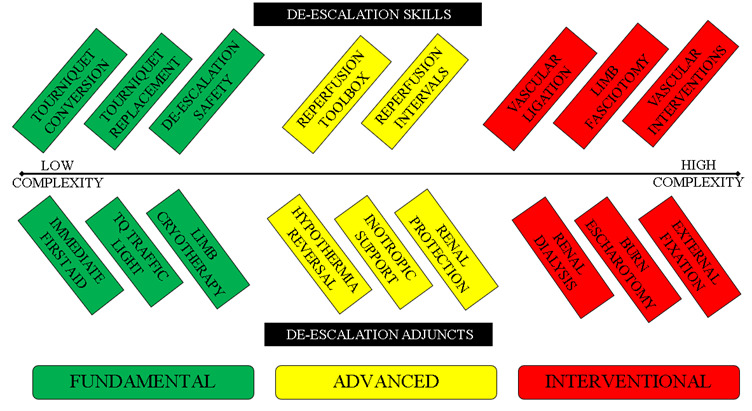
A coordinated organisational framework for tourniquet de-escalation may be represented by a three-level model of conversion complexity (Figure 2).79 Fundamental level tourniquet de-escalation includes uncomplicated conversion and replacement techniques, together with enhanced awareness of the indications for tourniquet application and a framework for the common understanding of time-dependent tissue ischaemia.8,10,80,82-86 Advanced level tourniquet de-escalation includes the capability to perform tourniquet conversion in high-risk clinical presentations, where systemic hypotensive and metabolic reperfusion syndromes are anticipated due to the effect of extended durations of limb ischaemia.35,87 Interventional-level tourniquet de-escalation represents the conduct of surgical procedures such as vascular ligation, shunting or repair to reperfuse a limb after significant vascular disruption. For each level of tourniquet de-escalation, there are associated adjuncts that may be employed to minimise the local impact of limb ischaemia and systemic effects of reperfusion (Figure 3).
Figure 2
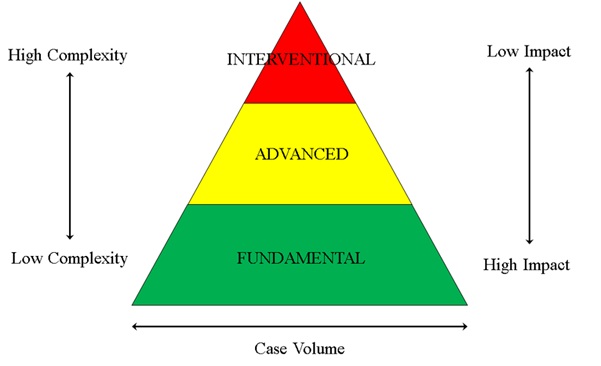
Figure 3
Delivery of a comprehensive tourniquet de-escalation program within the ADF needs to weigh the clinical impact, utilisation frequency and complexity of any specified skill or adjunct (Figure 2). Fundamental level tourniquet de-escalation procedures represent the highest value proposition from an organisational perspective. Tourniquet conversion is the most frequently conducted de-escalation measure, is simple to perform and delivers high-impact clinical and operational outcomes. By comparison, Interventional tourniquet de-escalation procedures apply to substantially fewer casualties, require specialised training and resources to deliver and are typically undertaken in the presence of concomitant severe trauma with the anticipation of lower functional outcomes. At an organisational level, therefore, emphasis should be placed on fundamental tourniquet de-escalation methods, representing high-impact, low-complexity interventions with the greatest utility.
Part 2: Fundamental skills and universal forward de-escalation82,85,88
From an organisational perspective, two broad strategies could be employed to mitigate the risk associated with iatrogenic tourniquet ischaemia in PCC.
The first strategy is to reduce the overall number of combat tourniquets applied by adopting a policy of restricted tourniquet application. The rationale of a restrictive policy is supported by the observations that many tourniquets placed in combat (typically greater than 50%) are medically unnecessary.20,23,33,89 If fewer combat tourniquets were applied, by selecting only those casualties presenting with high-rate limb haemorrhage from penetrating trauma, then the number of limbs at risk of sustaining tourniquet injury would be proportionately reduced.
The second strategy is to enable forward tourniquet de-escalation after initial application. A policy of forward de-escalation accepts the relatively liberal initial application of combat tourniquets, offset by the subsequent removal of those subsequently deemed medically unnecessary using a tourniquet conversion-replacement drill.23,84,90,91
The policies of restricted application and forward tourniquet de-escalation are not mutually exclusive; however, the nature of casualty care in a combat environment strongly favours an organisational policy preferentially biased towards liberalised forward tourniquet de-escalation. In comparison to most civilian trauma, military combat trauma is associated with an ongoing threat profile after initial wounding. Continued enemy action places a combat casualty and those providing immediate health care at enduring risk. These principles thus shape our current CUF protocols used within TCCC. Following transition to the phase of tactical field care, an ongoing threat profile may still exist, with time constraints and task saturation of combat teams. Accurate wound evaluation within these circumstances is difficult to achieve and creates a tactical burden. Delaying tourniquet application until comprehensive wound assessment has been conducted represents a risk to those casualties with high rates of haemorrhage masked by clothing, poor light conditions or the tactical environment. Furthermore, combat injuries resulting from blast explosions or high velocity projectiles may be associated with more severe wounding profiles. Polytrauma may result in cumulative blood loss from multiple body regions and wound assessment is made more challenging due to cavitation and projectile fragmentation.
Immediate action tourniquets in combat environments may therefore be reasonably applied for two reasons—medical requirement or tactical necessity. In an active combat environment, where there is suspicion of severe penetrating trauma with potential high-flow haemorrhage, the tourniquet must be applied. To promote a policy of restrictive tourniquet application during CUF introduces elements of uncertainty and complexity. If a soldier is concerned about the risk of catastrophic haemorrhage, then the decision to apply a limb tourniquet must be supported.
Should the ADF maintain current policy of relatively liberal tourniquet use, with expansion into operational environments other than counterinsurgency, then enhanced forward de-escalation capabilities are required, including the conduct of tourniquet conversion by non-medical defence personnel.23,84,90,91 Safe conduct of tourniquet de-escalation by non-medical defence personnel requires both boundary management and a technically simplified delivery method.86
The Tourniquet Traffic Light (TTL) is a risk stratification tool that provides a simplified framework to appreciate the time-dependent outcomes associated with limb tourniquet application.82 Ischaemic risk is stratified into progressive 2-hour intervals, starting from the time of initial wounding and continuing until distal reperfusion has been obtained (Figure 4).
Figure 4
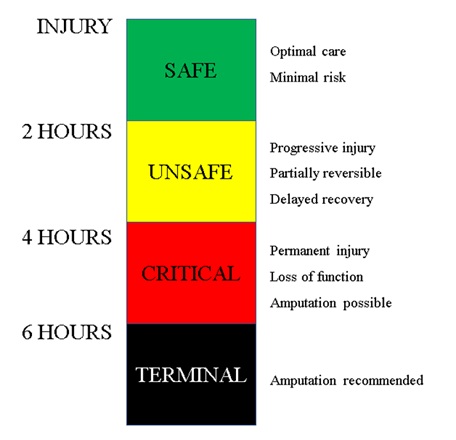
Green zone (safe): With appropriate tourniquet application techniques, application for less than 2 hours duration is safe. A tourniquet applied for less than 2 hours duration has negligible impact upon limb salvage rates with minimised systemic risks upon removal. Tourniquet application for less than 2 hours therefore represents the optimal standard of care.
Amber zone (unsafe): Tourniquet application greater than 2 hours in duration is associated with increased risk of permanent injury. Nerve tissue and fast-twitch muscle fibres are the most sensitive. Tourniquet application time represents a grey scale of increasing risk influenced by the pattern of wounding, tissue type and other associated injuries.
Red zone (critical): Tourniquet application greater than 4 hours is associated with progressively higher risk of significant permanent functional injury and failure of limb salvage. Should the limb remain viable, increasing tissue damage will likely be sustained, resulting in permanent injury and loss of function. Increasing health risks beyond the local limb effects are observed upon tourniquet conversion.
Black Zone (Terminal): Tourniquet application greater than 6 hours remains a strong predictor of unsuccessful functional limb preservation and amputation is typically recommended.
From an organisational perspective, the TTL sets a series of thresholds for communicating clinical risk and time-dependant healthcare requirements for resource allocation and casualty evacuation.36 From a clinical perspective, the TTL assists with clinical decision making for casualty triage and tourniquet de-escalation, including practical guidance for the conduct of forward conversion using an All-Corps Tourniquet Conversion-Replacement Drill (Figures 5 and 6).36,81,84,90
Figure 5
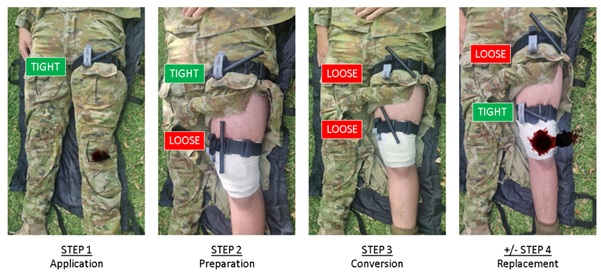
Figure 6
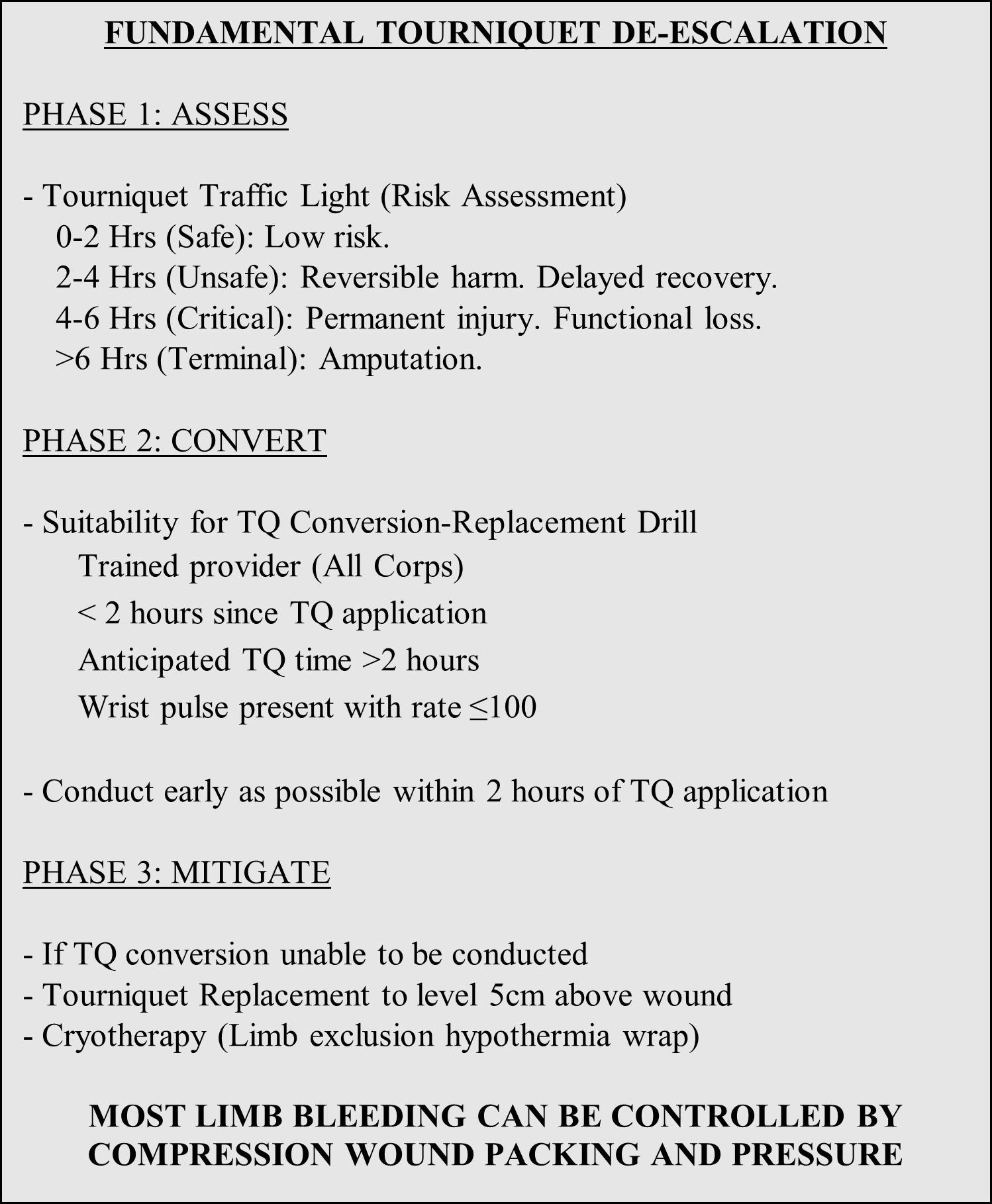
Part 3: High-risk ischaemia
Reperfusion injury after extended duration tourniquet application represents a significant threat to effective casualty resuscitation. Tourniquet conversion after application times greater than 2 hours should only be conducted by advanced health care providers with situational awareness of the negative clinical impacts of reperfusion and where appropriate resources are available.87
There are multiple situations where timely tourniquet conversion may be unsuitable for conduct in a field environment. Valid reasons to keep a tourniquet applied include significant vascular injury with resumption of catastrophic haemorrhage upon conversion, significant haemodynamic instability with insufficient resuscitative resources to risk further compromise, or the lack of appropriately skilled health care providers for the conduct of tourniquet conversion. In these situations, maintenance of combat tourniquet application, while a useful strategy, also carries negative consequences. Tourniquet-associated limb ischaemia is a complex problem to manage in PCC, with increasing impact relative to the duration of time to achieve reperfusion. Reperfusion syndromes upon tourniquet conversion are associated with potentially life-threatening consequences, particularly when extending beyond 2 hours of warm ischaemia time (Figure 7). As reperfusion injury potentially undermines the resuscitation of an already compromised casualty, tourniquet conversion must be appropriately timed in relation to haemodynamic suitability and reperfusion risk.
Figure 7
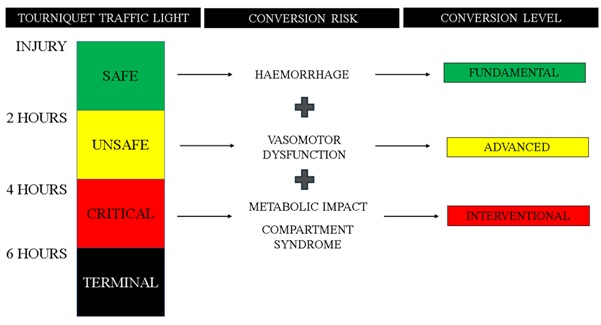
Within the first two hours of tourniquet application the primary risk of conversion is the resumption of haemorrhage (Figure 7). Within defined safety boundaries, haemorrhage risk may be safely managed by an all-corps provider during the conduct of the Tourniquet Conversion-Replacement Drill (Fundamental level).23 Tourniquet conversion beyond 2 hours of application time, however, is associated with progressive risk, requiring advanced and interventional-level healthcare assets to manage post-conversion pathologies, including hypotension, metabolic reperfusion risk and compartment syndrome.20
The Reperfusion Toolbox presents a recommended series of procedures to mitigate the risk of tourniquet conversion after application greater than 2 hours, in a casualty with an otherwise potentially viable limb (Figure 8). The Reperfusion Toolbox provides a framework to assist clinicians in the recognition and management of important features of resuscitation during ischaemic limb salvage. Individual components of the Reperfusion Toolbox may not require active management in all cases, therefore individual clinical assessment and judgement is required.
Figure 8
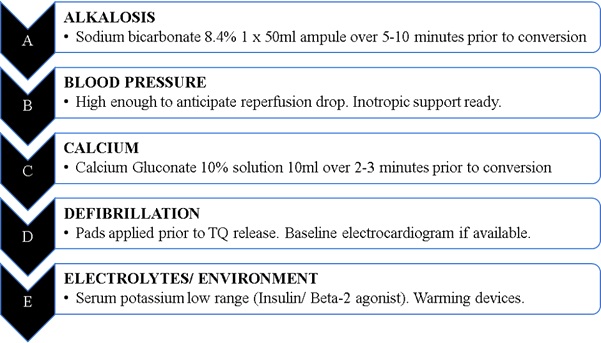
Alkalosis: Creation of mild metabolic and respiratory alkalosis by a combination of intravenous sodium bicarbonate infusion and mechanical hyperventilation (if ventilated and no concomitant traumatic brain injury). The typical adult dose of bicarbonate to be administered is one 50 ml ampoule of 8.4% sodium bicarbonate 5–10 minutes prior to tourniquet conversion. Minimising metabolic acidosis in a polytraumatised casualty impacts upon both cardiac dysfunction and coagulopathy. Urinary alkalosis together with adequate hydration status and adequate urine output rate may further reduce the renal impact of myoglobinuria.
Blood pressure: Pressures suitably managed in anticipation of rapid and potentially significant hypotensive events associated with the loss of pain-mediated pressor activity, volume sequestration within the limb compounded by nerve ischaemia-mediated sympathetic vasomotor dysfunction and ongoing haemorrhage.
Calcium: Calcium gluconate (10 mls of 10% solution (IV) over 2–3 minutes) to provide a cardiac-stabilising effect in consideration of dysrhythmia due to reperfusion hyperkalaemia. Associated role in the management of critical haemorrhage and transfusion-associated coagulopathy.
Defibrillation: Defibrillation pads applied prior to tourniquet release with cardioversion trolley available. Where resources enable, baseline and continuous electrocardiography monitored for the early detection of hyperkaliaemic dysrhythmia.
Electrocardiography, electrolytes and environment: Serum potassium ideally placed into low normal range (approximating 3.5 mmol/L) prior to tourniquet conversion. Consider dextrose insulin infusion (10 units in 50 ml of 50% solution (IV) over 2–3 minutes) or inhaled B2 agonist for active reduction in serum potassium levels.76,77. In anticipation of progressive compromise of hypothermia management, institution of regular (core) temperature monitoring, environmental temperature control with forced-air warming devices and fluid warming should be considered.
Beyond 4 hours of tourniquet application, post-ischaemic reperfusion is associated with significant rates of secondary renal injury and limb compartment syndrome.44 If the capabilities to perform dialysis and limb fasciotomy are not readily available, advanced healthcare providers should still consider tourniquet de-escalation measures, including tourniquet conversion, within the 4–6 hour post-application time window.
Conclusion
As the ADF continues to optimise the provision of health care within potentially diverse combat environments, it is important to recognise and mitigate the risks associated with combat tourniquet application in PCC. The use of combat tourniquets requires a dynamic approach to risk mitigation through the implementation of the application of safe and effective de-escalation strategies. Contemporary evidence-based frameworks for clinical decision making and organisational preparedness in the management of combat tourniquets, where delayed evacuation to higher-level healthcare is anticipated, have been described.
Approvals
The Australian Defence Force has approved publication of this manuscript.
Disclosures
The views expressed within this manuscript, however, are those of the authors and do not reflect current Australian Defence Force Policy.
The Cove (Australian Army) has provided copyright authority for re-publication of Figures 2-8 and associated written material (modified from original). The Cove is a non-peer reviewed Australian Defence Force Publication.
Please specify the URL of your file