
Abstract
Military veterans living with post-traumatic stress disorder (PTSD) often struggle with psychological, moral, spiritual and existential wounds that exceed the reach of conventional symptom‑focused treatments. Through a search for and critical synthesis of interdisciplinary psychological and psycho-spiritual literature, the paper demonstrates how archetypal narratives, shadow integration, compassion-based emotional regulation and post-traumatic growth (PTG) processes can converge to support veterans’ identity reconstruction and reintegration. Building on these findings, the paper proposes an innovative integrative framework that draws together Joseph Campbell’s mythological monomyth, Jungian analytical psychology, Robert Wicks’ resilience-oriented practices, and Kristin Neff’s self‑compassion research to address the deeper meaning-making dimensions of trauma. This approach reframes trauma not solely as pathology but as a transformative, often spiritual, journey requiring narrative coherence, tenderness, moral repair and renewed purpose. The resulting framework offers clinicians, chaplains and peer supporters a holistic, albeit new, model that honours veterans’ psychological, spiritual and relational realities while fostering healing and growth. While much more research is needed, there seems to be immense potential to use such frameworks in terms of trauma-informed veteran care, which honours the archetypal dimensions of the warrior’s journey while fostering psychological growth and post-traumatic development. Finally, limitations and future research directions are discussed.
Keywords: PTSD, veterans, Jungian psychology, mythology, positive psychology, self-compassion, PTG, resilience
Introduction
PTSD among military veterans remains one of the most complex and persistent challenges in contemporary mental health care, not only because of the severity of symptoms but because combat trauma disrupts meaning, identity and moral orientation at their foundations. Underscoring the urgency of new, innovative care, it is known that military service exposes individuals to potentially traumatic experiences that fundamentally alter their psychological landscape. Between 11% and 30% of veterans who served in Iraq and Afghanistan develop PTSD, with rates varying by deployment factors and combat exposure.1
Traditional evidence-based treatments such as Prolonged Exposure (PE) and Cognitive Processing Therapy (CPT) demonstrate efficacy. Yet, dropout rates remain high, and many veterans seek alternatives that resonate more deeply with their experiences and search for healing and meaning.2 In terms of this and beyond well-established clinical care, the veteran’s journey through trauma, treatment and reintegration mirrors archetypal patterns found across mythological traditions.
While evidence-based treatments such as PE and CPT provide important tools, many veterans report that these approaches fail to address the existential and psycho-spiritual dimensions of their suffering. Increasingly, scholars and clinicians are turning towards integrative frameworks that acknowledge trauma as a crisis of meaning rather than merely a dysregulation of fear. Mythology, depth psychology and positive psychology each offer distinct yet complementary insights into how individuals navigate profound disruption and transformation. Bringing these traditions into dialogue provides a promising pathway for understanding the veteran’s journey through trauma, recovery and reintegration.
When nearly one in three service members develop PTSD, and almost half of those who begin treatment discontinue prematurely, the field must look beyond incremental refinements of existing protocols to consider fundamentally different approaches. The existential weight of combat trauma, characterised by profound questions of meaning, identity disruption, moral injury, and what veterans themselves often describe as ‘soul wounds’, suggests that purely symptom-focused interventions may be addressing only surface manifestations of deeper psychological and spiritual ruptures. This recognition has prompted increasing interest in psycho-spiritual frameworks that honour the transformative nature of combat experience while providing pathways towards integration and healing.
For many military veterans, healing from combat trauma encompasses a spiritual journey in its broadest, most inclusive sense: a profound quest for meaning, moral reconciliation, renewed purpose and restored connection to oneself, others and something transcendent—whether understood through religious faith, philosophical reflection, connection to nature, creative expression or the simple yet profound experience of belonging and mattering in the world. The need for this spiritual dimension, which is a key motivator for the paper, distinct from but often intertwined with psychological healing, addresses the existential ruptures and ‘soul wounds’ that veterans themselves frequently describe, acknowledging that combat trauma
disrupts not only neurobiological functioning but also one’s fundamental sense of identity, moral orientation and place in the human community.
In these contexts, and of note, an emphasis on integrating spiritual frameworks, including culturally rooted myths, into trauma treatment is emerging. This argues that spiritual narratives can complement psychological care by addressing existential meaning and moral injury, which are common in veteran PTSD.3
Recent scholarship highlights a growing recognition that veterans’ healing requires more than symptom reduction. It demands engagement with the spiritual, existential, and meaning‑making dimensions of trauma. Captari and Worthington3 demonstrate that spiritual narratives can help veterans reinterpret suffering and rebuild coherence after moral injury, while Nieuwsma et al. show that spiritually integrated care directly addresses the moral and existential wounds that traditional PTSD treatments often overlook.4
Complementing these findings, Smith‑MacDonald et al. identify spiritual resilience as a significant predictor of post-traumatic growth (PTG) among veterans,5 underscoring the importance of inner purpose and meaning in long-term recovery. Yet despite these promising developments, psycho‑spiritual approaches remain fragmented across disciplines. The emerging research signals a powerful opportunity: to weave mythological, Jungian, spiritual and positive psychology resources into a unified model that honours veterans’ inner worlds while supporting identity reconstruction, moral repair and renewed purpose. What is needed now is deeper integration: an approach that bridges narrative, archetypal, spiritual and compassion‑based practices into a coherent, holistic pathway for veteran healing.
Motivated by the need to augment veteran care with psycho-spiritual action, this paper undertakes a critical synthesis of diverse psycho-spiritual perspectives that converge on understanding trauma as a meaning-making crisis and a catalyst for identity transformation. By examining depth psychological approaches, existential therapies, narrative methodologies and contemporary positive psychology research, this synthesis aims to identify theoretically coherent and clinically applicable frameworks for veteran PTSD care that extend beyond symptom management towards genuine healing and PTG.
The search for relevant psycho-spiritual themes and related frameworks requires an examination of diverse spiritual and psycho-spiritual work that converges around understanding trauma not merely as a disorder to be eliminated but as a meaning-making crisis that demands engagement with questions of identity, purpose and the human capacity to find growth through suffering.
This paper critically synthesises these theoretical traditions to propose an integrative framework for veteran PTSD care. By examining convergences between mythological structures, Jungian psychology and positive psychology interventions, this synthesis aims to identify theoretically coherent and clinically applicable approaches that honour veterans’ experiences while promoting PTG.
Method
Critical synthesis approach
This paper employs a critical synthesis methodology to integrate diverse theoretical perspectives and empirical findings across mythological, depth psychological and positive psychology literatures.6 Unlike systematic reviews that prioritise breadth and replicability, critical synthesis emphasises theoretical integration, conceptual analysis and the generation of novel frameworks through interpretive analysis.7
Literature selection strategy
Literature was selected through purposive sampling guided by theoretical relevance to the synthesis aims. Sources were identified through database searches (PsycINFO, PubMed, Google Scholar) using terms including ‘veteran PTSD’, ‘self-care’, ‘Jungian therapy’, ‘mythology’, ‘meaning’, ‘compassion’, ‘post-traumatic growth’ and ‘archetypal psychology’. Key and empirical studies that examined these approaches with veteran or trauma-exposed populations or that demonstrated transferable potential to address purpose, healing, inner meaning and existential issues, were prioritised.
Analytical framework
The synthesis proceeded through three iterative stages. First, key concepts were extracted from each theoretical tradition and organised thematically. Second, conceptual mapping identified convergences, tensions and complementarities across frameworks. Third, an integrative model was constructed that synthesises these perspectives while attending to empirical support and clinical applicability. Throughout this process, critical attention was given to epistemological assumptions, cultural contexts and potential limitations of each approach.
Quality considerations
While not employing systematic review quality assessment tools, this synthesis prioritised theoretical coherence, empirical grounding where available and clinical relevance. Limitations of the critical synthesis approach include potential selection bias towards confirmatory literature and the interpretive nature of conceptual integration. These limitations are acknowledged and reflexively examined throughout.
Literature review
Captari and Worthington highlighted how psycho-spiritual and spiritual resources and stories can foster resilience and meaning-making in PTSD recovery.3 In terms of this, the literature review explored the interdisciplinary foundations that inform contemporary approaches to supporting veterans’ wellbeing, drawing on psychology, pastoral care, trauma studies and spiritual formation. To ensure a comprehensive and credible evidence base, a structured search was conducted across major academic databases, including Scopus, PsycINFO, ATLA Religion and Google Scholar.
Search terms combined concepts such as veteran wellbeing, pastoral care, self‑compassion, resilience, moral injury, myth, meaning, spiritual integration and trauma recovery. Peer-reviewed articles, seminal texts and recent empirical studies published between 2000 and 2025 were prioritised. This review synthesises these diverse strands of scholarship to identify the core psychological, spiritual, and relational mechanisms that can strengthen support for veterans navigating stress, transition and moral or existential injury.
The reflective search uncovered several perspectives, especially on long-known spiritual and mythic works, yet some of these have not necessarily been used in a veteran context previously. Given the paper’s meaning-making and psycho-spiritual focus, these, set out below, are perhaps not surprising, even as their integration emerges as arguably innovative.
Recent research supports the clinical value of story, narrative and mythological approaches for veteran PTSD treatment. A comprehensive meta-analysis by Penix-Smith and Swift examining 181 studies with over 124 000 military participants, found that narrative-based therapeutic approaches demonstrated significantly lower dropout rates (16–20%) than traditional trauma-focused therapies (34–40%).8 This finding is particularly salient given that treatment retention represents a persistent challenge in veteran PTSD care.
Engagement with narrative modalities suggests that story-based frameworks may resonate more deeply with veterans’ experiences, potentially because they honour the transformative and meaning-laden nature of combat trauma rather than positioning it solely as pathology requiring extinction. These concepts are intended to provide support for integrating mythological and narrative structures into clinical practice, as such approaches appear to enhance veterans’ willingness to remain engaged in therapeutic processes. From this, several ideas and concepts emerged. Each is now explored in turn.
The search revealed several psychological and psycho-spiritual authors and researchers. Some are well known and others less so. Of note, mythologist Joseph Campbell’s hero’s journey provides a narrative structure that examines and can even validate the transformative nature of combat trauma while offering hope for return and renewal.9 So too, Carl Jung’s analytical psychology illuminates how trauma constellates archetypal content in the psyche, requiring integration rather than mere symptom reduction.10
Then, the positive psychologist Kristin Neff’s self-compassion framework11 and the trauma psychologist Dr Robert Wicks’ resilience-focused approach to secondary traumatisation,12 although far less known, emerged because they provide empirically supported interventions that complement these depth psychological perspectives,.
The hero’s journey: Campbell’s mythological framework
Joseph Campbell’s concept of the ‘monomyth’a, or hero’s journey, describes a universal narrative pattern found across world mythologies in which the hero ventures from the ordinary world into a realm of supernatural wonder, faces decisive trials and returns transformed with gifts to benefit their community.9 The journey’s structure, separation, initiation and return, maps remarkably onto the veteran’s experience of deployment, combat exposure and homecoming. That said, while there appears to be at least some immediate relevance to veterans, it is noteworthy that Joseph Campbell did not speak of, nor use, military or combat examples in his work.
Campbell identified the hero’s journey as expressing fundamental psychological truths about human transformation. The call to adventure represents the disruption of ordinary life, the threshold crossing symbolises entry into the unknown, and the road of trials tests the hero’s capacities. Central to Campbell’s framework is the concept of the return, in which the hero must integrate their transformed self back into ordinary society, often facing resistance or incomprehension from those who remained behind.
For veterans, combat deployment constitutes a literal threshold crossing into a radically different world governed by survival imperatives and exposure to death. The warrior archetype, which Campbell explores extensively, carries both constructive and shadow dimensions that become activated through military experience. The challenge lies not merely in surviving the journey but in integrating its transformative impact and finding meaning in the ordeal.13
Contemporary applications of Campbell’s framework to veteran experience suggest that narrative reconstruction through mythological lenses may facilitate meaning-making and identity integration. Briere and Scott note that trauma disrupts narrative coherence, and mythology provides pre-existing narrative structures that validate extraordinary experience while offering pathways towards resolution.14 Yet, critical perspectives have noted that Campbell’s framework reflects particular cultural assumptions and may not universally apply across diverse veteran populations.15
The application of Campbell’s hero’s journey as a therapeutic framework has gained renewed attention in recent clinical literature. Horvat et al. describe using the hero’s journey structure to facilitate script change and meaning reconstruction in mental health treatment, including trauma populations.16 This could be of value for veteran pastoral carers too, although it has not yet been examined in a chaplaincy context.
Horvat et al.’s approach positions the hero’s journey not as a metaphor but as an active therapeutic tool for reorganising life narratives and supporting psychological transformation. This aligns with earlier theoretical work by Tick13 and extends it into contemporary practice, suggesting that archetypal narrative structures provide veterans with recognisable patterns for making sense of their deployment experiences, combat exposure and challenging reintegration. The convergence of meta-analytic evidence for narrative engagement alongside specific applications of mythological frameworks strengthens the rationale for systematic integration of these approaches into veteran PTSD treatment protocols.
Jungian analytical psychology and trauma
Carl Jung’s analytical psychology offers profound insights into trauma’s impact on the psyche. Jung understood the psyche as comprising the conscious ego, the personal unconscious and the collective unconscious populated by universal archetypes that are the primordial patterns of human experience.10 Trauma, from a Jungian perspective, constellates archetypal content that overwhelms ego consciousness, requiring a process of individuation that integrates these unconscious contents.
The warrior archetype is particularly relevant to veteran psychology. Jung recognised the warrior as carrying both protective and destructive potentials, embodying courage, discipline and sacrifice while risking inflation, aggression and disconnection from feeling values.17 Combat trauma may activate the warrior archetype’s shadow aspects, manifesting in hypervigilance, rage and moral injury when warriors witness or participate in acts that violate deeply held values.
Jung’s concept of the shadow, which is those aspects of personality rejected from consciousness, illuminates PTSD symptoms as expressions of disowned experience demanding acknowledgment. Intrusive memories, flashbacks and nightmares represent the psyche’s attempts to integrate overwhelming material. Rather than merely reducing symptoms, Jungian approaches emphasise confronting and integrating shadow content through techniques including active imagination, dream work and symbolic exploration.
Post-Jungian theorists have extended these concepts to trauma specifically. Kalsched describes how trauma creates a self-care system that simultaneously protects and imprisons the traumatised individual,18 a dynamic frequently observed in veterans who remain in hypervigilant defensive postures years after deployment. Knox integrates attachment theory with Jungian concepts, suggesting trauma affects both personal attachment patterns and archetypal imagery, requiring therapeutic attention to both levels.19
Empirical support for Jungian approaches to trauma remains limited but growing. Harris found that Jungian sandplay therapy reduced PTSD symptoms in combat veterans,20 potentially through facilitating symbolic expression and integration. Schaverien describes art therapy with military personnel using Jungian principles, noting how visual symbolism allows veterans to express traumatic content that resists verbal articulation.21 However, randomised controlled trials specifically examining Jungian psychotherapy for PTSD are notably absent from the literature.
Robert Wicks: Resilience and secondary traumatisation
Dr Robert Wicks, a clinical trauma psychologist drawing heavily on Jungian and contemplative traditions, has extensively studied resilience among individuals exposed to secondary trauma, including military chaplains and healthcare providers. His framework emphasises self-care, compassionate engagement and the cultivation of perspective as protective factors against traumatisation.12,22
Wicks identifies the ‘shadow side of caring’ wherein helpers absorb others’ trauma through empathic engagement without adequate self-protection (12, pp. 23–37). This concept extends to military units where shared traumatic exposure creates collective wounding. Wicks advocates for what he terms ‘healthy detachment’ that is, maintaining compassionate presence while preserving psychological boundaries, a capacity essential for sustained deployment functioning and post-deployment recovery.
Central to Wicks’ approach is cultivating resilience through practices such as perspective-taking, self-awareness, humour and spiritual engagement. He emphasises recognising early warning signs of compassion fatigue and secondary traumatisation, particularly relevant for veterans transitioning from combat environments where such signs were necessarily ignored.22 His framework integrates Jungian concepts of shadow work with cognitive-behavioural and mindfulness-based techniques, creating a practical synthesis applicable to veteran populations.
Wicks collaborates extensively with military chaplains, recognising their unique role in supporting service members’ moral and spiritual struggles. His work addresses moral injury, the psychological distress that arises from perpetrating, witnessing or failing to prevent actions that violate moral beliefs. This is a dimension of combat trauma increasingly recognised as distinct from fear-based PTSD.23 Wicks’ integration of psychological and spiritual frameworks provides language for addressing existential dimensions of combat trauma.
While Wicks’ framework is widely applied in military contexts, empirical validation of its effects on veteran outcomes remains limited. His approach represents clinical wisdom synthesised from extensive consultation work rather than manualised treatment subjected to rigorous outcome studies. This limitation is acknowledged while recognising the value of experienced clinical perspectives in informing the development of integrative treatments.
Kristin Neff: Self-compassion and trauma recovery
Kristin Neff’s research on self-compassion which is about treating oneself with kindness, recognising common humanity in suffering, and maintaining mindful awareness of difficult emotions, has emerged as highly relevant to trauma recovery.11,24 Self-compassion comprises three interconnected components: self-kindness versus self-judgement, common humanity versus isolation and mindfulness versus over-identification with painful thoughts and emotions.
Veterans frequently struggle with intense self-criticism, guilt and shame related to combat experiences. Neff’s framework directly addresses these difficulties by cultivating alternative responses to self-blame and moral injury. Self-compassion research demonstrates associations with reduced PTSD symptoms, depression and anxiety while predicting greater psychological resilience and wellbeing.25
Critically for veteran populations, self-compassion predicts lower PTSD symptom severity even after controlling for negative life events and trait mindfulness.26 Hiraoka et al. found that self-compassion mediated the relationship between combat exposure and PTSD symptoms in Iraq and Afghanistan veterans,27 suggesting self-compassion may buffer against traumatic stress. These findings indicate that self-compassion is both a protective factor and a potential intervention target.
Neff and Germer developed Mindful Self-Compassion (MSC),25 an eight-week training program demonstrating efficacy in increasing self-compassion and reducing depression, anxiety and stress. While MSC has not been specifically tested with veteran PTSD populations, adaptations incorporating military-relevant contexts show promise. The Veterans Affairs system has begun integrating self-compassion components into existing evidence-based treatments, recognising veterans’ particular struggles with self-forgiveness and moral injury.28
Self-compassion intersects meaningfully with Jungian psychology’s emphasis on accepting shadow aspects rather than condemning oneself for them. Both frameworks advocate for compassionate witnessing of difficult psychological content rather than suppression or harsh self-judgement. This convergence suggests potential synergies between self-compassion practices and in-depth psychological exploration.
Positive psychology and post-traumatic growth
Positive psychology, pioneered by Seligman and Csikszentmihalyi, shifts the focus from pathology to human flourishing, examining strengths, virtues and conditions that enable individuals and communities to thrive.29 Within trauma studies, this orientation manifests in PTG research examining positive psychological changes following traumatic experiences.30
PTG describes improvements in relationships, personal strength, appreciation for life, new possibilities and spiritual development emerging through struggling with trauma’s aftermath. Tedeschi and Calhoun propose that PTG results from cognitive processing that rebuilds shattered assumptive worlds,30 a process facilitated by social support, disclosure and meaning-making. Importantly, PTG does not preclude ongoing PTSD symptoms; both can coexist.
For veterans, PTG research demonstrates that combat trauma may catalyse profound growth alongside distress. Pietrzak et al. found that 72% of deployed veterans reported at least moderate PTG, with growth predicting better mental health outcomes.31 However, critical perspectives note measurement challenges and the risk of minimising suffering by emphasising growth narratives.32
The intersection of PTG with mythological and Jungian frameworks is compelling. Campbell’s hero returns transformed, bearing gifts for the community, paralleling PTG’s emphasis on finding meaning and benefit in adversity. Jung’s individuation process involves integrating previously unconscious material to achieve greater psychological wholeness, conceptually aligned with PTG’s transformative potential. Both frameworks validate suffering as potentially generative rather than merely pathological.
Character strengths research within positive psychology identifies virtues, including courage, humanity, justice, temperance, transcendence and wisdom that may be cultivated to enhance resilience.33 Many veterans demonstrate extraordinary courage, loyalty and self-sacrifice—strengths that may be reframed from military training as enduring personal capacities applicable to civilian life. Strengths-based approaches complement traditional symptom-focused treatments by building capacities alongside addressing deficits.
Identified convergences, tensions and complementarities across frameworks
The critical synthesis reveals significant convergences across mythological, Jungian and positive psychology frameworks that strengthen their potential integration for veteran PTSD care. All three traditions emphasise meaning-making as central to trauma recovery, positioning the construction of coherent narratives that integrate traumatic experiences within broader life stories as foundational to healing.
Campbell’s monomyth provides an archetypal narrative structure through the hero’s journey motif, Jung’s analytical psychology illuminates the symbolic and archetypal dimensions that require integration, and positive psychology’s PTG research demonstrates empirically how meaning-making facilitates psychological transformation. Further, these frameworks converge in recognising trauma as potentially transformative rather than solely pathological: Campbell’s hero returns changed, with gifts for the community; Jung’s individuation process involves integrating previously unconscious content to achieve greater wholeness, and PTG acknowledges genuine growth emerging from struggle with trauma’s aftermath.
Self-compassion and shadow integration represent another crucial convergence, as both Neff’s framework and Jungian approaches advocate accepting rather than condemning difficult aspects of experience, providing veterans pathways to address profound guilt, shame and moral injury through compassionate witnessing rather than harsh self-judgement.
However, important tensions and complementarities also emerge, requiring careful consideration in implementation. A primary tension exists between the epistemological assumptions underlying depth psychology and the positivist empiricism that dominates contemporary trauma treatment research, creating paradigmatic challenges over what constitutes valid evidence and how outcomes should be measured.
Campbell’s monomyth and Jung’s archetypal theory have been criticised for claiming universality while potentially reflecting Western cultural assumptions, raising questions about their applicability across diverse veteran populations with varied cultural, ethnic and religious backgrounds. Gender considerations present additional complexity, as traditional warrior archetypes reflect masculine ideals that may not resonate with female veterans or may reinforce problematic hypermasculinity.
Despite these tensions, complementarities abound: positive psychology’s empirical rigour complements depth psychology’s theoretical richness; self-compassion practices provide concrete interventions that operationalise Jungian shadow acceptance; and narrative approaches bridge mythological frameworks with evidence-based treatments by enhancing engagement and reducing dropout rates. The frameworks complement rather than compete, suggesting that integration requires not wholesale adoption but thoughtful synthesis that honours empirical evidence while addressing existential and meaning-making dimensions inadequately served by symptom-focused treatments alone.
Discussion
In light of the complex contemporary realities veterans face, the findings of the literature review are applied to present an emerging integration model that combines psychological, spiritual and social domains. While each of these domains addresses valid needs in isolation, an integrated, holistic care model more effectively addresses the layered experiences of trauma, identity disruption and reintegration.
By examining the convergences between Wicks’ resilience‑building strategies, Neff’s self‑compassion framework, Jung’s insights into archetypes and the wounded psyche, and Campbell’s narrative understanding of the hero’s journey, this section proposes a unified approach that honours both the inner and outer dimensions of veteran recovery.
The discussion also considers practical implications for chaplains, clinicians, peer supporters and community organisations seeking to offer grounded, compassionate and sustainable care.
Several themes emerge across mythological, Jungian and positive psychology literatures with particular relevance to veteran PTSD care. First, in terms of meaning-making as central to recovery, all frameworks emphasise constructing coherent narratives that integrate traumatic experiences within broader life stories. Second, Campbell’s monomyth provides an archetypal structure for this narrative, which includes the ‘journey’ motif. Then, Jungian psychology illuminates symbolic dimensions, and positive psychology examines how meaning-making facilitates growth. Finally, Wicks is useful in that he speaks of ‘healthy detachment’, which is maintaining compassionate presence and Neff’s self-care framework encourages veterans to see their mistakes in terms of their shared humanity with others, self-compassion and mindfulness.
Transformation through adversity
Rather than positioning the goal as returning to pre-trauma functioning, these approaches recognise trauma as potentially transformative. The hero returns changed, individuation involves integrating previously unconscious content, and PTG acknowledges genuine growth through suffering.
Shadow integration and self-compassion
Jungian shadow work and self-compassion both advocate for accepting rather than condemning difficult aspects of experience. Veterans carry profound guilt, shame and moral injury requiring compassionate witnessing rather than harsh judgement.
The archetypal warrior and identity integration
Campbell and Jung both address warrior archetypes that carry both constructive and destructive potentials. Veterans must integrate warrior identities forged in combat with post-military civilian selves, a process that requires recognising both warrior gifts and wounds.
Community and common humanity
Campbell emphasises the hero’s return to benefit the community, Neff highlights common humanity in suffering, and positive psychology examines social connection as fundamental to wellbeing. Veterans’ isolation and disconnection from civilian society represent critical treatment targets.
In terms of critical synthesis an integration of mythological, Jungian, and positive psychology perspectives proffers an integrative framework positioning veteran PTSD treatment as facilitating a transformative journey through archetypal territory. This framework comprises five interconnected dimensions:
1. Recognising the hero’s journey structure
Many veterans, knowingly or unknowingly, have undertaken some form of hero’s journey. This includes the call to service, often requiring crossing thresholds into combat zones, facing mortal trials and returning home transformed in known and as yet unknown ways. However, many veterans become stuck in what Campbell terms ‘the refusal of the return’, unable to reintegrate their combat experiences and warrior identities into civilian life (9, pp. 179–192). Treatment facilitates completion of the hero’s journey by validating the departure and trials while supporting the return phase.
Narrative therapy approaches using mythological frameworks may help veterans contextualise their experiences within archetypal patterns. Rather than viewing PTSD symptoms as pathological, they may be understood as expectable responses to incomplete integration of extraordinary experiences. This reframing reduces stigma while providing hope that return and reintegration remain possible.
2. Engaging the warrior archetype and its shadow
Combat activates the warrior archetype in its fullness, both the noble protector willing to sacrifice for others and the shadow warrior capable of destruction. Many veterans struggle with warrior shadow material: rage, aggression, moral injury from killing or guilt over survival when comrades died. Jungian approaches encourage confronting rather than repressing this shadow content through symbolic exploration, dream work and guided active imagination.
Wicks’ concept of healthy detachment becomes relevant here, as veterans must recognise warrior capacities without remaining identified solely with warrior roles.
The task involves honouring the warrior’s contributions while developing other archetypal potentials—the lover, the sage, the caregiver—that are suppressed during military service. This expansion of archetypal identity allows veterans to draw on warrior strengths when needed without remaining perpetually mobilised for combat.
3. Cultivating self-compassion for moral injury
Moral injury, which encompasses the psychological, social and spiritual impact of perpetrating, witnessing or failing to prevent actions violating deeply held moral beliefs, may be inadequately addressed by traditional PTSD treatments focused on fear conditioning.23 Self-compassion directly targets the shame, guilt and self-condemnation characteristic of moral injury.
Neff’s framework encourages veterans to recognise that all humans make mistakes in impossible situations and that suffering is part of the shared human experience. That self-kindness is possible even when acknowledging regret or guilt. This stance seems to parallel Jungian shadow acceptance: recognising one’s capacity for darkness without being defined by it.
Integrating self-compassion practices with exploration of moral injury’s archetypal dimensions (the wounded healer, the scapegoat, the sacrificial figure) may facilitate both psychological and spiritual healing.
4. Meaning-making and post-traumatic growth
All frameworks converge on meaning-making as central to trauma integration. From a Jungian perspective, traumatic experiences constellate archetypal content demanding integration for individuation to proceed. Campbell’s framework suggests that the hero’s ordeals must be understood as purposeful trials yielding wisdom to share. Positive psychology’s PTG research demonstrates that actively processing trauma to construct meaning predicts better outcomes.
Facilitating meaning-making may involve multiple approaches: narrative reconstruction using mythological structures, Jungian symbolic exploration through art or sandplay, written disclosure exercises and the examination of character strengths developed through military service. The goal is not to impose predetermined meanings but to support veterans’ own discovery of significance in their experiences.
5. Return to community and sacred purpose
Campbell emphasises that the hero must return to benefit the community with hard-won wisdom. Many veterans struggle with purposelessness in civilian life, having experienced profound meaning through the clarity of mission and intensity of bonds in military service. That is not to say that many others do not find purpose and care for others. Reintegration requires finding new forms of sacred purpose and meaningful contribution.
This dimension connects to Wicks’ emphasis on perspective and purpose as resilience factors and positive psychology’s research on meaning, engagement and contribution to wellbeing. Veterans may find renewed purpose through peer support, advocacy, mentoring younger veterans or applying military-developed skills to civilian service. Facilitating this return with gifts intact represents the treatment’s ultimate aim. Overall, the five dimensions are as follows:
- Recognising the hero’s journey structure
- Engaging the warrior archetype and its shadow
- Cultivating self‑compassion for moral injury
- Meaning‑making and post‑traumatic growth
- Return to community and sacred purpose
Taken together, these five dimensions form a coherent and deeply human framework for understanding and supporting veterans as they navigate the aftermath of trauma. Rather than reducing PTSD to a set of symptoms or isolating psychological, spiritual and relational needs into separate silos, this integrative model recognises the veteran’s journey as a complex interplay of identity, meaning, moral struggle and community belonging.
As a practical guide for practitioners and veteran supporters, Figure 1 below summarises the integrative psycho-spiritual framework, depicting the dynamic interplay among narrative, archetypal, moral, existential and communal processes that collectively support veterans’ movement from trauma towards renewed purpose and belonging.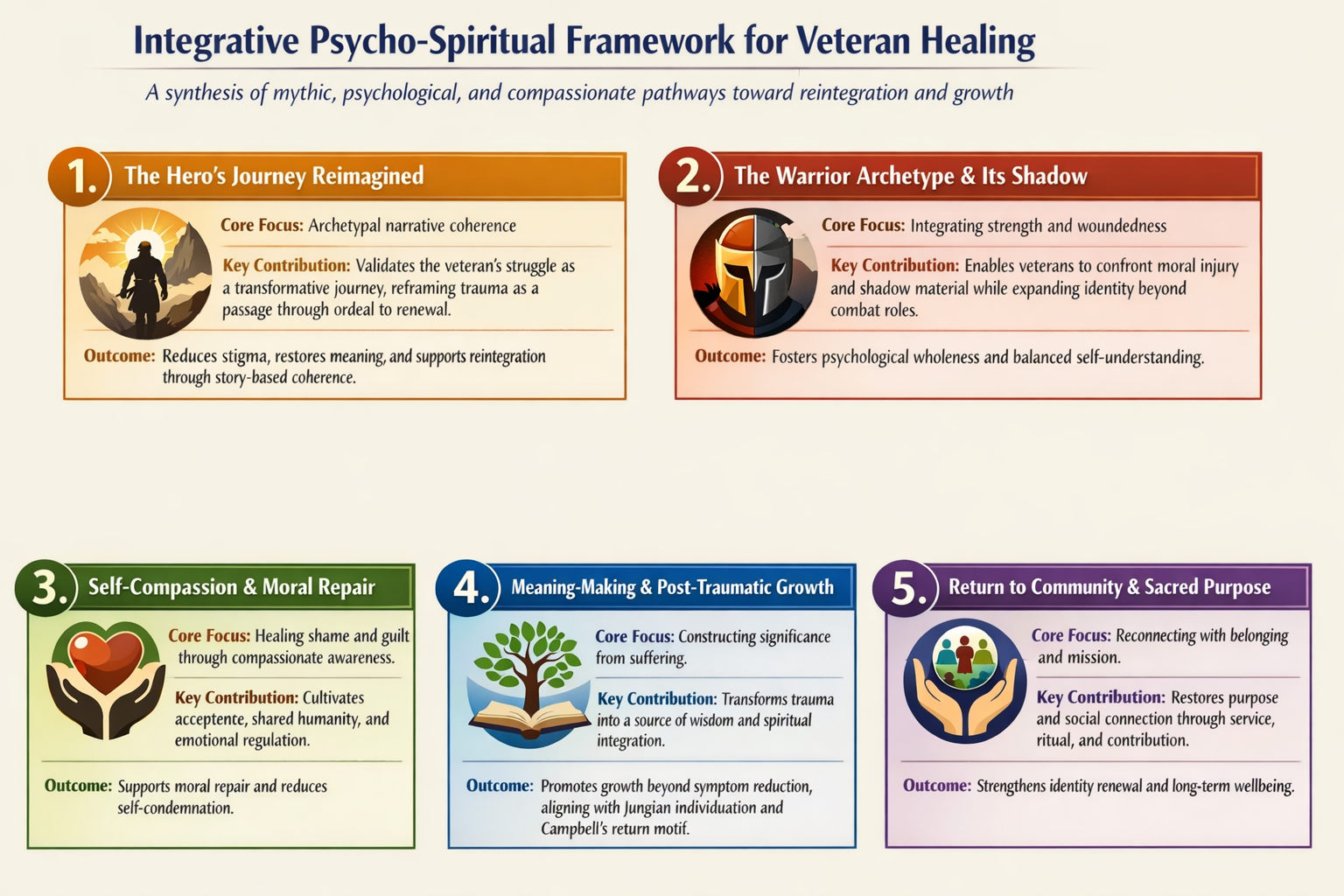
Campbell’s narrative arc provides a structure for understanding the veteran’s path; Jung’s archetypal psychology illuminates the inner terrain of shadow, warrior identity and individuation; Neff’s self‑compassion framework offers a pathway for healing shame and moral injury; and Wicks’ emphasis on resilience, perspective, and purpose grounds the process in sustainable practices that support long‑term wellbeing.
From all this, using the five dimensions, an integrative veteran support framework was constructed that synthesises these perspectives while attending to empirical support and clinical applicability. This is shown below in Table 1, which illustrates each dimension’s core focus and potential contribution(s) to veteran care:
| Dimension | Core Focus | Key Contribution |
| Recognising the Hero’s Journey Structure | Understanding the veteran’s experience through archetypal narrative and personally-relevant stories | Provides a coherent story framework that validates a veteran’s struggle, reduces stigma, and supports reintegration after trauma |
| Engaging the Warrior Archetype and Its Shadow | Exploring both the strengths and wounds of the warrior identity | Helps veterans integrate combat‑formed identities, confront shadow material, and expand into non‑warrior roles |
| Cultivating Self‑Compassion for Moral Injury | Addressing shame, guilt, and self‑condemnation through compassionate awareness | Supports healing of moral injury by fostering acceptance, shared humanity, and emotional regulation |
| Meaning‑Making and Post‑Traumatic Growth | Constructing significance and meaning from traumatic experiences | Facilitates psychological and spiritual integration, enabling growth rather than mere symptom reduction |
| Return to Community and Sacred Purpose | Re‑establishing belonging, societal connections and contribution, and mission in civilian life | Restores purpose, strengthens social connection, and supports long‑term wellbeing and identity renewal |
Table 1: Veteran support framework
This synthesis reframes veteran recovery not as a return to a pre-trauma state but as a potentially transformative journey in which suffering, courage and growth coexist. It highlights the importance of helping veterans integrate their warrior identity, make meaning of their experiences, cultivate compassion towards themselves and rediscover a sense of sacred purpose within the community. Ultimately, the framework suggests that healing occurs not only through clinical intervention but through restoring narrative coherence, reconnecting with humanity and reclaiming a place in the world. Such an approach offers chaplains, clinicians, peer supporters and communities a more holistic and hopeful way to walk alongside veterans as they move towards renewed identity, belonging and purpose.
Contributions and limitations
While each concept or framework brings theoretical richness, empirical validation of their integration for veteran PTSD treatment remains limited. Evidence-based treatments such as PE and CPT demonstrate superior efficacy in randomised controlled trials.34 However, high dropout rates and persistent symptoms for many veterans suggest the need for complementary approaches.
Emerging evidence supports specific components of this integrative framework. Self-compassion’s association with reduced PTSD severity,27 PTG’s prevalence among veterans,31 and preliminary support for arts-based therapies using symbolic expression21collectively suggest promise.
However, rigorous outcome studies specifically testing mythologically-informed, Jungian-oriented or integrated positive psychology approaches for veteran PTSD are notably absent.
It is noted that the paper is reflective in nature and, therefore, lacks empirical validation and limited cultural variability. There is also an epistemological tension between the symbolic, meaning-oriented foundations of depth psychology and mythology, and the positivist, symptom-focused empiricism that underpins contemporary evidence-based trauma treatments. This raises important questions, for future research, about what counts as valid knowledge and how healing is best understood and offered.
Methodological challenges include defining and measuring constructs such as archetypal integration, operationalising mythological interventions for replicability and distinguishing specific effects of meaning-making from general therapeutic factors. Additionally, the epistemological assumptions of depth psychology diverge from the positivist empiricism dominating contemporary trauma treatment research, creating paradigmatic tensions regarding what constitutes valid evidence.
Clinical issues
It is noted that the treatment regimes and applications suggested are already available in clinical or subclinical settings. Rather, this paper suggests a model to augment such interventions. It is also important to acknowledge that an exhaustive survey of all treatment protocols, both clinical and non-clinical, is not possible in this paper.
Further, it is important to consider whether randomised controlled trials (RCTs) represent a valid avenue for evaluating this integrative psycho‑spiritual model. This depends on how one conceptualises both the intervention and the outcomes it seeks to influence. RCTs remain the gold standard for establishing efficacy within contemporary trauma treatment research, and established modalities such as PE and CPT have earned their status through rigorous RCT evidence. In this sense, pursuing RCTs would allow the proposed model to be evaluated within the same evidentiary framework, strengthening its credibility and facilitating integration into clinical pathways.
However, the manuscript also highlights that the model addresses domains including meaning-making, archetypal integration, moral repair and spiritual coherence, which are not easily reducible to symptom scores or short-term behavioural outcomes. This approach also notes the methodological challenges, including defining and measuring constructs such as archetypal integration, operationalising mythological interventions for replicability and distinguishing specific effects of meaning-making from general therapeutic factors. These challenges suggest that while RCTs may be possible, they risk oversimplifying or misrepresenting the model’s aims if used in isolation. Mixed-methods designs, longitudinal qualitative inquiry and pragmatic trials may therefore be more appropriate starting points, capturing the depth-oriented, narrative and existential changes the model seeks to foster.
Cultural and individual considerations
A critical examination reveals important limitations in universalising these frameworks. Campbell’s monomyth has been criticised for reflecting Western, particularly Greco-Roman and Judeo-Christian, mythological patterns while claiming universality.15 Jung’s concept of universal archetypes, while compelling, remains controversial and may underestimate cultural variability in symbolic systems.
Veterans come from diverse cultural, ethnic and religious backgrounds that shape how they understand military service, combat trauma and healing. Indigenous veterans may connect more deeply with tribal warrior traditions than Campbell’s monomyth. Veterans from collectivist cultures may experience reintegration differently than the individualistic hero’s journey suggests. Effective implementation requires cultural humility and adaptation of archetypal frameworks to honour diverse meaning-making systems.
Gender considerations are also critical. Traditional warrior archetypes reflect masculine ideals that may not resonate with female veterans or may reinforce problematic hypermasculinity. Women veterans, comprising increasing proportions of military populations, may experience military service and combat trauma through different archetypal lenses requiring attention to feminine heroic patterns and warrior traditions.
Clinical applications and future directions
Despite empirical limitations, this integrative framework suggests clinical applications worthy of further development and testing:
- Narrative therapy using mythological structures: therapists trained in both trauma treatment and mythological frameworks could help veterans map their experiences onto the structures of the heroic journey, potentially facilitating meaning-making and narrative coherence. This might complement existing evidence-based treatments rather than replacing them.
- Jungian expressive therapies: art therapy, sand play and dreamwork may provide veterans with alternative avenues for expressing traumatic material that resists verbal articulation. Particularly for moral injury and complex trauma involving shame, symbolic modalities may circumvent defences blocking cognitive processing.
- Self-compassion training adapted for veterans: military culture often emphasises toughness and self-sufficiency, which can make self-compassion seem weak. Culturally adapted programs that frame self-compassion as warrior resilience, essential for sustained mission readiness, may increase acceptability while addressing shame and moral injury.
- Strengths-based interventions that recognise military character development: rather than focusing solely on deficits, treatment might systematically identify and amplify character strengths developed through military service, helping veterans recognise how courage, loyalty and perseverance serve them in civilian life.
- Group therapy incorporating ritual and meaning-making: warrior cultures historically employed rituals marking transitions from combat to peace. Contemporary group therapy might incorporate ritual elements, peer witnessing of stories and collective meaning-making that honour veterans’ archetypal journeys while fostering community reintegration.
Future research could examine the outcomes of interventions integrating these frameworks, ideally through mixed-methods designs that capture both symptom reduction and meaning-making, growth and identity integration. Qualitative research examining veterans’ own understandings of their experiences through mythological and archetypal lenses could inform the development of culturally resonant interventions.
Then, to address some of the limitations identified, particularly the lack of empirical validation, cultural variability and the epistemological tension between depth psychology and positivist research, the model could be positioned not as a replacement for PE or CP) but as a complementary, meaning‑oriented adjunct.b This positioning allows clinicians to maintain the symptom-reduction strengths of established treatments while integrating narrative, archetypal and compassion-based elements that may enhance engagement and reduce dropout, consistent with research affirming that narrative-based therapeutic approaches demonstrated significantly lower dropout rates.
Further, limitations related to cultural universality and gendered archetypes can be addressed through adaptive implementation rather than theoretical revision. This includes co‑designing interventions with diverse veteran groups, incorporating culturally specific warrior traditions, and expanding beyond masculine-coded archetypes to include feminine, relational and communal hero narratives. Finally, the model’s reliance on constructs such as shadow integration and sacred purpose can be operationalised through measurable proxies, such as the self-compassion scale, PTG indices, moral injury inventories and narrative coherence measures, allowing empirical evaluation without distorting the model’s psycho-spiritual foundations.
The manuscript highlights the centrality of self‑compassion in trauma recovery, noting that Neff’s framework ‘directly addresses the shame, guilt and moral injury characteristic of veteran experience’. This emphasis opens a rich avenue for further exploration of Eastern philosophical traditions that have long cultivated compassion, discipline and moral clarity within warrior cultures. In Buddhism, self‑compassion is inseparable from the recognition of shared suffering (dukkha) and the cultivation of non‑judgemental awareness. These principles closely align with the manuscript’s integration of mindfulness, shadow acceptance and moral repair. Similarly, the Bushidō code of the Japanese samurai emphasises honour, courage, benevolence and self-restraint, offering a culturally distinct but resonant framework for understanding the moral and existential dimensions of warrior identity.
Other Eastern traditions, such as Taoist balance, Confucian relational ethics or the yogic integration of body-mind-spirit, could also enrich the model by providing alternative pathways for meaning‑making, emotional regulation and identity reconstruction. Incorporating these perspectives would not only deepen the model’s intercultural relevance but also expand its capacity to address the ’soul wounds’ veterans describe in the manuscript.
Summary and conclusion
This critical synthesis integrates diverse theoretical perspectives and empirical findings across mythological, depth psychological and positive psychology literatures to address the complex, multidimensional nature of veteran PTSD care. Joseph Campbell’s hero’s journey provides a universal narrative structure that validates the transformative nature of combat trauma while offering archetypal patterns for understanding deployment, trials and the challenging return to civilian life, supported by recent meta-analytic evidence demonstrating that narrative-based therapeutic approaches achieve significantly lower dropout rates (16–20%) compared to traditional trauma-focused therapies (34–40%).8
Carl Jung’s analytical psychology illuminates how trauma constellates archetypal content in the psyche, particularly activating the warrior archetype’s shadow dimensions, requiring integration through symbolic exploration, dreamwork and active imagination rather than mere symptom reduction, with preliminary empirical support from studies showing reduced PTSD symptoms through Jungian sand play therapy and art-based interventions.20,21
Kristin Neff’s self-compassion framework contributes robust empirical evidence that self-compassion predicts lower PTSD severity and mediates the relationship between combat exposure and PTSD symptoms in Iraq and Afghanistan veterans,27 directly addressing the shame, guilt and moral injury inadequately served by fear-based treatments. Robert Wicks’ resilience-oriented approach, drawing on Jungian and contemplative traditions, provides practical wisdom for cultivating healthy detachment, perspective and meaning amid secondary traumatisation, particularly relevant for military chaplains and veterans navigating moral and existential wounds.12,22
Finally, positive psychology’s PTG research demonstrates that 72% of deployed veterans report at least moderate growth, with meaning-making predicting better mental health outcomes,31 validating suffering as potentially generative and aligning conceptually with both Campbell’s transformed hero returning with gifts and Jung’s individuation towards psychological wholeness. Together, these integrated perspectives suggest that effective veteran PTSD care must extend beyond symptom management to facilitate a transformative journey encompassing narrative reconstruction, archetypal integration, compassionate self-relation, resilience cultivation and meaning-making that honours veterans’ psychological, spiritual and relational realities while promoting PTG and renewed purpose.
The integration of mythological frameworks, Jungian analytical psychology and positive psychology, for veterans, while still embryonic, offers veterans and clinicians conceptual resources for understanding combat trauma as a transformative journey rather than merely a disorder requiring symptom management.
Joseph Campbell’s hero’s journey validates the extraordinary nature of military service while offering hope for a meaningful return. Carl Jung’s analytical psychology illuminates how trauma constellates archetypal content requiring integration for psychological wholeness. Robert Wicks provides practical wisdom for encouraging detachment, sustaining resilience and meaning amid trauma exposure. Kristin Neff’s self-compassion research offers practices to address shame and moral injury. Together, these perspectives suggest treatment approaches honouring veterans’ experiences while promoting PTG.
While validation of this new, integrative framework remains incomplete, its theoretical coherence and preliminary supporting evidence justify further development and rigorous testing. The high prevalence of PTSD among veterans, combined with significant dropout rates from existing evidence-based treatments, demands innovation in therapeutic approaches. By recognising veterans as heroes whose journeys remain incomplete rather than patients whose symptoms need to be eliminated, this framework may offer more resonant and ultimately more effective pathways towards healing and reintegration.
The warrior’s journey, Campbell reminds us, is never only personal but holds significance for the entire community. Supporting veterans in completing their heroic journeys and returning with wisdom intact represents not only a clinical imperative but also a sacred duty to those who have ventured into darkness on society’s behalf.