


Abstract
Background:
Working conditions have a significant impact on job-related performance, and in the military context, this can affect the outcome of exercises and missions. Therefore, the scientific recording and consequentialist improvement of soldiers’ conditions of service is important.
Purpose:
This study aims to contribute to a deeper understanding and potentially improve the wellbeing and performance of NATO soldiers in 1GNC.
Material and methods:
This study is conceived as an anonymised, observational cohort study. During the command-post exercises STJU23, LOLE24 and AVTR24, the soldiers of the 1GNC were interviewed before and after each exercise. The adapted ‘Culture of Care Barometer’ was used as a measuring instrument to investigate the workplace-related strengths and weaknesses of 1GNC.
Results:
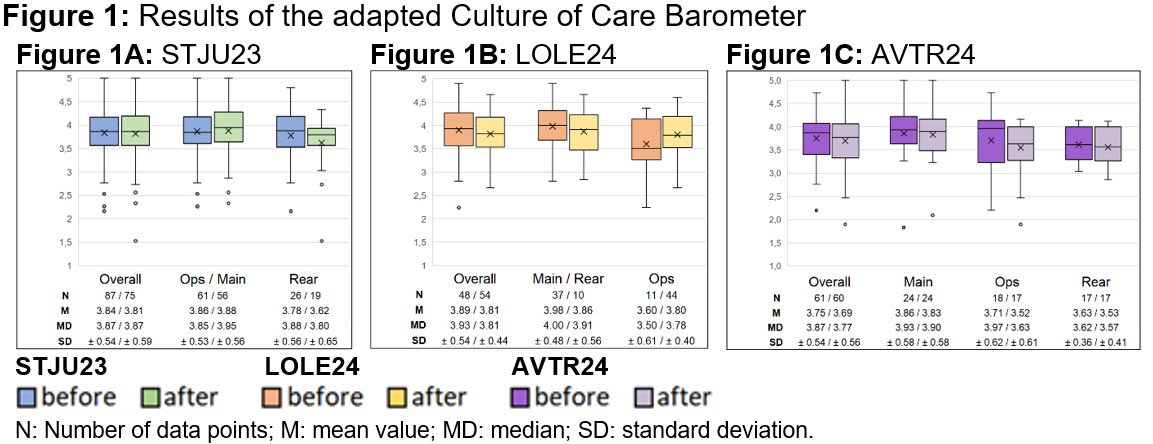
The response rates were 34.8% (STJU23), 21.6% (LOLE24) and 24.8% (AVTR24). On average, the overall result for STJU23, LOLE24 and AVTR24 was a mean of 3.84/3.81 (pre/post STJU23), 3.89/3.81 (pre/post LOLE24), 3.75/3.69 (pre/post AVTR24) and a median of 3.87/3.87 (pre/post STJU23), 3.93/3.81 (pre/post LOLE24), 3.87/3.77 (pre/post AVTR24). The factor analysis detects a positive correlation for all factors. The highest values were achieved in factor 3 (relationships with colleagues).
Conclusion:
Our study conclusively demonstrated that potentially stressful working conditions can be detected by using the aCoCB. Professional medical advice can support military leaders in fulfilling their duty to take care of the mental health of their soldiers. Furthermore, psychological factors have a significant influence on military tactical considerations.
Keywords: Culture of Care Barometer (CoCB), conditions of service, NATO exercises, 1 German-Netherlands Corps (1GNC).
Background
The 1 German-Netherlands Corps (1GNC) is a multinational high-readiness and warfighting headquarters within the NATO force structure. 1GNC is capable of rapid deployment in various fields of operations, including humanitarian aid and deterrence operations.1 This NATO exercise series is tailored to current geopolitical events (particularly Article 5 scenarios) in order to improve structures and work processes. A key factor is the division and distribution of 1GNC’s forces into several command posts (CPs) to reduce vulnerability and increase endurance, thereby maintaining leadership ability at the highest possible standard. Steadfast Jupiter (STJU23), Loyal Leda (LOLE24) and Avenger Triad (AVTR24) are simulation-based exercises involving the participation of several NATO Headquarters in which 1GNC takes part with different CP configurations. The soldiers face new challenges in every exercise and must constantly adapt flexibly to changing circumstances.2,3
These working conditions have a significant impact on our job satisfaction, productivity and effectiveness, which also applies to soldiers’ conditions of service. In general, military missions are often complicated by external stressors, such as limited private communication, cramped living space without privacy, limited medical care, extended day shifts and daily routines dictated by others. This lack of control and resulting reduction in performance can potentially jeopardise the mission’s success. Human factors also play a crucial role in the military context, primarily when serving in a high-readiness warfighting NATO Headquarters such as 1GNC. This includes cognitive performance, mental and physical resilience and recovery strategies.4‑7 Research in the fields of space travel and submarine crews has provided important findings, as it has helped reduce the adverse effects through the selection of interpersonally compatible crews, pre-mission team training and the implementation of self-monitoring tools for psychological parameters. These findings can only be transferred to a limited extent to the situation of NATO soldiers in the Article 5 scenarios, because this extensive preparation might not be possible in this case.8-10
This paper aims to assess the soldiers’ conditions of service by utilising an adapted version of the Culture of Care Barometer (aCoCB). The results of a previous study testing this questionnaire could already be used for optimisation within 1GNC. Ultimately, this research is intended to ensure that NATO’s performance and functionality remain resilient
Methods
Study population
Multinational soldiers from 1GNC voluntarily participated in this study within the context of the NATO exercises STJU23, LOLE24 and AVTR24. We collected baseline parameters such as ‘number of exercises’ and ‘years spent in 1GNC’, which were each divided into three subgroups. No further basic data were collected to ensure the participants’ anonymity. Anonymisation was achieved by generating an alphanumeric identification code that allowed individual questionnaires to be unmistakably assigned to a participant.
Design of the study
This study was conducted at multiple locations, depending on the CP structure within the framework of STJU23, LOLE24 and AVTR24. The data were collected at two points in time: during the immediate preparation for the exercise (‘before’) and in the last 3 days before the exercise ended (‘after’) for each exercise. Detailed information to clarify the study’s aim was included in the questionnaires, and the accessibility of our working group to study participants was ensured to clarify any uncertainties. Inclusion in the study occurred after informed consent was obtained and the data were evaluated anonymously. The cohort was observed without blinding, randomisation or intervention. To assess and openly communicate the quality of this study design, we used the ‘Risk of Bias in Non-randomized Studies of Interventions’-tool (ROBINS-I) and the level of evidence according to the Agency for Health Care Policy and Research (AHCPR).12,13
Culture of Care Barometer
The Culture of Care Barometer (CoCB) is used for benchmarking and exploring various aspects of care culture within organisations. This customisation ensures that the questionnaire resonates more effectively with the unique work environment and culture of 1GNC, leading to more accurate and relatable responses and capturing the conditions of service (adapted from the Culture of Care Barometer [aCoCB]).11,14 Additionally, we performed a factor analysis on the following levels: factor 1 (organisational values—macro level), factor 2 (team support—meso level), factor 3 (relationships with colleagues—micro level), and factor 4 (job constraints—micro level). Each question was assigned a predetermined loading and applied to the factors. It includes 30 questions and the responses were rated on a five-point Likert scale from ‘strongly disagree’ to ‘strongly agree’ (1 ≙ strongly disagree; 2 ≙ disagree; 3 ≙ neither; 4 ≙ agree; 5 ≙ strongly agree). The wording of this questionnaire was adapted to suit the unique military context, work environment and culture of 1GNC better (Terms like ‘co-workers’ and ‘organisation’ were replaced with ‘colleagues’ and ‘1GNC’; ‘line manager’, ‘colleagues’ and ‘managers’ were changed to ‘superior’, ‘comrades’ and ‘flag officers’). Additionally, we performed a factor analysis after predetermined loading on the following levels: factor 1 (organisational values—macro level), factor 2 (team support—meso level), factor 3 (relationships with colleagues—micro level) and factor 4 (job constraints—micro level).
Statistical assessment
Data collection was performed using Microsoft Excel 2023 (Microsoft Deutschland GmbH, Munich, Germany), along with preliminary graphical analyses, including the creation of box plots. Subsequent statistical analyses were conducted using R statistical software (R Foundation for Statistical Computing, Vienna, Austria). To assess the data distribution, we used the Shapiro-Wilk test, histograms and QQ plots, which indicated a deviation from normal distribution, leading to the adoption of non-parametric approaches for statistical evaluation. Furthermore, the Wilcoxon signed-rank test was used to assess the relationship between dependent variables. Spearman’s rank correlation coefficient (rho value) and Kruskal-Wallis H test (H value) were additionally employed for assessing statistical significance, with a threshold set at p < 0.05. Moreover, the effect size was estimated using Cohen’s d, and paired t-tests were used where appropriate to compare dependent samples.
Results
Study population
In each exercise, we distributed 250 sets of questionnaires. At STJU23, the results from 87 at LOLE24 54 and at AVTR24 61 questionnaires could be included in the statistical analysis (see Table 1). The detailed baseline parameters are also depicted there. The level of evidence is categorised as Level III based on the criteria established by AHCPR. The ROBINS-I tools’ risk of bias indicates varying degrees across different categories: 3 instances of low risk, 2 of moderate risk and 2 of severe risk (see Table 2).
Table 1: Results of the baseline parameters
| Figure 2A: STJU23 | Figure 2B: LOLE24 | Figure 2C: AVTR24 | |||||||
|---|---|---|---|---|---|---|---|---|---|
| Participation rate | 87 34.8% |
54 21.6% |
61 24.4% |
||||||
| Number of exercises | 15 17.2% |
18 20.6% |
54 62.1% |
12 22.2% |
12 22.6% |
30 55.5% |
9 14.8% |
15 24.5% |
37 60.7% |
| Years spent in 1GNC | 32 36.8% |
33 37.9% |
2 25.3% |
19 35.2% |
20 37.0% |
15 27.8% |
17 27.9% |
20 32.8% |
24 39.3% |
Illustration of the distribution of the baseline parameters (Participation rate, Number of exercises, Years spent in 1GNC), absolute number, percentage distribution shown below.
Table 2: Assessment of the risk of bias following ROBINS-I
| 1* | 2* | 3* | 4* | 5* | 6* | 7* |
| pre- | at- | post- | ||||
| intervention | ||||||
1* confounding bias
2* selection bias
3* information bias
4* confounding bias
5* selection bias
6* information bias
7* reporting bias
Types of bias distinguished by time of occurrence
(Pre-, at- and post-intervention):
green = low,
yellow = moderate,
amber = severe,
red = critical,
blue = no information.
Adapted Culture of Care Barometer (aCoCB)
Initially, the study’s results were categorised based on the three locations: Main (Bergen, Germany), OPS (Grafenwöhr) and the Rear (Grafenwöhr) (see Figure 1). A comparison of the average values of the aCoCB before and after the exercise revealed a statistical significant correlation in all localities. The WSR did not show a statistically significant trend in the average values before and after exercise.

Adapted Culture of Care Barometer – factor analysis
The statistical analysis of aCoCB’s factors is presented below the figure (see Figure 2) and was created by summarising the questions and applying a predefined loading. All factors showed a positive correlation when comparing the mean values recorded before and after the exercise. The best results were achieved in the parameters of factor 3 (relationships with colleagues). In factor 3 before STJU23, the mean value was 2.99, and the median was 3.06. After the exercise, the mean value increased slightly to 3.02, and the median remained unchanged at 3.06. No relevant changes in the mean value and median before and after the exercise could be detected.
Adapted Culture of Care Barometer—single questions
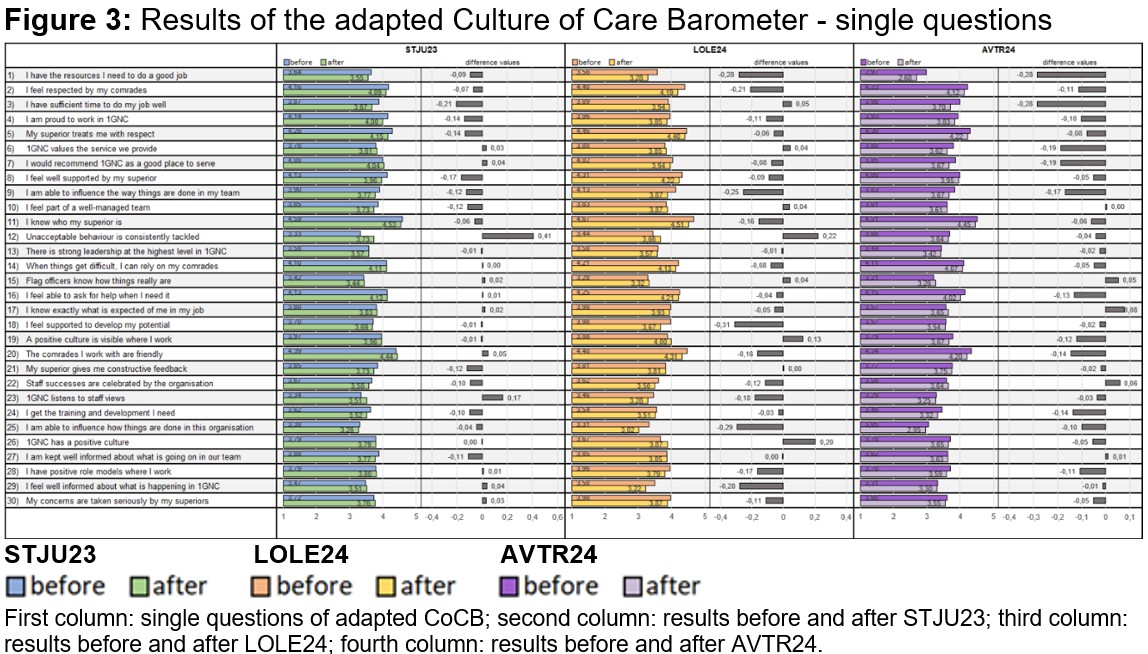
In addition to the overall analysis, we conducted a detailed examination of the responses to each question (see Figure 3). This approach allowed us to engage in more nuanced discussions with colleagues in 1GNC and to evaluate specific aspects of the battle rhythm and its impact on sections’ service processes in greater depth.
Discussion
From 2023 to 2024, 1 GNC completed three NATO exercises (STJU23, LOLE24 and AVTR24). Our study assessed the mental status and conditions of service during the exercises by handing out the adapted Culture of Care Barometer immediately before and after the exercises. Unfortunately, the response rate was low in all three exercises. Most recently, the response rate during AVTR24 was only 24.4%. During exercise STJU23, a response rate of 34.8% was achieved. However, the lowest response rate recorded LOLE24 with only 21.6%. The low response rates affect both the informative value and the representativeness. One possible reason for the low participation and response rate could be the lack of an informative event. However, this was done on a small scale, at least in the AVTR24 main, with a brief introduction to the NCOs of each branch, in order to achieve the highest possible participation in the main. This may explain the increase in the response rate for AVTR24 in contrast to LOLE24. Generally, upon observing the mean, median and standard deviation, a consistent perception of working conditions was evident before and after the exercises, with slight but relevant differences. The mean value for STJU23 remained almost unchanged, decreasing slightly from 3.84 to 3.81. Whereas, the decrease in the mean value in LOLE24 turned out to be larger, with a change from 3.89 to 3.81. In AVTR24, the mean value decreased from 3.75 to 3.69. These small changes indicate that the general conditions and support structures were perceived as largely stable by the soldiers. The minimal differences could be due to the specific environmental conditions and stresses of the respective exercises. Interestingly, this is also reflected in the larger standard deviation difference between the comparison of before and after the exercise at LOLE24 (±0.54 / ±0.44). In contrast, the standard deviations for STJU23 (±0.54 / ±059) and AVTR24 (±0.54 / ±0.56) remained largely constant. This suggests that perceptions of service conditions varied more widely in LOLE24, indicating a broader range of experiences among the soldiers. However, the different perceptions could also be due to the different infrastructure and location at LOLE24, where both outdoor tent structures and fixed infrastructure were used. In contrast, STJU23 took place in a NATO bunker, where the conditions were constant and relatively controlled. At AVTR24, the conditions, at least in the OPS/REAR, were comparable to LOLE24. Whereas in the MAIN there were constant conditions and a fixed infrastructure. This controlled environment may have stabilised the perception of duty conditions, while the more variable environment at LOLE24, with outdoor CPs and changing weather conditions, led to different ratings. Studies show that extreme or isolated environments, such as Antarctica or submarine deployments, pose similar challenges to resilience and psychological wellbeing.8-10,15 The results of the factor analysis support this. The differences in the factors ‘relationships with colleagues’ (factor 3) and ‘job constrains’ (factor 4), which show greater variability in LOLE24, are particularly striking. This could be due to the infrastructure and limited communication between the locations, which were more pronounced in LOLE24 than in STJU23. This suggests that interpersonal support and camaraderie bonds are less stable under difficult communication conditions. Such conditions can potentially increase the feeling of isolation and thus increase psychological stress, which negatively impacts soldiers’ resilience.4,5 Factor 4 (job constraints) relates to the necessary resources and clear objectives, and shows a higher dispersion at LOLE24 (±0.77 / ±0.44) than in comparison to STJU23 (±0.41 / ±0.43) and AVTR24 (±0.46 / ±0.45). This is indicative of the requirements in temporary outdoor CPs, which offer less structured duty conditions than a fixed NATO bunker, as in STJU23 or existing infrastructure predominantly in AVTR24. Such limitations in the duty environment could make tasks more difficult to perform and lead to an increased perception of stress. This underlines the importance of considering these factors in future planning. Adjustments such as improved communication structures, clearer allocation of resources and stronger team support could help to improve service conditions for soldiers and reduce psychological stress.
A detailed examination of the individual question analysis reveals further interesting patterns that point to specific aspects of the service conditions. In the STJU23 exercise, there were only minimal changes in the rating of individual questions, which suggests a largely stable perception across the exercise. Particularly striking was the significant improvement in the question ‘unacceptable behaviour is constantly tackled’, which recorded a positive increase of 0.41. This indicates that the perception and addressing of problematic behaviours could be implemented more effectively within the controlled bunker environment. LOLE24 and AVTR24 exercises, on the other hand, show significantly higher fluctuations in the ratings of the individual questions before and after the exercises. The highest decreases were observed in the assessment of one’s influence on team processes (LOLE24 -0.25 and AVTR24 -0.17) and one’s available resources during LOLE24 and AVTR24 (-0.28 both). The most significant decrease was recorded for the statement ‘I feel supported to develop my potential’ by 0.31, while LOLE24 and the statement ‘I have sufficient time to do my job well’ decreased by 0.28. These specific deviations suggest that the conditions at LOLE24 and AVTR24, particularly the adaptation to temporary structures, made communication and the feeling of co-creation more difficult.1 The individual question analysis thus confirms that the variable environmental conditions at LOLE24 and partially at AVTR24 led to a more critical perception in certain aspects of team dynamics and service support.
Conclusion
In summary, the data results indicate that the service conditions in all three exercises were rated as stable overall, although specific environmental conditions do influence perception. The slightly higher fluctuations and more variable perceptions in LOLE24 and AVTR24 suggest that a structurally uniform environment, as in STJU23, may lead to a more homogeneous and stable perception of duty conditions. These findings emphasise the importance of adapting support measures and resources to meet the special requirements of multinational deployments in order to sustainably promote the conditions of service and the wellbeing of soldiers.7,10 In future exercises, increased structural and communicative support at deployment sites such as LOLE24 could help reduce perceived stress and increase consistency in the perception of service conditions.
In the future, NATO exercises should record the conditions of service and the resulting mental stress on soldiers, as these factors can have a decisive influence on service performance, the commander’s effectiveness and warfighting capacity. Regular use of the aCoCB, along with self-critical reflection of the survey results, can help to strengthen organisational resilience, which is particularly useful in military units. Questionnaire-based surveys have been indicated to be suitable for further investigations.
Corresponding Author: Philipp Georg Schnadthorst, philippschnadthorst@bundeswehr.org
Authors: P G Schnadthorst, L Geerkens1, F Weinreich2
Author Affiliations:
1 Münster Germany
2 Koblenz Germany