


Abstract
Background. This study builds on prior research suggesting that demographics and attributes can better predict positive or negative experiences in the military-to-civilian transition.
Purpose. We measured differences in self-reported experience of military-to-civilian transitions on a range of in-service and post-service variables suggested in the literature.
Materials and methods. Drawing on a survey of Australian veterans (n=864), we use descriptive statistics to examine factors including service length, category of discharge, combat experience, friendship groups and other demographics. One-way ANOVA was performed to determine the mean scores, followed by post hoc t-tests.
Results. Transition difficulty is self-reported on a scale of 1 to 10. Negative transition experiences are associated with: younger age of entry, younger current age, medical and administrative discharge, moderate years of service (more than 1 year and less than 30 years), combat exposure and having mainly veteran friendship groups. In contrast, more successful transition experiences are associated with very long service duration, voluntary or age-retirement discharge and mainly civilian friendship groups post-discharge.
Conclusion. Military veteran transition to civilian life is not uniform. Our findings underscore the importance of a granular approach to understanding veteran experiences and future support needs.
Keywords: mental health, veterans, discharge, social support, wellbeing, military-to-civilian transition
Introduction
The transition from full-time military service to civilian life is a multifaceted process that varies widely among individuals. Research establishing the impact of this transition commenced with analysing veterans as a single group distinct from those who have never served in the military. This in itself has only recently become possible; until the inclusion of veteran status in the 2021 Australian Census, there was no reliable count of ex-serving military members in Australia. However, the Australian Defence Force (ADF) currently has approximately 90 000 members and has deployed personnel to over 30 countries since the Vietnam era. The Census identified 496 300 former ADF members, representing 2.4% of the population aged 15 and over.1 Measuring differences between ‘veterans’ and ‘non-veterans’ could now obscure the needs and outcomes of subpopulations within the veteran community. For example, where they can be identified, former ADF members report higher-than-average social and economic wellbeing, including higher rates of full-time employment, educational attainment, stable relationships and community engagement. These suggest that military service may support positive life outcomes.2 More than 50% of veterans, across all discharge categories, report household incomes above the national median.3 Yet a growing body of qualitative work, media coverage, and findings from the Royal Commission into Defence and Veteran Suicide highlight significant challenges faced by some veterans.4-6 These include elevated rates of mental health disorders, suicidality and over-representation in homeless and incarcerated populations.2,7
Australian research, which differentiates between veteran subgroups, has historically focused on those conscripted and deployed to the 1965–1975 period of Australia’s involvement in the Vietnam War. A scoping review of mental health interventions for veterans found 29 studies published since 2000, all of which either used broad participant categories such as ‘veterans’ or ‘current and ex-serving ADF’, or differentiated ‘Vietnam Veterans’. Much of the remaining literature is qualitative or uses small sample sizes.8 International research can similarly lack detail to guide Australian researchers.9 The same is true for the investigation of the experience of ‘military-to-civilian transition’. The ADF workforce now spans seven service categories, from full-time service to standby reserve, with some members making multiple moves between categories. This makes the ‘military-to-civilian’ transition, as it is sometimes referred to, a heterogeneous experience. However, expert consensus is that there is a general effect of leaving full- or part-time military service (with constraints on lifestyle and significant work–life overlap) to life in the civilian community with limited military contact. This is referred to as ‘transition to civilian life’.10
Some indicators suggest particularly vulnerable cohorts of veterans. A large-scale ADF-commissioned research study identified risk factors for mental health disorders and suicidality, including being male, younger, of lower rank, serving fewer years, in Army service (as opposed to other Branches) and being medically discharged.5 UK research found that while many service leavers transition successfully, those with short service experiences and medical discharge may be more like to face compounded challenges such as ill health, unemployment, debt and homelessness.10 These risk factors may not be unique to military personnel; there are parallels with police, firefighters and paramedics.11
In-service and post-service experiences
Veteran experiences can be conceptualised as occurring across two phases: in-service and post-service.
Experiences during service, as well as demographic factors such as age and gender, can affect a person’s experience of military life. There is some suggestion that enlisting at an older age increases the risk of mental health injury.12 Gender, for a range of reasons, appears to affect mental health outcomes for both in-service and veteran personnel.5 Another critical in-service factor is exposure to potentially traumatic events. This exposure can occur during combat. The largest current Australian data sample distinguishes between those who deployed to the Middle East Area of Operations (MEAO) vs those who did not, but found no differences in mental health outcomes.13 However, this study was unable to differentiate between location, role and exposure context. Other studies have shown increased PTSD symptoms among veterans with higher exposure to traumatic events during MEAO deployments and Vietnam.14-15 Not all potentially traumatic exposures during deployment are related to combat. Research on deployment to Rwanda indicate greater vulnerability to PTSD among veterans exposed to gruesome or horrific scenes.16 There may also be during-service experiences that result in better health outcomes: veterans who are older at discharge, served longer, held officer ranks, or served in the Air Force (as opposed to other Branches) are less likely to experience mental health disorders or suicidality.5
Transition experiences straddle the during and post-service experience and the reason for leaving the military is one of the most frequently studied aspects of transition, possibly because data exists to stratify veterans by discharge type. UK research shows that personnel discharged for disciplinary or medical reasons are more likely to experience homelessness,10 At the same time, early service leavers (ESL) face increased risks of mental health issues, unemployment, homelessness and substance abuse.17 Australian data similarly show that medically or administratively discharged veterans are more likely to experience mental health disorders.5 However, this ‘medically or administratively discharged’ group is growing and thus becoming increasingly heterogenous. Of those who left ADF service between 2003 and 2019, almost half (44%) were medically or involuntarily discharged.18
Another important post-transition factor may be social support, social connectedness or social capital.19 In US veterans, social isolation has been linked to poor mental health outcomes.20 In Australia, there are numerous programs aimed at increasing social support within the veteran community; however, few have been rigorously evaluated or target any particular subgroup who may have been identified as in need of social support.21 Families are often the strongest source of social support. Some ex-service organisations aim to support both veterans and their families, on the understanding that veteran involvement in ex-service organisations can support mental health,22 and family involvement overall may lead to better outcomes for mental health injuries in veterans.23
The present study aims to explore associations between some commonly cited in-service and post-service experiences and their impact on the civilian-to-military transition experience, as perceived by the veteran. As transition is the ‘start’ of the post-service veteran experience, this research seeks to inform targeted support strategies and guide further investigations by identifying attributes of veterans that may influence their transition experience. A more nuanced understanding of veteran experiences is essential to developing programs that effectively support veterans at risk of adverse outcomes. The research questions were:
- Is there a difference in transition experience for veterans who have different types of during-service experiences (namely age, gender, service length, combat exposure)?
- Is there a difference in transition experience for veterans who have different types of post-service experiences (reason for leaving, social support, family engagement with veteran support)?
Materials and methods
The research employed data from the Victorian Veterans’ Needs (VVN) research project, a mixed-methods project which recruited over 1000 Victorian-based ADF veterans to investigate their experiences post-service (Australian Catholic University HREC Approval No 509-23). All data was obtained using online informed consent.
The study design and thematic emphasis were guided by findings from the Australian Royal Commission into Defence and Veteran Suicide. Veterans were not directly involved in the conduct or reporting of the study. However, their input was central to its conceptual development, provided by veteran members of the Returned and Services League (RSL) Victoria Veteran Reference Group.
Recruitment method
Data for this study was from the survey component of the VVN. Survey data was collected between August 2024 and February 2025. Respondents were recruited to the study via: the Returned and Services League (Victoria) service members database; social media (Facebook) announcements; snowball (word-of-mouth) sampling; radio appearances by a member of the research team; and written advertising material in regional areas, such as Wodonga, Geelong and Frankston, with large veteran populations. Efforts were taken to achieve variation in sample demographics representative of the Victorian military veteran population; however, the survey mode could exclude veterans without internet access or literacy, and the recruitment strategy of RSL advertisement meant the survey oversampled RSL members: 69% of survey respondents were RSL members, and 25% of all Victorian veterans are estimated to be RSL members. The advertisement included a link to a REDCap secure online consent form and survey.
Inclusion criteria
Inclusion criteria for this piece of research were valid VVN survey responses (those who consented to participate, stated that they lived in Victoria, and completed the online survey), as well as additional criteria:
a) Those who were former members of the ADF (i.e. those who served in overseas militaries were omitted).
b) Those who gave a rating on the transition experience question (see below).
Participant demographics
From the original survey data of 1192 responses, n=864 responses were included.
Table 1 shows the demographics of the sample, which mirror the Victorian veteran population, being majority male and with a peak in ages between 60–79 years, reflecting the ongoing influence of conscription on the demographics of Australian veterans. Branch of service and highest rank achieved reflect the demographics of the Victorian veteran population. Over 90% of the sample completed full-time service at some point, and at least half served for more than 2 years. Importantly for this research, there are variations in discharge type, with the spread representative of the known Australian veteran population.
Table 1. Demographics of sample (n=900)
| Category | n | % | |
|---|---|---|---|
| All respondents | 864 | 100.00 | |
| Variables used in the analysis | |||
| Gender | Male | 726 | 84.03 |
| Female | 95 | 11.00 | |
| Levene test of homogeneity = 0.59, df=1, p=0.443 | |||
| I use a different term | 1 | 0.12 | |
| Blank or prefer not to say | 42 | 5.33 | |
| Age | 20-29 years | 3 | 0.35 |
| 30-39 years | 22 | 2.55 | |
| 40-49 years | 54 | 6.25 | |
| 50-59 years | 115 | 13.31 | |
| 60-69 years | 259 | 29.98 | |
| 70-79 years | 318 | 36.81 | |
| 80+ years | 52 | 6.02 | |
| Blank or prefer not to say | 41 | 4.75 | |
| Age (2-category) | Younger (<55 years) | 162 | 18.75 |
| Older (≥55 years) | 450 | 52.08 | |
| Levene test of homogeneity = 2.74, df=1, p=0.098 | |||
| Blank or prefer not to say | 252 | 29.17 | |
| Age joined the military | Under 21 years | 655 | 75.81 |
| Over 21 years | 174 | 20.14 | |
| Blank | 35 | 4.05 | |
| Length of FULL-TIME service only | Less than 12 months | 29 | 3.35 |
| 2-4 years | 67 | 7.75 | |
| 5-9 years | 81 | 9.38 | |
| 10-19 years | 101 | 11.69 | |
| 20-29 years | 99 | 11.46 | |
| 30 years or more | 36 | 4.17 | |
| “I served for more than one year” | 380 | 43.98 | |
| Reserve service only | 69 | 7.99 | |
| Levene test of homogeneity = 2.07, df=7, p=0.044 | |||
| Blank | 0 | 0.00 | |
| Reason for leaving (discharge type) | Administrative (involuntary) | 32 | 3.70 |
| Medical (involuntary) | 126 | 14.58 | |
| Age retirement (mixed) | 43 | 4.98 | |
| Completed National Service contract (mixed) | 125 | 14.47 | |
| Voluntary and not in contract (voluntary) | 487 | 56.37 | |
| Levene test of homogeneity = 3.33, df=6, p=0.003 | |||
| Other (mixed) | 14 | 1.62 | |
| Blank or prefer not to say | 37 | 4.28 | |
| Family engagement with ESOs | Not currently sharing my life with a family | 47 | 5.44 |
| Family not at all engaged | 298 | 34.49 | |
| Family somewhat engaged | 208 | 24.07 | |
| Family very engaged | 45 | 5.21 | |
| Levene test of homogeneity = 1.14, df=4, p=0.337 | |||
| Blank or prefer not to say | 266 | 30.79 | |
| Variables not used in the analysis | |||
| Branch of service | Navy | 156 | 18.06 |
| Army | 549 | 63.54 | |
| Air Force | 108 | 12.50 | |
| Blank | 51 | 5.91 | |
| Type of service | Full-time | 643 | 74.42 |
| Both full- and part-time | 154 | 17.82 | |
| Part-time | 60 | 6.94 | |
| Blank | 7 | 0.81 | |
| Highest rank achieved | Other Ranks | 445 | 51.50 |
| NCO | 228 | 26.39 | |
| Officer | 141 | 16.32 | |
| Other or not stated | 46 | 5.33 | |
*Respondents were given the option to categorise their service time as ‘more than one year’ instead of quantifying it, to cater for those who might not remember the exact number of years of full-time or part-time service.
Analysis
The survey included the dependent variable of transition experience. Participants were asked to ‘please rate your personal experience of transitioning from military to civilian life on a scale of 1 (not at all difficult) to 10 (overwhelmingly difficult)’. It is an important facet of this research that the transition experience reported here is from the veterans’ perspective, ensuring the research is informed by veterans’ priorities.
A range of independent variables measured demographic, in-service, and post-service factors: age, gender, combat exposure, reason for leaving, age of enlistment, service length, and two aspects of social support: description of current friendship group and family engagement with the veteran community (via veteran ex-service organisations). Particular attention was given to the categories of vulnerability and strength suggested in the literature.
Descriptive data and comparative analyses were conducted to identify subgroups with statistically significant deviations in transition difficulty scores. For two-category variables, independent t-tests were used, and for multicategory variables,
Missing data. ANOVA was used. Little’s MCAR test was conducted to explore missing data. Variance analysis using all ANOVA variables indicated that the data were missing completely at random (χ2=0.928, df=1, p=0.335). Subsequently, listwise deletion was used when missing data were present for the variables being analysed.
Normality and homogeneity. Independent variables were tested using Levene’s test for homogeneity of variance. Statistics are reported in Table 1. All of the t-test variables (age, age joined, gender, combat exposure) violate the assumption of homogeneity. ANOVA variables, friendship group and family engagement violated the assumption of homogeneity. Subsequently, where the assumption of homogeneity was violated, Welch’s ANOVA was used as a robust alternative to the standard ANOVA F-statistic, and the unequal variance t-test as an alternative to the standard t-test. For length of full-time service and discharge type, the standard ANOVA F-statistic was used.
Results
Transition experience
On a scale of 1–10, the transition mean was 5.39. Figure 1 shows the distribution of scores, which is not normally distributed but instead shows varied experiences of transition, with a correlation coefficient close to zero.
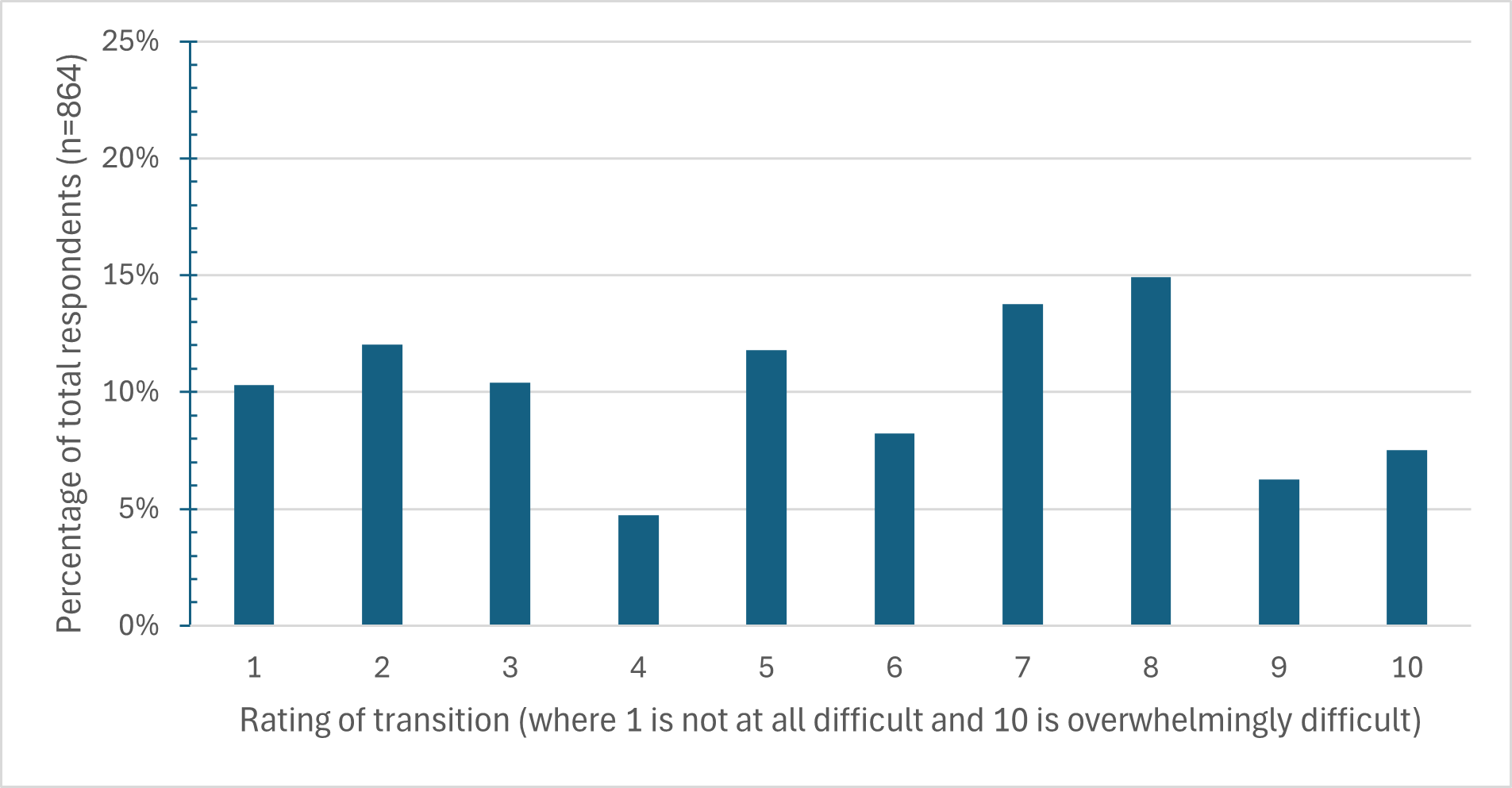
Figure 1. Spread of transition ratings for Victorian Veterans Needs research data (n=864).
Ratings were examined for differences in subgroup means and results are shown in Table 2 for independent t-tests and in Table 3 for one-way ANOVA with subsequent post-hoc analysis.
Transition per age or gender
Age was investigated in two ways: participant’s current age and the age at which they joined the military. Both variables were significantly different: those joining at a younger age reported a more difficult transition, and those currently under 55 years reported a more difficult experience. However, the effect sizes for both differences were small. Gender was investigated for those reporting as male and female (other categories had too few participants for analysis) and was not significantly different.
Transition per exposure to combat
Self-reported combat exposure during service was significantly related to a more difficult transition experience, with a small effect size.
Table 2. Transition difficulty scores by veteran subgroups—independent t-tests (equal variance not assumed)
| Category | N | M | St Dev | df | t | 95% CI | p | Effect size (d) |
|---|---|---|---|---|---|---|---|---|
| All respondents | 864 | 5.40 | 2.81 | |||||
| Current age: | ||||||||
| Older (≥55 years) | 450 | 5.30 | 2.72 | |||||
| Younger (<55 years) | 162 | 6.43 | 2.63 | 610 | 4.56 | 0.64–1.61 | <0.001 | 0.41 small |
| Age joined the military: | ||||||||
| Over 21 years | 174 | 5.02 | 2.72 | |||||
| Under 21 years | 655 | 5.44 | 2.82 | 279 | 1.78 | -0.04–0.88 | <0.05 | 0.15 small |
| Gender: | ||||||||
| Male | 726 | 5.35 | 2.82 | |||||
| Female | 95 | 5.57 | 2.74 | 121 | 0.72 | -0.81–0.38 | >0.1 | 0.08 ns |
| Combat exposure: | ||||||||
| Did not exp combat | 560 | 5.04 | 2.77 | |||||
| Experienced combat | 253 | 6.08 | 2.78 | 485 | 4.93 | 0.63–1.45 | <0.001 | 0.37 small |
Table 3. Transition difficulty scores by veteran subgroups—one-way ANOVA (Welch’s ANOVA where homogeneity is violated)
| Category | N | M | St Dev | CI 95% | df | SS | MS | F | P | f 2 |
|---|---|---|---|---|---|---|---|---|---|---|
| Full-time service length: | ||||||||||
| Reserve service only | 69 | 3.90 | 2.60 | 3.27–4.52 | ||||||
| 30+ years | 36 | 5.19 | 3.34 | 4.06–6.32 | ||||||
| 20–29 years | 99 | 5.45 | 2.69 | 4.92–5.99 | ||||||
| 10–19 years | 101 | 6.23 | 2.68 | 5.70–6.76 | ||||||
| 5–9 years | 81 | 5.64 | 3.07 | 4.96–6.32 | ||||||
| 2–4 years | 67 | 5.78 | 2.63 | 5.13–6.42 | ||||||
| <12 months | 31 | 3.87 | 2.80 | 2.84–4.90 | ||||||
| ‘More than one year’ (no figure) | 380 | 5.47 | 2.71 | 5.20–5.75 | 7 | 315.17 | 45.02 | 5.93 | <0.001 | 0.05 very small |
| Discharge category: | ||||||||||
| Age retirement | 43 | 3.95 | 2.30 | 3.25–4.66 | ||||||
| Voluntary | 487 | 4.95 | 2.74 | 4.70–5.19 | ||||||
| Completed National Service | 125 | 5.43 | 2.60 | 4.97–5.89 | ||||||
| Administrative | 32 | 6.38 | 2.98 | 5.30–7.45 | ||||||
| Medical | 126 | 7.25 | 2.55 | 6.80–7.70 | 4 | 649.73 | 162.43 | 22.67 | <0.001 | 0.11 small |
| Friendship group: | ||||||||||
| Friends mostly non-veteran | 249 | 4.87 | 2.80 | 4.52–5.22 | ||||||
| Mixed friendship group | 417 | 5.32 | 2.75 | 5.05–5.59 | ||||||
| Friends mostly ex-serving | 122 | 6.21 | 2.89 | 5.69–6.73 | 2 | 147.39 | 73.70 | 9.00 | <0.001 | 0.02 very small |
| Family ESO engagement: | ||||||||||
| Not currently sharing my life with a family | 47 | 5.17 | 2.88 | 4.32–6.02 | ||||||
| Family not at all engaged | 298 | 5.53 | 2.80 | 5.21–5.85 | ||||||
| Family somewhat engaged | 208 | 5.12 | 2.62 | 4.75–5.48 | ||||||
| Family very engaged | 45 | 5.38 | 3.11 | 4.44–6.31 | 3 | 22.67 | 7.56 | 1.01 | >0.1 | 0.01 ns |
Transition per reason for leaving
Discharge category had a small but significant influence on transition experience. The ‘easiest’ transition rating was given by those who left due to age retirement, and the ‘most difficult’ rating by those with medical discharge. Bonferroni post-hoc tests revealed a significantly worse transition experience for medical discharge compared to voluntary (mean diff = 2.3, t=8.59, p<0.001), national service (mean diff=1.81, t=5.37, p<0.001) and age retirement (mean diff=3.29, t=6.96, p<0.001). However, there was no significant difference in scores between medical and administrative discharge (mean diff=0.87, t=1.64, p>0.5). Administrative discharge also showed significant post-hoc t-test differences, with a worse experience compared to voluntary discharge (mean diff=1.43, t=2.92, p<0.05), and age retirement (mean diff=2.42, t=3.87, p<0.001). The only other significant difference was between national service and the better experience of age retirement (mean diff=1.48, t=3.12, p<0.05).
Transition per length of service
While the one-way ANOVA showed a significant difference in service length, the effect size was considered weak. Looking at the difference between those who completed reserve service only and those who completed some amount of full-time service, post-hoc Bonferroni t-tests showed no significant difference between those who had completed less than 12 months of service (mean diff=0.03, t=0.05, p>0.1) and those who completed more than 30 years of service (mean diff=-1.30, t=-2.29, p>0.5). There were significant differences between reserve service and those who completed all other lengths of service: reserve service reported a significantly better transition experience than those serving more than one year (mean diff=-1.57, t=-4.36, p<0.001); 2–4 years (mean diff=-1.88, t=-3.97, p<0.005); 5–9 years (mean diff=-1.74, t=-3.86, p<0.005); 10–19 years (mean diff=-2.33, t=-5.41, p<0.001); and 20–29 years (mean diff=-1.56, t=-3.6, p<0.01).
For all other comparisons between length of service, the only other significant effects were for the <12 months category, which reported a significantly better transition experience than those serving 2-4 years (mean diff=-1.91, t=-3.18, p<0.05) and 10–19 years (mean diff=-2.36, t=-4.16, p<0.001).
Transition per social support
A one-way ANOVA showed a significant difference, with a small effect size, in transition experience across different types of friendship groups. Using all data, the least difficult transition experience was for those with a mostly non-veteran friendship group, followed by a mixed friendship group, and the most challenging transition was for those with a mostly all-veteran friendship group. In Games-Howell post-hoc t-tests, significant differences were between those with mostly veteran friendship groups: worse transition experience compared to a mixed friendship group (mean diff=-0.89, p<0.05) and mostly non-veteran friendship group (mean diff=-1.34, p<0.001). The difference between the other two friendship groups was nonsignificant.
Participants were asked, ‘How engaged are other members of your family with activities at your ex-service organisation?’ to explore whether family engagement in veteran-related activities contributes to transition experiences. There was no significant relationship between these variables.
Discussion
This study represents an initial attempt to determine in-service and post-service variables that may impact the wellbeing trajectories for veterans leaving ADF service. Using the veterans’ self-reported experience of transition, it suggests that it is possible to provide more nuanced engagement with different groups of veterans. In this study, using the transition experience of the entire group (n=864) of veterans yielded an uninterpretable distribution of experiences. Conversely, some subgroups showed small but significant differences in their reporting of their transition.
In-service factors
This study found that younger veterans are more likely to self-report transition as a problematic experience. The possible reasons for this result are beyond the scope of this study, including generational and cohort experiences, expectations of military support during transition, and the importance of the transition process in the person’s current life. Inconsistent with expectations from UK research, the finding was that those who entered the military at a younger age reported worse transition experiences. This might point to the importance of preparing those who enter service with minimal civilian life experience for civilian life after service. Gender was not found to directly influence transition experience, although there may be variables associated with gender that influence people’s experiences.
Combat exposure appears to play a critical role in the transition experience. As an anonymous survey, this study could not ask participants directly about potentially traumatic experiences, and combat exposure was used as a proxy to determine whether self-reported combat experience might be a better way of capturing data than deployment location. We found that combat exposure, as measured by a self-report question, can have a small but significant influence on transition experience. Australian studies on deployments to Rwanda and Vietnam support this view.15,16
Transition and post-service factors
The lens through which a person ceases to be a military member and becomes a ‘civilian’ again has changed over time and across cultures. Historically, in Australia, the process we describe as transition was intended to help soldiers return to their homes and resume a productive and healthy civilian life. The emphasis was on the good citizen who had become a good soldier and would become a good citizen again. The contemporary concept of transition encompasses the entire process.31
Consistent with mental health studies, RCDVS findings and qualitative reports, those who were medically and administratively discharged from the military reported worse transition experiences. There remain few social support programs directly targeting those who are medically discharged from service, despite a clear picture now emerging of transition and post-service needs in this group.
Being an early service leaver may be a more complicated picture. There is no ABS or AIHW data on the number of veterans who leave service earlier than their original contract. In this study, those with only reserve service reported better transition experiences, which might be expected for members with less impact from ADF postings, deployments or career requirements that impact on family, social and occupational development. While a small effect size, it may point to a less pronounced ‘transition back to civilian life’ for this group at the end of service. In Defence data, reservists have lower rates of mental health injury than those who served full-time. In this study, the difference between ‘reserve service only’ transition experiences and almost all other categories was significant. The only two categories that did not show a significantly more difficult transition were those who served 30+ years—consistent with the easier transition experiences for those who left due to age retirement—and those who served less than 12 months. This is an interesting finding, because less than 12 months of service suggests a ‘lack of fit’ that led to early service departure for these members. Perhaps identifying this early on and discharging very early may result in less disruption to a person’s life.
The role of social identity and support in adjusting to life transitions is well established. Many veteran programs offer social groups for veterans to connect with one another, on the assumption that this will support their wellbeing. Contradicting this, research suggests that veterans who perceive their military identity as a difference between them and their local community can experience worse outcomes.24 Our findings suggest that those who maintain friendship networks mostly with veteran peers report more difficulty in transition. This builds on findings that stress the importance of social group engagement and identity in successful transition,17,21,25 and the significance of veterans’ pre-existing social networks in shaping post-service adjustment. Veterans who maintain civilian friends may be more able to preserve non-military aspects of the self and mitigate the discontinuity that often accompanies discharge. Civilian friendship networks also facilitate more adaptive social comparison processes by exposing veterans to civilian norms, expectations and behavioural reference points. Identity, social comparison and community embeddedness may be interconnected mechanisms that make the military-to-civilian transition less psychologically disruptive.32 This finding may also describe the transition experience of early service leavers. Any culture takes time to influence a person’s values, thoughts and behaviours.26 While recruits appear to commence internalising values and coping styles during recruit training, this process is often not complete by the end of initial training.27,28 Psychosocial transition enablers include establishing new community connections.29 To date, few funded programs focus on these areas.30
Strengths and limitations
This large sample represents approximately 1% of the Victorian ex-serving veteran population and provides a good representation of veterans across different demographic perspectives. It also includes a self-report of the transition experience, positioning the veteran as the expert on their own experience. It suggests ways in which different in-service and post-service experiences can shape a person’s transition, leading to distinct post-service trajectories. However, there are also limitations of a cross-sectional, anonymous online survey without a control group. All participants were self-identified veterans, and all information was provided solely by the veterans, potentially introducing recall or identity effects in the answers. Those without the capacity to complete online surveys were excluded (although we note that most ADF roles require online literacy, we acknowledge that those who served many years ago may be excluded, as well as those without access to the internet or computer facilities). We are grateful to the RSL for promoting the survey (among other recruitment methods), but this did result in an over-representation of RSL members in the sample, and it is unknown whether particular aspects of the transition experience are related to RSL membership. We were also required to make assumptions with the data, for example, classifying anyone who left service prior to 12 months as an early service leaver, or suggesting that combat exposure has a relationship to potentially traumatic events. Finally, many of the significant effects had a small or very small effect size. This means the findings are suggestions for future research rather than definitive conclusions.
Summary
This study adds empirical weight to calls for a differentiated (and veteran-centred) approach to veteran support. It supports the idea that the transition experience can be predicted from a range of in-service and post-service factors. More granular research with veterans that points to tailored support rather than generic ‘veteran-labelled’ programs, and promotion of social enablers of transition, may assist those attempting to solve the puzzle of military-to-civilian transition.
Please specify the URL of your file